The discovery, explained · Chemist no. 291 of 350
The Hammett Equation: How Louis Hammett Put Numbers on Substituent Effects
Why does a nitro group make benzoic acid stronger, while a methoxy group makes it weaker? Every student of organic chemistry learns this as a rule of thumb. In 1937 the American chemist Louis P. Hammett turned that rule of thumb into a quantitative law. His Hammett equation showed that the effect of a substituent on the rate or equilibrium of a reaction can be written as a simple product of two numbers. It became the foundation of physical organic chemistry, a term Hammett himself popularised through his 1940 textbook. Today the equation is used in drug design, catalysis and mechanism studies, and it appears regularly in IIT-JAM, CSIR-NET and GATE papers.
The Scientific Problem Before the Discovery
By the 1930s chemists had thousands of rate and equilibrium measurements for substituted benzene derivatives. They knew that electron-withdrawing groups such as -NO₂ and -Cl increased the acidity of benzoic acids and phenols, and that electron-donating groups such as -CH₃ and -OCH₃ decreased it. But the knowledge was only qualitative. Nobody could predict how much faster a given ester would hydrolyse if a chlorine were placed at the meta position.
Chemists also noticed something puzzling. When they plotted the logarithm of one series of rate constants against the logarithm of another series (for the same set of substituents), the points often fell on a straight line. This hinted at a hidden order, but no one had given it a clear mathematical form or a standard reference scale.
The Discovery: A Linear Free-Energy Relationship
Hammett chose one reaction as the standard: the ionisation of substituted benzoic acids in water at 25 °C. He defined the substituent constant sigma (σ) using the equilibrium constants:
σ = log (K / K₀) (K = Ka of substituted benzoic acid, K₀ = Ka of benzoic acid itself)
For hydrogen, σ = 0 by definition. A positive σ means the substituent makes the acid stronger (electron-withdrawing); a negative σ means weaker (electron-donating). Hammett then proposed that for any other reaction of meta- or para-substituted benzene derivatives:
log (k / k₀) = ρσ       (rate constants)
log (K / K₀) = ρσ       (equilibrium constants)
Here ρ (rho) is the reaction constant. It depends on the reaction type, solvent and temperature, but not on the substituent. By definition ρ = 1 for the ionisation of benzoic acids. Because log k is proportional to -ΔG‡ and log K is proportional to -ΔG°, the Hammett equation is called a linear free-energy relationship (LFER).
Some typical values of σ are given below.
| Substituent | σ (meta) | σ (para) |
|---|---|---|
| -NO₂ | +0.71 | +0.78 |
| -Cl | +0.37 | +0.23 |
| -H | 0.00 | 0.00 |
| -CH₃ | -0.07 | -0.17 |
| -OCH₃ | +0.12 | -0.27 |
Notice how -OCH₃ is slightly electron-withdrawing at meta (inductive effect) but strongly donating at para (resonance effect). The two positions probe different electronic effects, and σ captures this.
The Chemistry Behind It
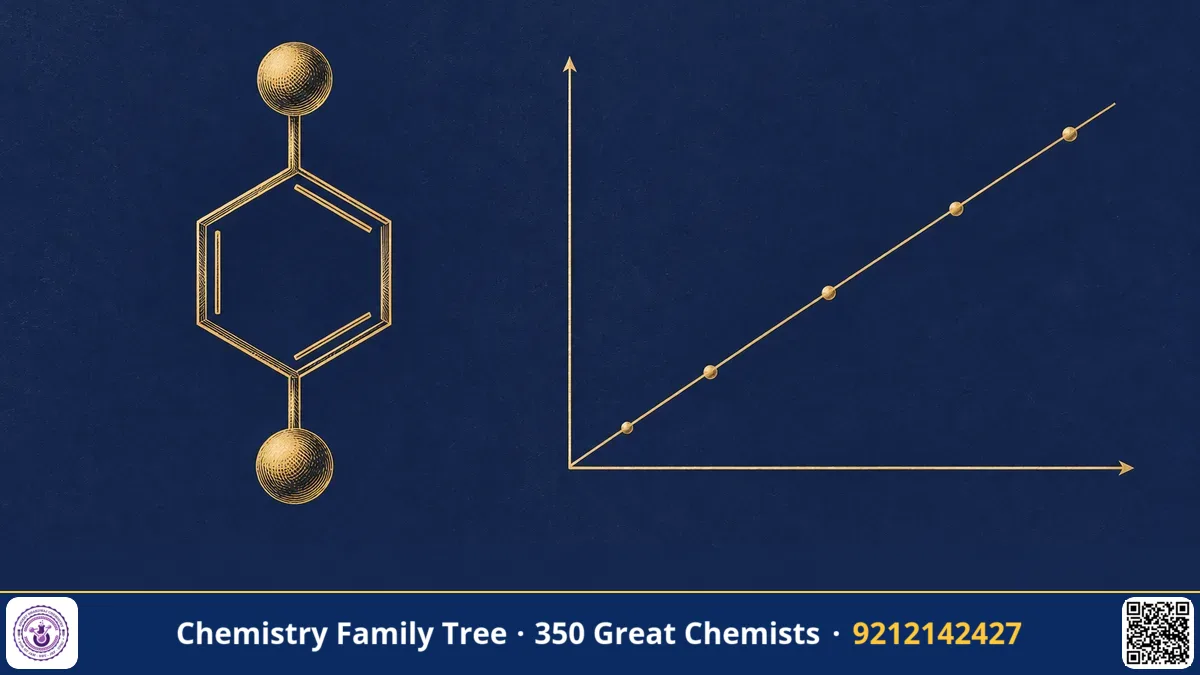
Meaning of the sign of ρ. The slope of a plot of log(k/k₀) against σ gives ρ.
- ρ > 0: the reaction is accelerated by electron-withdrawing groups, so negative charge builds up (or positive charge is lost) in the transition state. Example: alkaline hydrolysis of ethyl benzoates, ρ is about +2.5.
- ρ < 0: electron-donating groups help, so positive charge builds up in the transition state. Example: solvolysis of cumyl chlorides, which have a large negative ρ.
- Large |ρ|: the reaction is very sensitive to substituents. Small |ρ|: little charge change at the reaction centre.
Break in the plot. A curved or V-shaped Hammett plot suggests a change in mechanism or rate-determining step. This is a powerful mechanistic tool.
σ⁺ and σ⁻. Later workers (Brown and Okamoto, and others) introduced σ⁺ for substituents that donate strongly by resonance to a developing positive charge, and σ⁻ for those that stabilise a developing negative charge by direct conjugation. These extensions were needed because the original σ values failed for such cases.
Limits. The equation works for meta and para substituents. It fails for ortho substituents because of steric effects, and for aliphatic systems unless modified (Taft equation).
The Hammett acidity function, H₀
With his student Alden Deyrup, Hammett also tackled strongly acidic, non-aqueous media where pH is meaningless. In 1932 they defined the acidity function:
H₀ = pK(BH⁺) + log ([B] / [BH⁺])
Here B is a weak indicator base (for example a nitroaniline). By stepping through a series of weaker and weaker bases, they could measure acidity beyond the pH scale. Pure sulfuric acid has an H₀ of about -12. Acids stronger than 100% H₂SO₄ are called superacids, which is why H₀ is central to the chemistry of carbocations.
Applications Today
- Mechanism studies: The sign and size of ρ reveal the charge distribution in a transition state, and curved plots reveal changes of mechanism.
- Drug design: Medicinal chemists use σ as a descriptor in QSAR models to predict how a substituent changes a drug's pKa, binding and metabolism.
- Catalyst tuning: Ligands on metal catalysts are electronically tuned by choosing substituents with suitable σ values.
- Dyes, polymers and sensors: Substituents are selected to shift absorption and acidity predictably.
- Indian classrooms: Hammett plots and pKa comparisons of substituted benzoic acids and phenols are a standard topic in B.Sc. and M.Sc. organic chemistry syllabi.
Exam Corner
- The Hammett equation is log(k/k₀) = ρσ. σ depends on the substituent and its position; ρ depends on the reaction and conditions.
- ρ = 1 for the ionisation of benzoic acids in water at 25 °C, by definition; σ(H) = 0.
- Positive ρ means a negative charge develops in the transition state (for example, base hydrolysis of esters).
- p-NO₂ has the highest positive σ among common groups (+0.78), while p-OCH₃ is negative (-0.27).
- H₀ is the Hammett acidity function used for concentrated and superacid media; the Hammett equation is not valid for ortho substituents.
Common Misconceptions
- "Hammett postulate and Hammett equation are the same." No. The Hammond postulate (about transition state resemblance) is named after George Hammond, not Louis Hammett.
- "σ is a property of the reaction." No. σ belongs to the substituent; ρ belongs to the reaction.
- "The equation works for all substituent positions." It works for meta and para only. Ortho substituents add steric effects, which break the linear relationship.
Quick Revision Box
- Equation: log(k/k₀) = ρσ (rate) or log(K/K₀) = ρσ (equilibrium).
- Reference reaction: ionisation of benzoic acids in water at 25 °C (ρ = 1).
- σ > 0: electron-withdrawing; σ < 0: electron-donating.
- ρ > 0: negative charge builds up in the transition state; ρ < 0: positive charge builds up.
- Curved Hammett plot: change in mechanism or rate-determining step.
- H₀ = pK(BH⁺) + log([B]/[BH⁺]); pure H₂SO₄ has H₀ about -12.
FAQ
What is the Hammett equation in simple words?
It is a straight-line relationship that predicts how a substituent on a benzene ring changes the rate or equilibrium of a reaction. You multiply the substituent's sigma value by the reaction's rho value to get the change in log k or log K.
Why is the Hammett equation called a linear free-energy relationship?
Because log k and log K are proportional to free-energy changes. A straight line between them means that the free-energy change of one reaction is linearly related to that of the reference reaction.
What does a negative rho value tell us?
A negative rho means the reaction is helped by electron-donating groups. This indicates that positive charge is building up at, or near, the reaction centre in the transition state, as in many SN1 solvolysis reactions.
Why does the Hammett equation fail for ortho substituents?
An ortho group sits close to the reaction site, so it adds steric hindrance and possible hydrogen bonding in addition to electronic effects. These are not captured by a constant that was derived from meta and para data.
Published by ABC Chemistry — IIT-JAM | CSIR-NET | GATE Chemistry Coaching. Visit abcchemistry.com

About the chemist
Louis Hammett
1894-1987 · United States
Hammett equation; acidity function