The discovery, explained · Chemist no. 239 of 350
Louis Nicolas Vauquelin: Chromium, Beryllium and the Art of Analysis
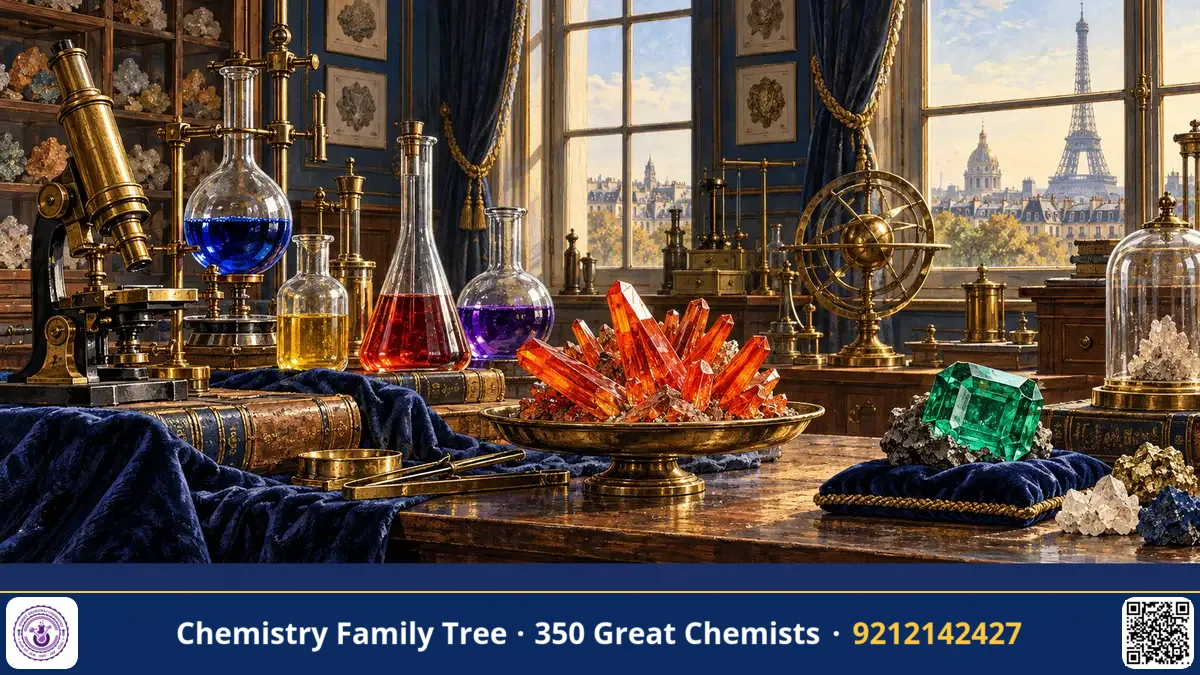
Why are rubies red and emeralds green? Why does potassium dichromate change from orange to green in an organic oxidation? The answer starts with chromium, an element discovered in 1797 by the French analytical chemist Louis Nicolas Vauquelin in a rare orange-red Siberian mineral. A year later, he found another element hidden in the gemstone emerald, which we now call beryllium. In this post, we follow his discovery in step-by-step form, with the relevant equations and the exam concepts.
The Scientific Problem Before the Discovery
By the 1790s, Lavoisier's work had defined what an element is: a substance that cannot be broken down further by chemical analysis. Dozens of minerals were still poorly understood, and analytical procedures had to be developed to separate the metals and earths in them. One such mineral, a bright orange-red crystal from the Beryozovsk mines in the Urals, had been called "Siberian red lead" (now crocoite, PbCrO₄). It was described by Johann Gottlob Lehmann in 1766, and its composition remained unclear. Mineralogists such as René Just Haüy also puzzled over emerald and beryl: they had similar properties and were thought to have the same composition, but the chemical analysis was incomplete, as aluminium oxide seemed to be the main component.
The Discovery: Step by Step
Step 1: Decomposing crocoite (1797)
Vauquelin boiled powdered Siberian red lead with potassium carbonate. This precipitated lead as carbonate and left a yellow-orange solution containing a new salt of an unknown metallic acid (chromate):
PbCrO₄ + K₂CO₃ → PbCO₃↓ + K₂CrO₄
Step 2: Recovering the acid and the oxide
He treated the solution with mineral acid and obtained the acid anhydride, red chromium trioxide crystals (CrO₃). Alternatively, the lead could be precipitated using hydrochloric acid, and the chromium compound isolated from the filtrate. Heating the chromium oxide in contact with charcoal then gave a metallic, greyish, hard and brittle solid:
2CrO₃ → Cr₂O₃ + 3/2 O₂
Cr₂O₃ + 3C → 2Cr + 3CO
The metal was obtained as small, shiny crystals, and he recognised that it was a new element.
Step 3: Naming it
The compounds of the new element had striking colours: red-orange, yellow, green and violet. At the suggestion of friends including Fourcroy and Haüy, he named it chrome, from the Greek chroma, meaning colour. He also noticed that the green colour of emerald and the red of ruby were due to traces of the new element. Vauquelin noted the presence of chromium in emerald; Haüy had asked him to analyse emerald.
Step 4: Beryllium from beryl and emerald (1798)
While analysing the emerald and the beryl of Peru and Limoges, Vauquelin found that after dissolving the mineral and adding excess alkali, one part of the "alumina" dissolved differently. He treated it with ammonium carbonate and found that the new earth redissolved in excess, whereas alumina does not. Its salts also tasted sweet. For that reason, he called it "glucine" (from Greek glykys, sweet), and the element was later renamed beryllium, after beryl, because yttrium salts were also sweet. The metal itself was isolated in 1828 by Friedrich Wöhler and independently by Antoine Bussy.
BeCl₂ + 2K → Be + 2KCl (Wöhler / Bussy, 1828)
The Chemistry Behind It
- Chromium: electron configuration [Ar] 3d⁵ 4s¹, an exception because a half-filled d subshell is extra stable. Common oxidation states are +2, +3 (most stable) and +6.
- Chromate–dichromate equilibrium: 2CrO₄²⁻ + 2H⁺ ⇌ Cr₂O₇²⁻ + H₂O. Yellow chromate in base, orange dichromate in acid.
- Oxidising power: in acid, Cr₂O₇²⁻ + 14H⁺ + 6e⁻ → 2Cr³⁺ + 7H₂O (E° = +1.33 V). Orange to green colour change is used in titrations and in breath analysers.
- Beryllium: [He] 2s², Group 2, but with a small radius and high charge density it shows covalent character and diagonal relationship with aluminium. Be(OH)₂ is amphoteric: Be(OH)₂ + 2OH⁻ → [Be(OH)₄]²⁻; Be(OH)₂ + 2H⁺ → Be²⁺ + 2H₂O.
- Gem colours: ruby is Al₂O₃ with Cr³⁺ replacing Al³⁺ in octahedral sites, giving red; emerald is beryl, Be₃Al₂Si₆O₁₈, with Cr³⁺ (and sometimes V³⁺) giving green. The different colours come from crystal field effects on the same ion.
Applications Today
Chromium is used in stainless steel (at least about 10.5% Cr) and in chrome plating, giving corrosion resistance. Chromite (FeCr₂O₄) is mined in Odisha, India's major chromium-producing state. Dichromates are used in leather tanning, pigments and organic oxidations, although hexavalent chromium is toxic and carcinogenic, so industrial effluent standards are strict. Beryllium is a light, stiff metal used in aerospace parts, X-ray windows and beryllium–copper alloys in non-sparking tools; beryllium compounds are toxic, so handling needs care. Both elements are tested in qualitative inorganic analysis: chromium by the chromyl chloride test and by lead chromate precipitation.
Exam Corner
- Chromium discovered by Vauquelin in 1797 in crocoite (PbCrO₄, "Siberian red lead"); named from Greek chroma (colour).
- Chromium configuration is [Ar]3d⁵4s¹, an exception; Cr³⁺ is the most stable state in aqueous solution; Cr⁶⁺ is strongly oxidising.
- Chromate (yellow) ⇌ dichromate (orange): H⁺ shifts to the right, OH⁻ to the left.
- Beryllium discovered by Vauquelin in 1798 as an oxide in beryl and emerald. Be(OH)₂ is amphoteric; BeCl₂ is covalent (diagonal relationship with Al).
- Chromyl chloride test: K₂Cr₂O₇ + 4NaCl + 6H₂SO₄ → 2CrO₂Cl₂ + 4NaHSO₄ + 2KHSO₄ + 3H₂O (red vapours).
Common Misconceptions
- "Chromium is a pale, common metal." It has an unusually wide set of colourful compounds.
- "Be behaves exactly like Mg." Beryllium differs greatly because of its small size; it behaves like Al.
- "Vauquelin made the metal immediately." He obtained chromium metal in impure form. Beryllium metal came decades later.
Quick Revision Box
- Vauquelin: Cr (1797) from crocoite, Be (1798) from beryl and emerald.
- PbCrO₄ + K₂CO₃ → PbCO₃ + K₂CrO₄.
- Cr: [Ar]3d⁵4s¹; common oxidation states +3 and +6.
- 2CrO₄²⁻ + 2H⁺ ⇌ Cr₂O₇²⁻ + H₂O.
- Beryllium oxide was called glucine due to the sweet taste of its salts; do not taste beryllium salts, they are toxic.
- Be: amphoteric hydroxide, diagonal relationship with Al.
FAQ
Why is chromium named after colour?
Because its compounds show many bright colours: yellow, orange, red, green, violet.
Why is beryllium called glucinum in some old books?
The name glucinum came from the sweet taste of its salts. The name beryllium, from beryl, later became standard, although French literature used glucinium for a long time.
What gives emerald its green colour?
Traces of Cr³⁺ ions in the beryl crystal lattice, which absorb light by d–d transitions.
Did Vauquelin discover other substances?
Yes. Among other work he isolated quinic acid, studied asparagine (with Robiquet, the first amino acid isolated, in 1806), and analysed many minerals.
Published by ABC Chemistry — IIT-JAM | CSIR-NET | GATE Chemistry Coaching. Visit abcchemistry.com
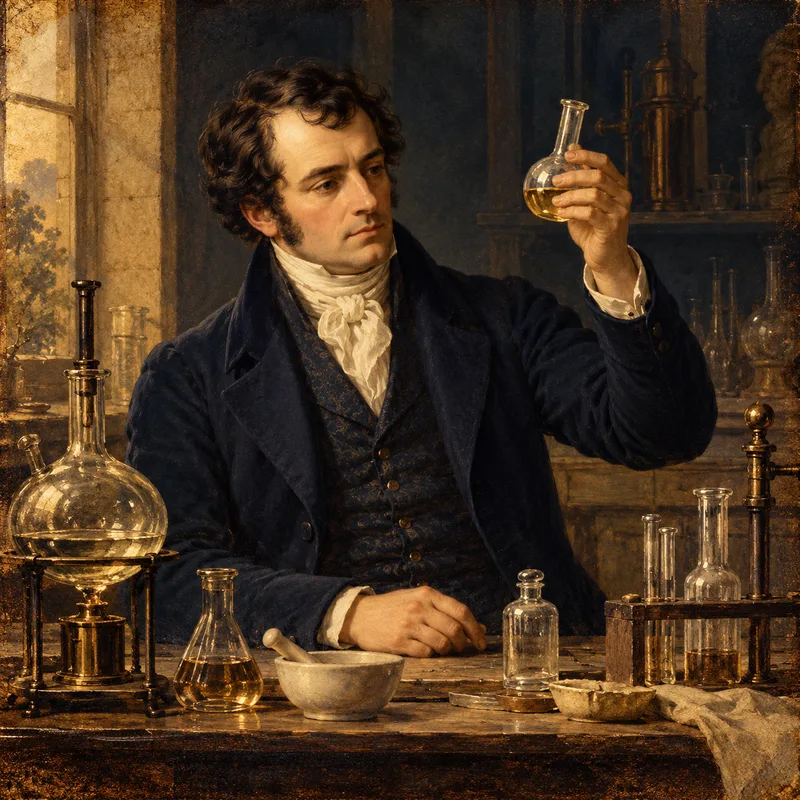
About the chemist
Louis Nicolas Vauquelin
1763-1829 · France
Discovered chromium and beryllium