Biography · Chemist no. 46 of 350
Louis Pasteur: The Chemist Who Saved Lives with Crystals, Microbes and Vaccines
Introduction
Louis Pasteur (1822-1895) trained as a chemist, yet he is remembered as the founder of modern microbiology. He discovered molecular chirality, explained fermentation, disproved spontaneous generation, developed pasteurisation, saved the French silk and wine industries and created vaccines against anthrax and rabies. Few scientists changed both pure science and everyday life so much. Legacy in one line: he showed that chemistry and microbes are connected, and that disease can be prevented.
Early Life & Family
Louis Pasteur was born on 27 December 1822 in Dole, in the Jura region of eastern France. His father, Jean-Joseph Pasteur, was a tanner and a veteran of Napoleon's army. The family moved to the small town of Arbois, where Louis grew up. He was a good but not brilliant student in school, and was known more for his drawing and painting than for science. Several of his portraits of family members survive. His father had great ambitions for his son's education and encouraged him to study hard.
Education & Mentors
Pasteur studied at the Collège of Besançon and then entered the École Normale Supérieure in Paris in 1843. He attended the lectures of the chemist Jean-Baptiste Dumas at the Sorbonne, who inspired him to take up chemistry, and he worked in the laboratory of Antoine Jérôme Balard. He also met the physicist Jean-Baptiste Biot, who supported his early work on optical activity and became a lifelong supporter. Pasteur obtained his doctorate in 1847 with theses in chemistry and physics.
Career Timeline
| Year | Event |
|---|---|
| 1822 | Born in Dole, France |
| 1847 | Doctorate from the École Normale Supérieure |
| 1848 | Separates enantiomeric tartrate crystals; discovers molecular chirality |
| 1849 | Professor at Strasbourg; marries Marie Laurent |
| 1854 | Dean of the Faculty of Sciences at Lille |
| 1857 | Returns to Paris as director of scientific studies at the École Normale; shows fermentation is caused by living yeast |
| 1862 | Experiments with swan-neck flasks disprove spontaneous generation |
| 1865-1870 | Studies diseases of silkworms and saves the silk industry |
| 1868 | Suffers a stroke that partly paralyses his left side |
| 1879-1881 | Chicken cholera and anthrax vaccines; public trial at Pouilly-le-Fort (1881) |
| 1885 | Treats nine-year-old Joseph Meister with the rabies vaccine |
| 1888 | Pasteur Institute inaugurated in Paris |
| 1895 | Dies near Paris on 28 September |
Major Scientific Contributions
- Molecular chirality (1848): mirror-image forms of tartaric acid. See our companion article on Pasteur and tartaric acid for the chemistry.
- Fermentation: he proved that lactic and alcoholic fermentations are carried out by specific living micro-organisms, and that some microbes live without air (anaerobes). He described life without oxygen as "fermentation".
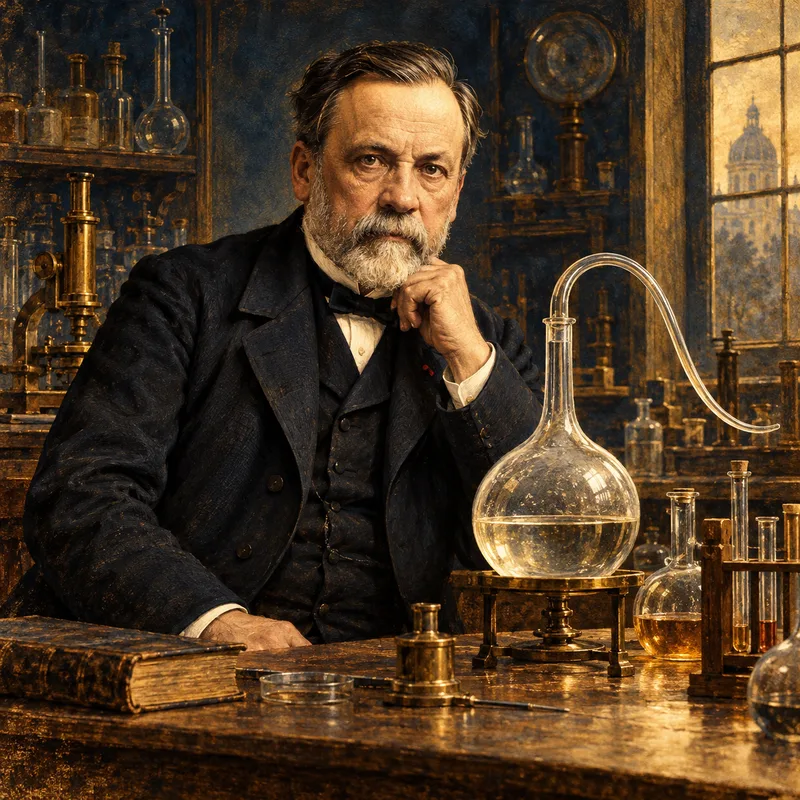
- Against spontaneous generation: in flasks with long S-shaped necks, boiled broth stayed clear because dust and germs could not reach it; when the neck was broken, microbes grew.
- Pasteurisation: gentle heating of wine and later milk to destroy spoilage organisms without ruining taste.
- Germ theory and vaccines: he supported the idea that microbes cause infectious disease, and developed attenuated vaccines for chicken cholera, anthrax and rabies.
Awards, Honours & Nobel Prize
Pasteur did not receive a Nobel Prize, since he died in 1895, six years before the first prizes. He was elected to the Académie des Sciences in 1862 and to the Académie française in 1881. He received the Rumford Medal and Copley Medal of the Royal Society, and the Légion d'honneur. He was given a state funeral, and his body rests in a crypt at the Pasteur Institute in Paris.
Personality, Struggles & Lesser-Known Facts
- Family tragedy. Pasteur and Marie Laurent had five children, but three died young, including a daughter who died of typhoid at the age of nine. These losses deepened his determination to fight disease.
- Stroke at 45. He suffered a serious stroke in 1868 that left him with a weakened left side, yet continued to work for another 27 years.
- The Joseph Meister case. In July 1885, Pasteur, who was not a medical doctor, agreed to treat a boy bitten by a rabid dog. The boy survived. Pasteur worried about the ethics of the decision, and the case brought worldwide fame.
- Combative style. He engaged in public debates with rival scientists such as Félix Pouchet on spontaneous generation and Justus von Liebig's followers on fermentation.
- Art connection. His early training as an artist helped him see the fine details of crystals under the microscope.
- Link to India. The Pasteur Institutes in Kasauli and Coonoor, set up in the early 1900s, produced anti-rabies vaccine for India and continue as important public health institutions.
Legacy & Influence on Modern Chemistry
Pasteur's first discovery began the field of stereochemistry, developed by van 't Hoff and Le Bel in 1874 and applied today in drug design. His work on fermentation led to biochemistry, and the Pasteur Institute in Paris became a world centre of research with later Nobel laureates. Pasteurisation of milk is used in every dairy industry, including the Indian dairy cooperatives. His vaccines launched the modern approach to preventing disease. The idea of chiral purity in medicines can be traced to the crystals on his microscope slide.
Lessons for Students
- Observe closely. Pasteur noticed tiny crystal faces that others missed.
- Prepared minds meet luck. His lucky temperature mattered only because he was ready to see.
- Use basic science to solve social problems. Wine, silk, milk and rabies were all addressed by laboratory work.
- Persist despite setbacks. Family loss and a stroke did not stop him.
Quick Facts Box
- Born: 27 December 1822, Dole, France
- Died: 28 September 1895, Marnes-la-Coquette, near Paris
- Nationality: French
- Field: Chemistry and microbiology
- Famous for: Molecular chirality, pasteurisation, germ theory, rabies and anthrax vaccines
- Nobel: None (died before the prizes began)
FAQ
Was Pasteur a chemist or a biologist?
He began as a chemist and became the founder of microbiology; modern science calls him both.
Did Pasteur invent the rabies vaccine?
He and his colleagues, notably Émile Roux, developed it; the first human treatment was on Joseph Meister in 1885.
What is pasteurisation?
Controlled heating of liquids such as milk or wine to kill harmful microbes without changing quality too much.
Why is the institute named after him?
The Pasteur Institute was founded in 1887-88 through public donations to continue his research on infectious disease.
Published by ABC Chemistry — IIT-JAM | CSIR-NET | GATE Chemistry Coaching. Visit abcchemistry.com
About the chemist
Louis Pasteur
1822-1895 · France
Molecular chirality; germ theory; vaccines