The discovery, explained · Chemist no. 46 of 350
Pasteur and Tartaric Acid: The Day Molecules Were Found to Have Handedness
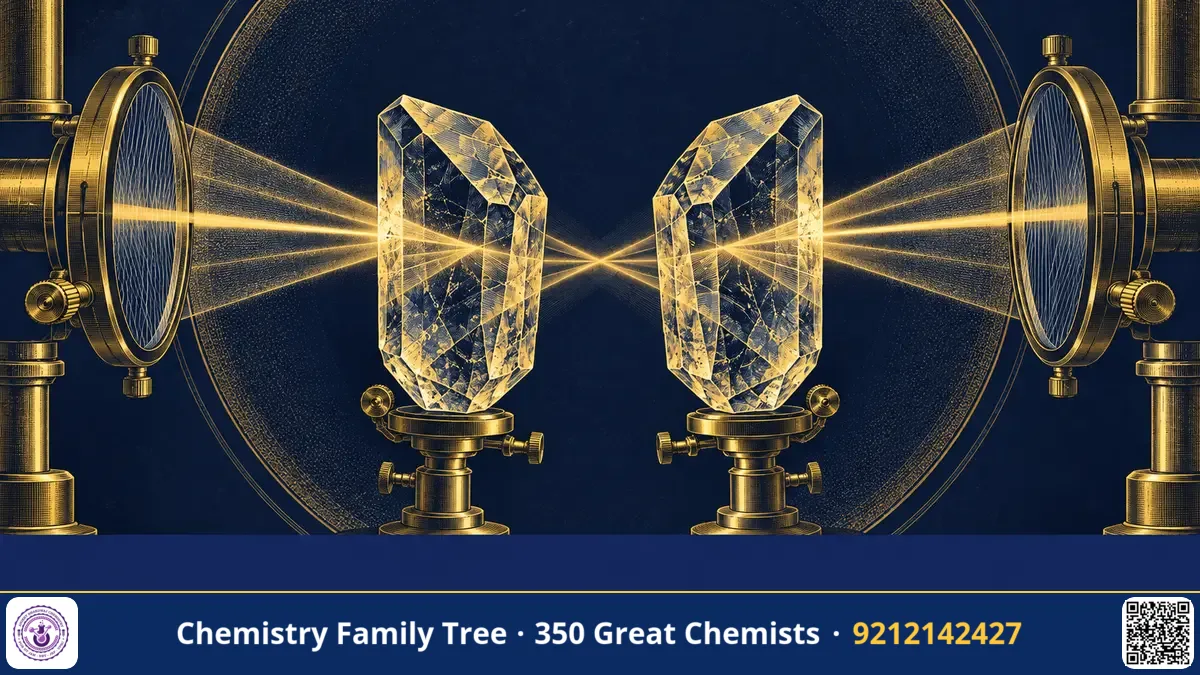
Your left and right hands are mirror images, but you cannot superimpose one on the other. Molecules can have the same property, called chirality, and it is behind the action of many drugs, the taste of foods and the working of enzymes. The first person to separate two mirror-image forms of a compound by hand was the 26-year-old French chemist Louis Pasteur in 1848. Using a microscope and a pair of tweezers, he sorted tiny crystals of sodium ammonium tartrate into two piles. Their solutions rotated polarised light in opposite directions. This simple experiment founded stereochemistry, and Pasteur himself said that molecules must have a dissymmetric structure. Here we explain it for Class 12, B.Sc., IIT-JAM, CSIR-NET and GATE.
The Scientific Problem Before the Discovery
In 1815 Jean-Baptiste Biot had found that some natural organic substances, such as sugar solutions, camphor and tartaric acid, rotate the plane of polarised light. Mineral crystals such as quartz did so too, in the crystal but not when dissolved. Biot also noted that the tartaric acid from wine barrels was optically active, but there was a second acid, called racemic acid (paratartaric acid), with the same formula C₄H₆O₆ and similar properties, which was optically inactive.
- Why should two substances with identical composition, one active and one inactive, exist?
- Eilhard Mitscherlich, a German chemist, reported that the sodium ammonium salts of the two acids had the same crystal form and the same properties, yet differed in optical activity. If true, this contradicted the idea that crystal shape is linked to molecular structure.
The Discovery: Step by Step
- Preparing crystals. Pasteur, as a young researcher at the École Normale Supérieure in Paris, prepared the sodium ammonium salt of racemic acid and let it crystallise slowly from solution at a temperature below about 27 °C.
- Looking closely. Under the microscope, he saw small crystals that showed tiny extra faces (hemihedral faces). Mitscherlich had missed this. In the tartrate from natural tartaric acid, the hemihedral faces were all on one side. In the racemic salt, he saw two types: some with the faces to the right, others to the left. The two types were mirror images of each other.
- Separating by hand. With tweezers, Pasteur painstakingly separated the right-handed and left-handed crystals into two heaps.
- Testing with polarised light. He dissolved each heap in water and measured the rotation. One solution rotated the plane to the right (dextrorotatory), the same as natural tartaric acid, and the other rotated it to the left (laevorotatory) by an equal amount. A mixture of equal amounts of both rotated light by zero.
- Interpreting the result. Pasteur concluded that racemic acid is a 1 : 1 combination of dextro- and laevo-tartaric acids, and that the molecules themselves, not only the crystals, are asymmetric (he used the term "dissymmetric").
(+)-tartaric acid  +  (−)-tartaric acid  →  racemic acid (±)   [α] = 0
natural (R,R)          (S,S)                  optically inactive
Pasteur later said that he was fortunate: the sodium ammonium salt forms separate left and right crystals only below roughly 27 °C, and the temperature of his laboratory was suitable. Most racemic compounds do not do this, so he was lucky as well as skilled.
The Chemistry Behind It
Enantiomers, racemic mixtures and meso forms
The two mirror-image forms are enantiomers. They have identical melting points, solubilities and spectra, and differ only in rotating polarised light in opposite directions and in reactions with other chiral molecules. A 50 : 50 mixture is a racemic mixture (racemate), shown as (±), which is optically inactive because of external compensation. Tartaric acid has two stereocentres, so there are three stereoisomers: (R,R), (S,S) and the achiral meso form (R,S), which is inactive because of internal compensation (it has a mirror plane).
| Form | Configuration | [α] | Reason |
|---|---|---|---|
| L-(+)-tartaric acid | (R,R) | +12° | Chiral |
| D-(−)-tartaric acid | (S,S) | −12° | Chiral |
| Racemic acid | (±) | 0° | External compensation |
| Meso-tartaric acid | (R,S) | 0° | Internal compensation |
Specific rotation
[α] = α / (l × c) (l in dm, c in g/mL)
Three ways Pasteur showed to resolve racemates
- Mechanical separation: hand-picking of crystals (rare, works only for a few conglomerates).
- Biochemical method (1857): a mould such as Penicillium glaucum consumed the (+)-tartrate in a racemic solution faster, leaving (−)-tartrate behind.
- Chemical method (1853): react the racemate with a pure chiral base such as cinchonine to form diastereomeric salts, which have different solubilities and can be separated by crystallisation. This is still the main method in industry.
Applications Today
- Pharmaceuticals: the two enantiomers of a drug may act differently. (S)-naproxen is the active anti-inflammatory; (S)-ibuprofen is the more active form of ibuprofen; thalidomide's tragedy reminds us that enantiomers can have different biological effects, although racemisation in the body complicates this.
- Asymmetric synthesis: chiral catalysts (Noyori, Knowles and Sharpless, Nobel 2001) make a single enantiomer.
- Food and flavour: (R)-carvone smells of spearmint; (S)-carvone smells of caraway.
- Indian industry: large Indian generic drug makers produce single-enantiomer drugs such as levocetirizine and escitalopram, which are chiral switches from racemic products.
- Analytical chemistry: polarimetry and chiral HPLC are standard quality checks in labs.
Exam Corner
- Pasteur (1848) separated sodium ammonium tartrate crystals of racemic acid by hand and found equal and opposite rotation.
- A racemic mixture is optically inactive due to external compensation; a meso compound is inactive due to internal compensation.
- A molecule with n stereocentres and no symmetry has 2ⁿ stereoisomers; tartaric acid has only 3, because of the meso form.
- Enantiomers have identical physical properties except for the direction of optical rotation; diastereomers differ in all properties.
- Resolution through diastereomeric salts uses a chiral resolving agent such as brucine, cinchonine or (+)-tartaric acid itself.
Common Misconceptions
- "D and L mean dextro and laevo rotation." D/L describe configuration relative to glyceraldehyde; (+)/(−) describe the direction of rotation. They are unrelated in general.
- "A racemic mixture has no chiral molecules." It contains chiral molecules, in equal amounts of both enantiomers.
- "Pasteur discovered the tetrahedral carbon." That came later with van 't Hoff and Le Bel in 1874; Pasteur showed that molecules are dissymmetric.
Quick Revision Box
- 1848: Pasteur hand-sorted mirror-image sodium ammonium tartrate crystals.
- Enantiomers rotate polarised light equally and oppositely.
- Racemic = 50 : 50 mixture (±); meso = internally compensated.
- Natural tartaric acid is (R,R)-(+); [α] about +12°.
- Resolution: mechanical, biochemical (mould), chemical (diastereomeric salts).
- Foundation for stereochemistry; later developed by van 't Hoff and Le Bel.
FAQ
Why did Pasteur use tartaric acid?
It was available as a by-product of wine-making, and Biot had already shown the natural form was optically active.
Can all racemic mixtures be separated by hand?
No. Only the rare ones that crystallise as separate mirror-image crystals (conglomerates) can be.
What is optical activity?
The ability of a substance to rotate the plane of plane-polarised light.
Is meso-tartaric acid chiral?
No. It has two stereocentres but an internal mirror plane, so the molecule is achiral.
Published by ABC Chemistry — IIT-JAM | CSIR-NET | GATE Chemistry Coaching. Visit abcchemistry.com
About the chemist
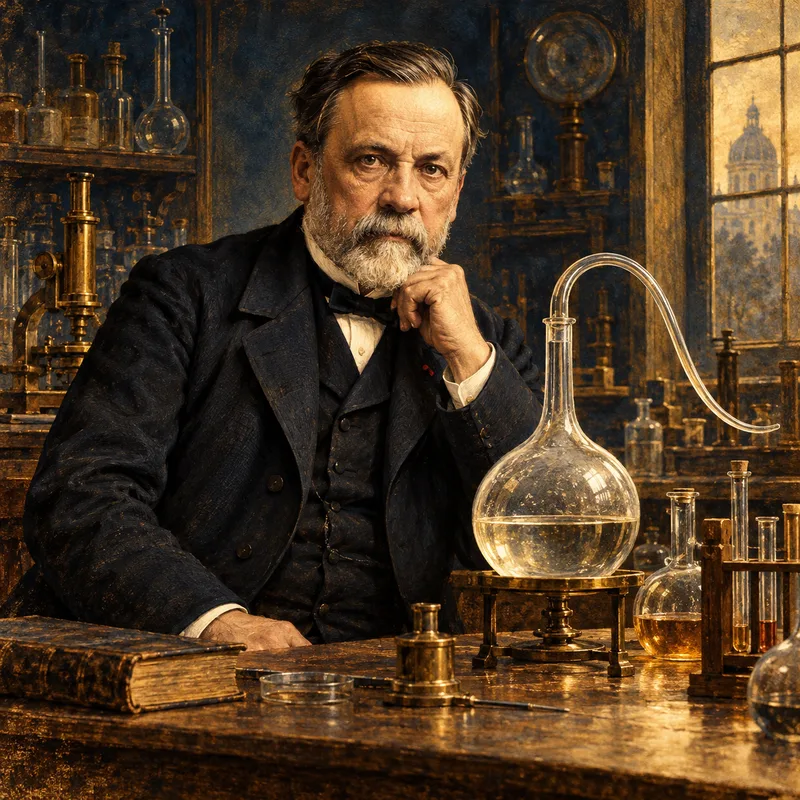
Louis Pasteur
1822-1895 · France
Molecular chirality; germ theory; vaccines