Biography · Chemist no. 280 of 350
Ludwig Claisen (1851–1930): A Life Devoted to Carbon–Carbon Bond Chemistry
Introduction
Rainer Ludwig Claisen was a German organic chemist whose name appears in nearly every organic chemistry textbook. The Claisen condensation, the Claisen–Schmidt condensation and the Claisen rearrangement all trace back to his laboratory work, and the Claisen distillation flask carries his name too. He was not a famous public figure and never received a Nobel Prize, yet few chemists have left such a practical mark on the way molecules are built. In one line: Claisen showed chemists how to join esters, aldehydes and ethers into larger, more valuable structures.
Early Life & Family
Ludwig Claisen was born on 3 January 1851 in Cologne, in the Rhineland of Prussia. He grew up in a city with deep commercial and cultural traditions, a short distance from the university town of Bonn. Reliable details of his parents and childhood are sparse, so we focus on what is documented: he showed an early interest in science and moved to Bonn for university studies at a time when Bonn was one of the strongest centres for organic chemistry in Germany.
Education & Mentors
At Bonn, Claisen studied under August Kekulé, the architect of the structural theory of organic chemistry and the proposer of the benzene ring. Kekulé's laboratory trained many future leaders, and Claisen absorbed both the structural way of thinking and the discipline of careful experimental work. He completed his doctorate at Bonn in 1874. He later worked with various chemists in other centres, learning to combine careful analysis with creative reaction design. The Kekulé connection is a point worth remembering for exams because it places Claisen in the lineage that also produced Baeyer, Fischer-era chemists and others.
Career Timeline
| Year | Event |
|---|---|
| 1851 | Born in Cologne |
| 1874 | Doctorate at Bonn under Kekulé's school |
| Early 1880s | Work on aromatic aldehydes and ketones, leading to the Claisen–Schmidt condensation |
| 1882–1885 | Period at Owens College, Manchester |
| 1887 | Reports condensation of esters to give acetoacetic ester (Claisen condensation) |
| 1890s | Professorships at Aachen and then Kiel, with research on 1,3-dicarbonyl compounds |
| 1904 | Moves to Berlin to succeed in a leading chair of the university |
| 1907 | Leaves university post, later works in a private laboratory in Godesberg |
| 1912 | Publishes the rearrangement of allyl phenyl ethers (Claisen rearrangement) |
| 1930 | Dies on 5 January in Godesberg, near Bonn |
Major Scientific Contributions
- Claisen condensation: base-mediated self-condensation of esters giving β-keto esters, a model for how C–C bonds can be formed by enolate chemistry.
- Claisen–Schmidt condensation: reaction of aromatic aldehydes with ketones under base to give conjugated enones; the foundation for chalcone chemistry.
- Claisen rearrangement: thermal [3,3]-shift of allyl aryl ethers, later extended by others to allyl vinyl ethers and many variants (Johnson, Ireland, Eschenmoser).
- Study of tautomerism: detailed work on 1,3-dicarbonyl compounds and their enol content, pioneering ideas about keto-enol equilibria in compounds like acetoacetic ester and diketones.
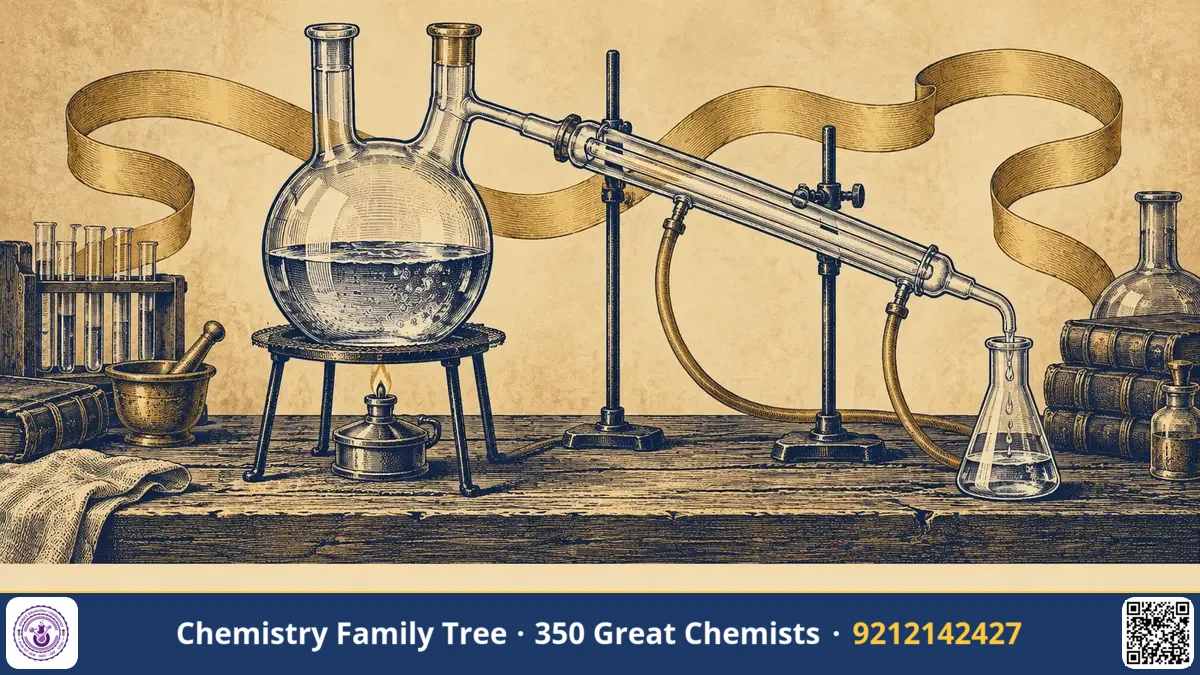
- Laboratory techniques: the Claisen flask and the use of vacuum distillation for sensitive compounds.
For mechanisms and exam points, read our companion discovery post on Ludwig Claisen.
Awards, Honours & Nobel Prize
Claisen did not win a Nobel Prize. He held senior professorships at respected German universities, and his name became permanently attached to several reactions, which is the most durable honour in organic chemistry. The Claisen rearrangement later became a subject for Nobel-level work by others on pericyclic reactions, as the Woodward–Hoffmann rules, recognised with the 1981 Nobel Prize to Roald Hoffmann and Kenichi Fukui, explained why [3,3]-shifts proceed so smoothly.
Personality, Struggles & Lesser-Known Facts
- A traveller between laboratories. Few German chemists of his era spent time at a British university; his years in Manchester put him in contact with English chemistry and its practical tradition.
- Private laboratory in retirement. After leaving university life, he continued to work in a laboratory he set up himself near Bonn, publishing papers well into old age, which shows how deeply he loved bench work.
- Slow recognition of the rearrangement. His rearrangement paper of 1912 was just one of many articles; it took decades for chemists to appreciate its generality and mechanism.
- A glass legacy. The Claisen adapter and flask are still catalogued by glassware suppliers today, a rare case where a chemist's everyday tool outlives textbooks.
- Pre-electronic reasoning. He proposed his reactions long before electrons and orbitals were understood. The tools to explain his rearrangement mechanism came only after the 1960s.
Legacy & Influence on Modern Chemistry
Claisen's reactions are woven into biochemistry and industry. The Claisen condensation is the logic behind fatty acid synthesis in cells. The Claisen–Schmidt reaction is the standard route to chalcones, precursors of flavonoids. The Claisen rearrangement is a template for stereocontrolled C–C bond formation and appears in the total synthesis of complex natural products. In the 1970s and 1980s, variants such as the Ireland–Claisen and Johnson–Claisen rearrangements became everyday tools. For Indian students, Claisen is a rare name that appears in school books, B.Sc. practicals and advanced research papers alike.
Lessons for Students
- Learn mechanisms, not just names. Claisen's reactions all follow from one idea: acidic α-hydrogens make enolates, and enolates attack carbonyls.
- A good reaction can be ahead of its theory. Claisen's rearrangement was understood fully only after pericyclic theory arrived.
- Keep working. Claisen did important research outside a university after retiring.
- Combine reading with experiments; his career moved across Germany and Britain to learn from different traditions.
- Remember the differences between related reactions (aldol, Claisen, Dieckmann); examiners love such comparisons.
Quick Facts Box
- Born: 3 January 1851, Cologne, Prussia
- Died: 5 January 1930, Godesberg (near Bonn), Germany
- Nationality: German
- Field: Organic chemistry
- Famous for: Claisen condensation, Claisen–Schmidt condensation, Claisen rearrangement, Claisen flask
- Nobel Prize: None
FAQ
Who was Ludwig Claisen's teacher?
He studied at Bonn in the school of August Kekulé, the founder of structural organic chemistry.
Did Claisen win a Nobel Prize?
No. His fame rests on the reactions that carry his name rather than on an award.
What is the Claisen flask?
It is a distillation flask with two necks (one for a thermometer or capillary, one for the condenser), designed to reduce bumping and splashing during vacuum distillation.
When did Claisen discover the rearrangement?
He reported the rearrangement of allyl phenyl ethers in 1912, when he was over sixty years old.
Published by ABC Chemistry — IIT-JAM | CSIR-NET | GATE Chemistry Coaching. Visit abcchemistry.com
About the chemist
Ludwig Claisen
1851-1930 · Germany
Claisen condensation and rearrangement