The discovery, explained · Chemist no. 280 of 350
Ludwig Claisen: Three Reactions That Built Modern Organic Synthesis
Ask any student of organic chemistry about carbon-carbon bond formation, and the name Claisen appears again and again. Ludwig Claisen, a German chemist who worked in the last decades of the nineteenth century and the early twentieth, gave his name to the Claisen condensation, the Claisen–Schmidt condensation and the Claisen rearrangement. Each of them is a core topic in the IIT-JAM, CSIR-NET and GATE syllabus. Together they show how ester enolates, aromatic aldehydes and allyl ethers can be turned into larger, more useful molecules. This post walks through the problem Claisen faced, the reactions he discovered, and the mechanisms you must know.
The Scientific Problem Before the Discovery
By the 1870s and 1880s chemists could make simple molecules, but building longer carbon skeletons was hard. They knew that acetoacetic ester (ethyl 3-oxobutanoate) was an extremely useful building block. It was already used to make ketones and acids, but its own preparation was clumsy and its structure was debated. Was it a ketone, an enol, or both? How could esters, which seemed unreactive, be coupled to form new C–C bonds?
There was also the matter of aldehydes and ketones. Aldol-type reactions were known, but a general, reliable way to join an aromatic aldehyde (with no α-hydrogen) with a ketone to make conjugated products was needed. And phenols, an important family of compounds, could be converted into ethers, but chemists did not know that certain ethers would rearrange on heating to give carbon-substituted phenols.
The Discovery / Experiment
1. Claisen condensation (1887). Claisen showed that when ethyl acetate is treated with sodium ethoxide, two molecules combine to give ethyl acetoacetate:
2 CH₃COOC₂H₅ --(1. NaOEt, 2. H₃O⁺)--> CH₃COCH₂COOC₂H₅ + C₂H₅OH
2. Claisen–Schmidt condensation. Working in the early 1880s, Claisen and later others found that an aromatic aldehyde with no α-hydrogens (such as benzaldehyde) reacts with a ketone like acetone in the presence of dilute NaOH to give an α,β-unsaturated ketone (a chalcone-type compound):
PhCHO + CH₃COCH₃ --(NaOH)--> PhCH=CH–COCH₃ + H₂O
3. Claisen rearrangement (1912). Claisen found that allyl phenyl ether, when heated to about 200 °C, migrates the allyl group to the ortho position of the ring to give 2-allylphenol:
Ph–O–CH₂–CH=CH₂ --(heat)--> 2-allylphenol
He also developed the Claisen flask, a distillation flask with two necks used for vacuum distillation, and a "Claisen alkali" (potassium hydroxide dissolved in methanol and water) used in extraction of phenols.
The Chemistry Behind It
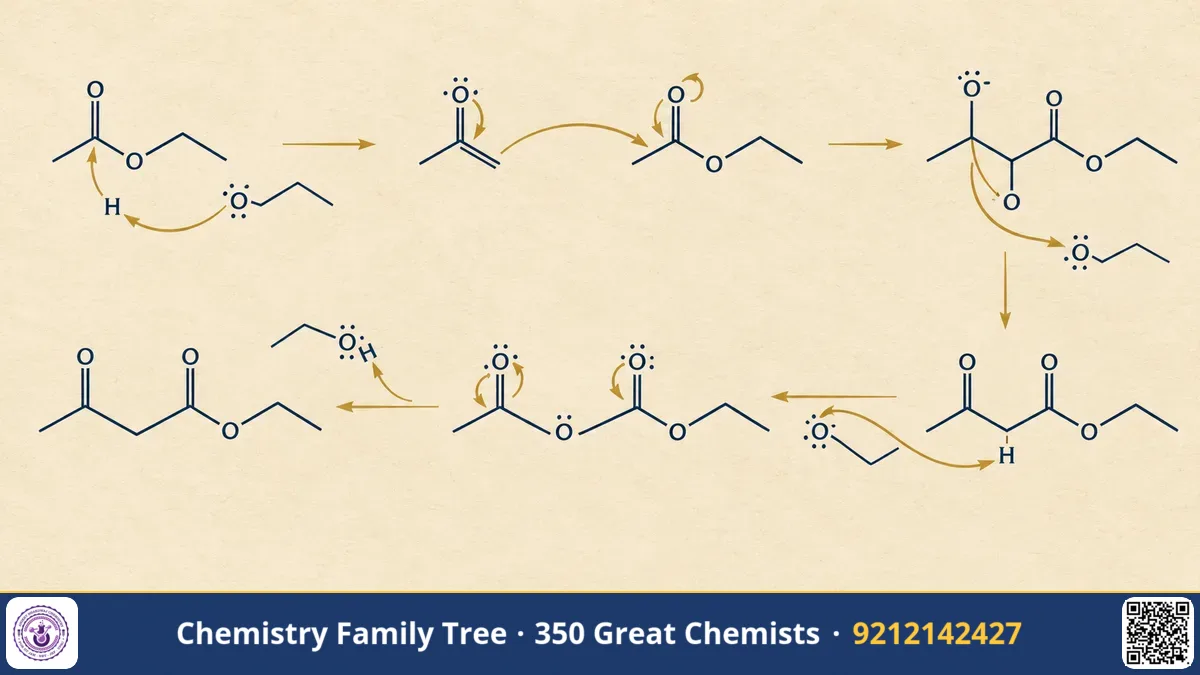
Mechanism of the Claisen condensation.
- Ethoxide removes an α-hydrogen from ethyl acetate to form an ester enolate (pKa of the α-H is about 25).
- The enolate attacks the carbonyl carbon of a second ester molecule, giving a tetrahedral intermediate.
- The intermediate expels ethoxide to give the β-keto ester.
- Ethoxide removes the very acidic hydrogen between the two carbonyls (pKa about 11). This irreversible deprotonation drives the whole equilibrium forward.
- Acid work-up at the end regenerates the neutral β-keto ester.
Two points matter here. The base must be an alkoxide matching the ester's alcohol part (NaOEt for ethyl esters) to avoid transesterification. And at least one α-hydrogen must remain in the product, since the stable enolate of the product is what pulls the reaction through. An ester with only one α-hydrogen, like ethyl isobutyrate, fails under normal conditions for exactly this reason.
The intramolecular version is the Dieckmann condensation, which forms five- and six-membered cyclic β-keto esters from diesters. A crossed Claisen uses one ester with no α-hydrogens (ethyl benzoate, ethyl formate, diethyl carbonate) to avoid mixtures.
Claisen–Schmidt. The ketone enolate attacks the aldehyde, forming a β-hydroxy ketone that dehydrates readily because the double bond becomes conjugated with the aromatic ring.
Claisen rearrangement. This is a concerted [3,3]-sigmatropic shift through a six-membered chair-like transition state. In allyl phenyl ethers the first product is a non-aromatic cyclohexadienone, which quickly tautomerises to the phenol. Because the allyl group inverts during migration, the carbon attached to the ring is the original terminal CH₂= carbon. If both ortho positions are blocked, the allyl group continues to the para position through a second shift (the Cope rearrangement).
Applications Today
- Pharmaceuticals: β-keto esters from Claisen-type reactions are building blocks for drugs including barbiturates, and heterocycles such as pyrazolones and quinolones.
- Biochemistry: Nature runs Claisen condensations constantly. Fatty acid biosynthesis joins acetyl-CoA and malonyl-CoA by a Claisen-type step, and polyketide antibiotics use the same logic.
- Flavours and fragrances: Claisen–Schmidt condensations give cinnamaldehyde-type and chalcone derivatives used in perfumery and in flavonoid chemistry.
- Industrial synthesis: Claisen rearrangements are used to build substituted aromatic intermediates and in the synthesis of vitamin precursors and natural products.
- Teaching: The Claisen flask is a familiar piece of glassware for vacuum distillation of high-boiling liquids.
Exam Corner
- Claisen condensation of ethyl acetate with NaOEt gives ethyl acetoacetate; the driving force is deprotonation of the product.
- The base should have the same alkyl group as the ester (to avoid transesterification).
- Claisen–Schmidt: aromatic aldehyde (no α-H) + ketone/aldehyde with α-H under NaOH gives an α,β-unsaturated carbonyl.
- Claisen rearrangement of allyl aryl ethers is a [3,3]-sigmatropic shift, giving ortho-allylphenol; para product when both ortho positions are blocked.
- Dieckmann condensation is the intramolecular Claisen condensation, best for 1,6- and 1,7-diesters giving five- and six-membered rings.
Common Misconceptions
- "Claisen and aldol condensations are the same." The aldol uses aldehydes or ketones and gives β-hydroxy carbonyls; the Claisen uses esters and gives β-keto esters with loss of alkoxide.
- "A catalytic amount of base is enough." The Claisen condensation needs a full equivalent of base because the product is deprotonated and that step drives the equilibrium.
- "The Claisen rearrangement is ionic." It is a concerted pericyclic reaction without free ions or radicals.
Quick Revision Box
- Claisen condensation: ester + ester, NaOEt, gives β-keto ester.
- Product deprotonation (pKa about 11) drives the reaction forward.
- Claisen–Schmidt: ArCHO + ketone with dilute NaOH gives enone.
- Claisen rearrangement: allyl aryl ether to o-allylphenol by heat, [3,3] shift.
- Dieckmann is the cyclic Claisen.
- Claisen flask has a side arm and two necks for vacuum distillation.
FAQ
What is the difference between Claisen and Claisen–Schmidt condensation?
Claisen condensation couples two esters to make a β-keto ester. Claisen–Schmidt couples an aromatic aldehyde with a ketone to make an α,β-unsaturated ketone.
Why can't ethyl isobutyrate undergo Claisen condensation easily?
The β-keto ester product would have no acidic hydrogen between the carbonyls, so the final deprotonation that drives the equilibrium cannot occur.
What type of reaction is the Claisen rearrangement?
It is a thermal, concerted [3,3]-sigmatropic rearrangement that proceeds through a six-membered cyclic transition state.
Is the Claisen condensation important in biology?
Yes. Fatty acid and polyketide biosynthesis rely on Claisen-type condensations of thioesters such as acetyl-CoA and malonyl-CoA.
Published by ABC Chemistry — IIT-JAM | CSIR-NET | GATE Chemistry Coaching. Visit abcchemistry.com
About the chemist
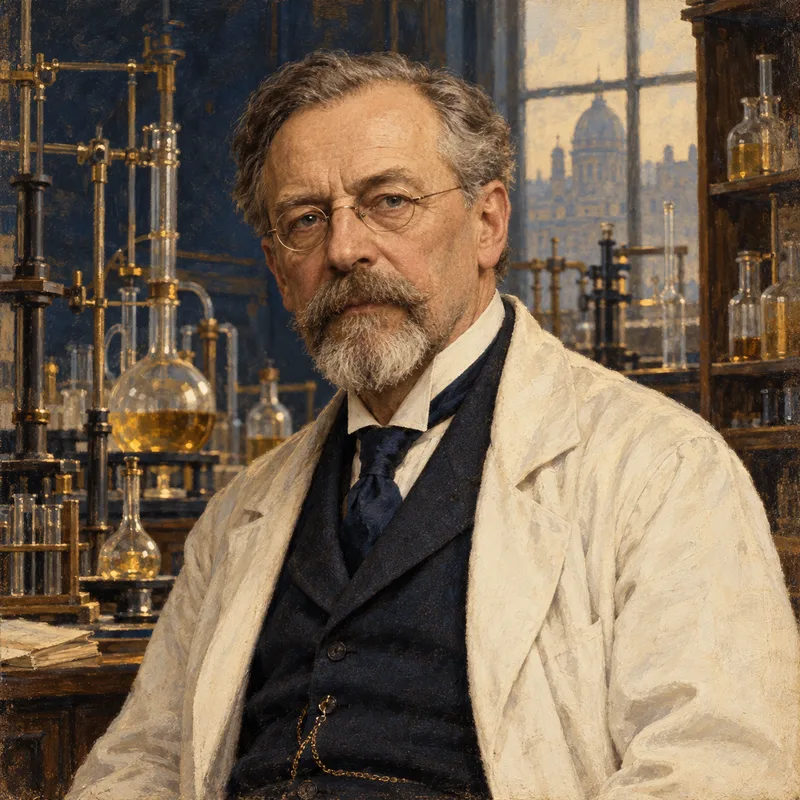
Ludwig Claisen
1851-1930 · Germany
Claisen condensation and rearrangement