The discovery, explained · Chemist no. 71 of 350
Luis Leloir and Sugar Nucleotides: How Cells Build Carbohydrates
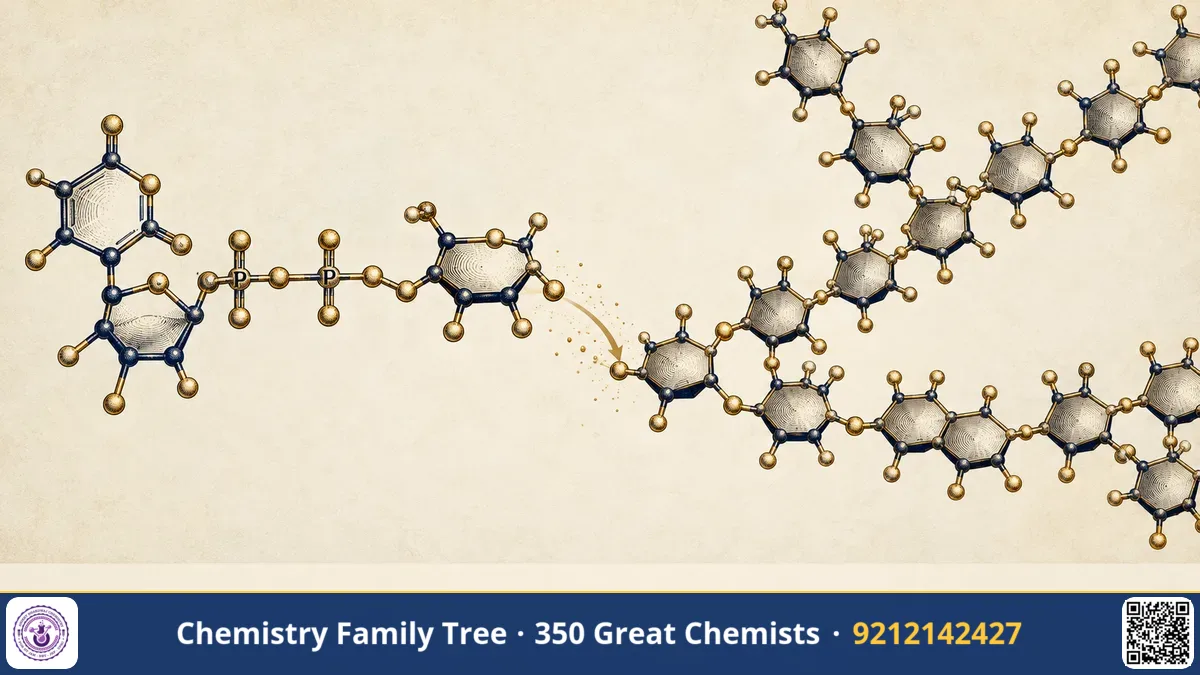
When you eat rice or bread, your body stores some of the glucose as glycogen in the liver and muscles. How does a cell join thousands of glucose units into this large branched polymer? The answer was found by the Argentine biochemist Luis Federico Leloir, who discovered a class of molecules called sugar nucleotides, especially uridine diphosphate glucose (UDP-glucose). These activated sugar donors drive the biosynthesis of glycogen, starch, cellulose and many other carbohydrates. For this discovery he received the Nobel Prize in Chemistry in 1970. His work also explained a metabolic route for galactose, now called the Leloir pathway, which is important for understanding the disease galactosaemia.
The Scientific Problem Before the Discovery
By the 1940s, biochemists understood that glycogen is broken down by the enzyme phosphorylase, using inorganic phosphate to form glucose-1-phosphate:
Glycogen(n) + Pi ⇌ Glycogen(n-1) + glucose-1-phosphate
Carl and Gerty Cori had shown that this reaction can run in the reverse direction in a test tube. Many scientists therefore believed that the same enzyme built glycogen in cells. However, inside cells the concentration of inorganic phosphate is high relative to glucose-1-phosphate, which strongly favours breakdown, not synthesis. Biosynthesis needed a different route. Also, the formation of other polysaccharides such as starch, cellulose and the sugar chains on proteins had no explanation. Another puzzle was the conversion of galactose, a sugar from milk lactose, into glucose; cells could do this, but the mechanism was unknown.
The Discovery: Step-by-Step
- Studying galactose conversion. Leloir and his colleagues at the Instituto de Investigaciones Bioquímicas in Buenos Aires, including Carlos Cardini, Ranwel Caputto, Raúl Trucco and Alejandro Paladini, studied yeast extracts that convert galactose to glucose.
- A heat-stable cofactor. They found that the reaction needed a small heat-stable cofactor, which they purified and identified as uridine diphosphate glucose (UDP-glucose).
- Structure. UDP-glucose consists of glucose joined through its anomeric carbon (C-1) to the terminal phosphate of uridine diphosphate.
- Glycogen synthesis (1950s). Leloir showed that an enzyme, glycogen synthase, uses UDP-glucose to add glucose units to a growing glycogen chain.
- Extension to other polysaccharides. Similar nucleotide sugars were found for starch (ADP-glucose in plants), and many others such as UDP-galactose, GDP-mannose and UDP-glucuronic acid.
The Chemistry Behind It
The central reaction of glycogen synthesis is:
UDP-glucose + (glucose)n → (glucose)n+1 + UDP
The nucleotide diphosphate is a good leaving group. The sugar is therefore "activated", like an acyl group in acetyl-CoA. Glucose units are attached by α(1→4) glycosidic bonds, and branches via α(1→6) bonds are made by a separate branching enzyme. The UDP-glucose itself is formed from glucose-1-phosphate and UTP, in a reaction catalysed by UDP-glucose pyrophosphorylase:
Glucose-1-phosphate + UTP → UDP-glucose + PPi
The pyrophosphate is rapidly hydrolysed by pyrophosphatase to two phosphate ions, which pulls the reaction forward and makes the process effectively irreversible. This clarifies why synthesis and degradation of glycogen use different routes, an important principle of metabolic regulation.
The Leloir pathway of galactose metabolism has three main steps:
- Galactose + ATP → galactose-1-phosphate + ADP (galactokinase)
- Galactose-1-phosphate + UDP-glucose → UDP-galactose + glucose-1-phosphate (galactose-1-phosphate uridylyltransferase)
- UDP-galactose → UDP-glucose (UDP-galactose 4-epimerase)
The epimerase works through a temporary oxidation of C-4 of the sugar by tightly bound NAD⁺ to a keto intermediate, followed by reduction from the opposite face. This changes the configuration at C-4 only.
Applications Today
- Medical diagnosis: A deficiency of galactose-1-phosphate uridylyltransferase causes classical galactosaemia. Babies are screened, and a lactose-free diet is lifesaving.
- Diabetes and metabolism: Understanding glycogen synthase regulation helps in studying insulin action and glucose storage.
- Glycobiology: Sugar nucleotides are donors for glycosyltransferases that build glycoproteins, blood group antigens and bacterial cell walls.
- Biotechnology: Enzymatic synthesis of oligosaccharides and glycoprotein drugs uses sugar nucleotides.
- Food industry: Understanding lactose metabolism supports the management of lactose-related conditions, which are common in India.
A useful way to remember the main idea is to compare sugar nucleotides with ATP. ATP activates phosphate groups for transfer, while UDP-glucose activates glucose units for transfer. In both cases the cell links a high-energy bond to a reaction that would otherwise be unfavourable. The same logic appears in the synthesis of lactose, where UDP-galactose donates galactose to glucose, and in the building of cell wall polysaccharides in bacteria and plants. For this reason, a single concept from Leloir's laboratory helps to explain a large part of carbohydrate biochemistry.
Exam Corner
- UDP-glucose is the activated glucose donor for glycogen synthesis; in plants ADP-glucose is used for starch.
- Glycogen synthase forms α(1→4) bonds; branching enzyme forms α(1→6) bonds.
- Leloir pathway enzymes: galactokinase, galactose-1-phosphate uridylyltransferase, UDP-galactose 4-epimerase.
- Glucose-1-phosphate + UTP → UDP-glucose + PPi; hydrolysis of PPi drives the reaction.
- Leloir received the Nobel Prize in Chemistry in 1970 for discovering sugar nucleotides and their role in carbohydrate biosynthesis.
Common Misconceptions
- "Glycogen is made by reversing glycogen breakdown." Cells use UDP-glucose and glycogen synthase, a separate pathway.
- "Epimerase changes glucose to galactose by removing water." It changes the configuration at C-4 through an oxidation and reduction using NAD⁺.
- "UDP is only an RNA component." Uridine nucleotides also serve as carriers in sugar metabolism.
Quick Revision Box
- Sugar nucleotides are activated donors, such as UDP-glucose.
- UDP-glucose + glycogen(n) → glycogen(n+1) + UDP.
- Leloir pathway: galactose → Gal-1-P → UDP-Gal → UDP-Glc.
- Epimerase uses NAD⁺ to invert C-4.
- Deficiency of the uridylyltransferase causes galactosaemia.
- Nobel Prize in Chemistry 1970.
FAQ
What is a sugar nucleotide?
It is a sugar linked to a nucleoside diphosphate, such as UDP-glucose. It acts as an activated donor of the sugar unit.
Why is UDP a good leaving group?
The diphosphate is stabilised by resonance and by charge, and its departure releases energy, which makes the transfer thermodynamically favourable.
Where did Leloir work?
He worked in Buenos Aires, mainly at the Instituto de Investigaciones Bioquímicas (Fundación Campomar).
Why is the Leloir pathway medically important?
Defects in its enzymes cause galactosaemia, a serious genetic disorder that can be managed by diet if detected early.
Published by ABC Chemistry — IIT-JAM | CSIR-NET | GATE Chemistry Coaching. Visit abcchemistry.com
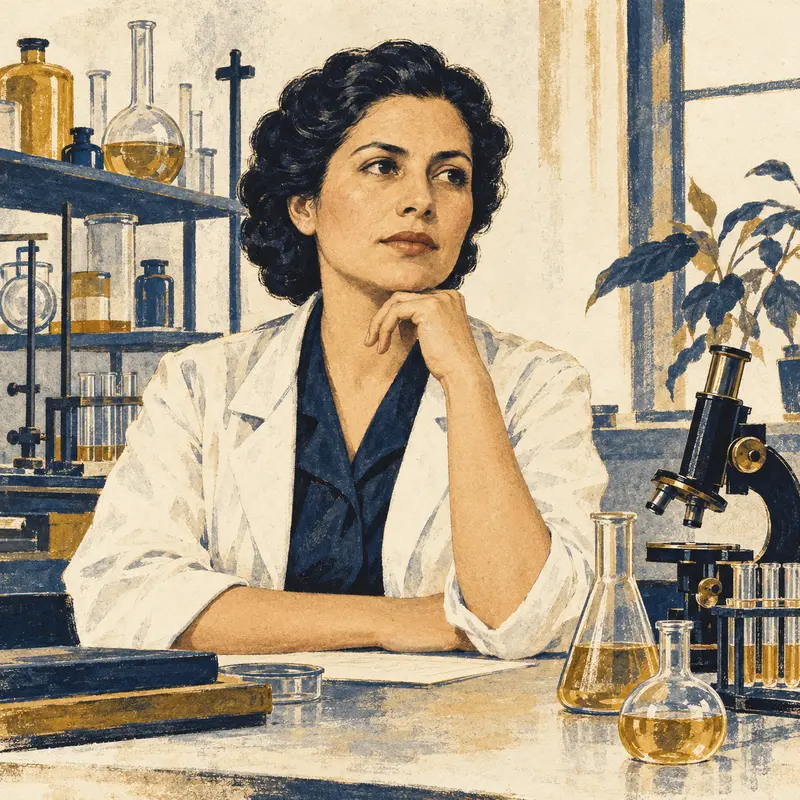
About the chemist
Luis Federico Leloir
1906-1987 · Argentina · Nobel Chemistry 1970
Sugar nucleotides; carbohydrate metabolism