Biography · Chemist no. 215 of 350
M. Stanley Whittingham: The Chemist Who Taught Lithium to Move In and Out
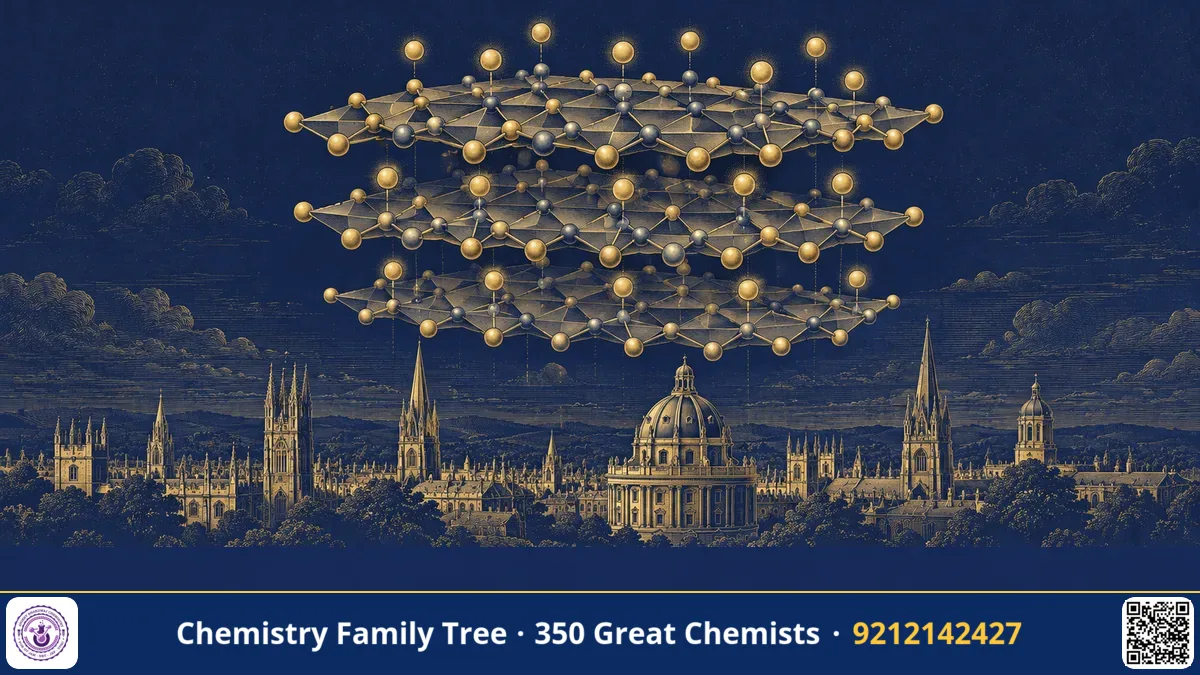
Michael Stanley Whittingham (born 22 December 1941) is a British-American chemist and Distinguished Professor at Binghamton University, part of the State University of New York. He shared the 2019 Nobel Prize in Chemistry with John B. Goodenough and Akira Yoshino. His legacy in one line: he showed that lithium ions can be reversibly inserted into a solid cathode, which made the first rechargeable lithium battery possible.
Early Life and Family
Whittingham was born in Nottingham, England, and grew up in the Midlands of Britain. Although few details of his family are widely documented, his career shows an early interest in practical chemistry and in solid materials, qualities that later suited his work on batteries.
Education and Mentors
He studied chemistry at New College, Oxford, and completed his DPhil there in 1968, working on solid-state chemistry, including studies of ionic conduction and defects in solids. After Oxford, he moved to Stanford University in the United States as a postdoctoral researcher in the materials science department, where he worked with Robert Huggins, an expert on solid-state ionics and electrochemistry. At Stanford, he first explored how ions move through solids, and he became interested in layered materials that could host guest species.
Career Timeline
| Year | Event |
|---|---|
| 1941 | Born in Nottingham, England |
| 1968 | DPhil in chemistry, University of Oxford |
| Late 1960s-1970s | Postdoctoral researcher at Stanford University |
| 1972-1984 | Research at Exxon in New Jersey |
| 1976 | Publishes the Li/TiS₂ rechargeable battery |
| 1984 | Leaves Exxon for other work in industry |
| 1988 | Joins Binghamton University, State University of New York |
| 2019 | Shares the Nobel Prize in Chemistry |
Major Scientific Contributions
- Intercalation electrodes: recognising layered sulfides, especially TiS₂, as reversible hosts for lithium.
- First rechargeable lithium battery: lithium metal anode with TiS₂ cathode, operating near 2 V.
- Structure-property understanding: studies of how crystal structure changes during lithium insertion.
- New cathodes: work on vanadium oxides and other multielectron host materials that could store more than one lithium per metal ion.
- Training the next generation: he founded and directed NECCES, an Energy Frontier Research Center on battery materials, and led the Institute for Materials Research at Binghamton.
The details of the TiS₂ work are in our companion post on the discovery of the lithium intercalation battery.
Awards, Honours and Nobel Prize
Whittingham shared the 2019 Nobel Prize in Chemistry with Goodenough and Yoshino "for the development of lithium-ion batteries". He has also received awards from electrochemistry and battery societies for his work on intercalation materials.
Personality, Struggles and Lesser-Known Facts
- A corporate scientist: He worked in the research arm of an oil company, a fact that often surprises students, because the company wanted a post-oil future.
- Frustrated by the end of the project: When oil prices fell, the company's interest in the battery waned, and the technology was passed on without becoming a product.
- Persistence: He continued to work in the field through decades when lithium batteries were not fashionable, and later moved to academia.
- Passion for sustainability: He has spoken often about the need for energy storage to support renewable energy.
- Transatlantic career: He is British by birth and has spent most of his working life in the United States.
Legacy and Influence on Modern Chemistry
Whittingham provided the conceptual basis for the lithium-ion battery: the electrode as a host. This idea is so familiar today that it is easy to forget that it had to be discovered. Research on next-generation batteries, such as sodium-ion, lithium-sulfur and solid-state cells, builds on the same concept. India's growing battery industry and research programmes use these principles for electric vehicles and grid storage.
Whittingham's contribution is easier to appreciate when we remember what a battery is. A battery is two electrodes separated by an ion-conducting medium; the chemistry lies in how each electrode stores and releases charge. Before the 1970s, most electrodes were consumed and rebuilt in each cycle, which damaged them. Whittingham's insight was to choose a structure which acts as a flexible host, taking in ions and giving them back with minimal change. This insight links solid-state chemistry, which he studied in Oxford, with electrochemistry, which he met in practice at Stanford and Exxon. Later in his career, he continued to explore how to store more than one lithium ion per metal centre, which could increase capacity considerably. At Binghamton University he built a strong group on battery materials and trained students who now work in universities and industry. His story proves that fundamental ideas can wait years for the right technology and partners to arrive.
Lessons for Students
- Look for the principle. A general idea (intercalation) matters more than one material.
- Industry can do deep science. Fundamental discoveries are made in company labs too.
- Be patient with technology. Safety and cost problems can delay a good idea by years.
- Build on others. Whittingham, Goodenough and Yoshino each added a missing piece.
- Study solid-state chemistry. Crystal structure and defects drive materials performance.
Quick Facts Box
- Born: 22 December 1941, Nottingham, England
- Died: Living (as of this writing)
- Nationality: British-born, based in the USA
- Field: Solid-state chemistry, electrochemistry, materials science
- Famous for: Intercalation chemistry; first rechargeable lithium battery (TiS₂)
- Nobel: Chemistry 2019, shared with Goodenough and Yoshino
FAQ
Where does Whittingham work now?
At Binghamton University, State University of New York.
Which company did he work for?
Exxon, in its corporate research laboratory in New Jersey.
How did his work connect to Goodenough's?
Goodenough replaced the sulfide cathode with an oxide (LiCoO₂), doubling the voltage.
Which exam points should I remember?
Intercalation, TiS₂, Li metal anode, dendrites and the three 2019 laureates.
Published by ABC Chemistry — IIT-JAM | CSIR-NET | GATE Chemistry Coaching. Visit abcchemistry.com
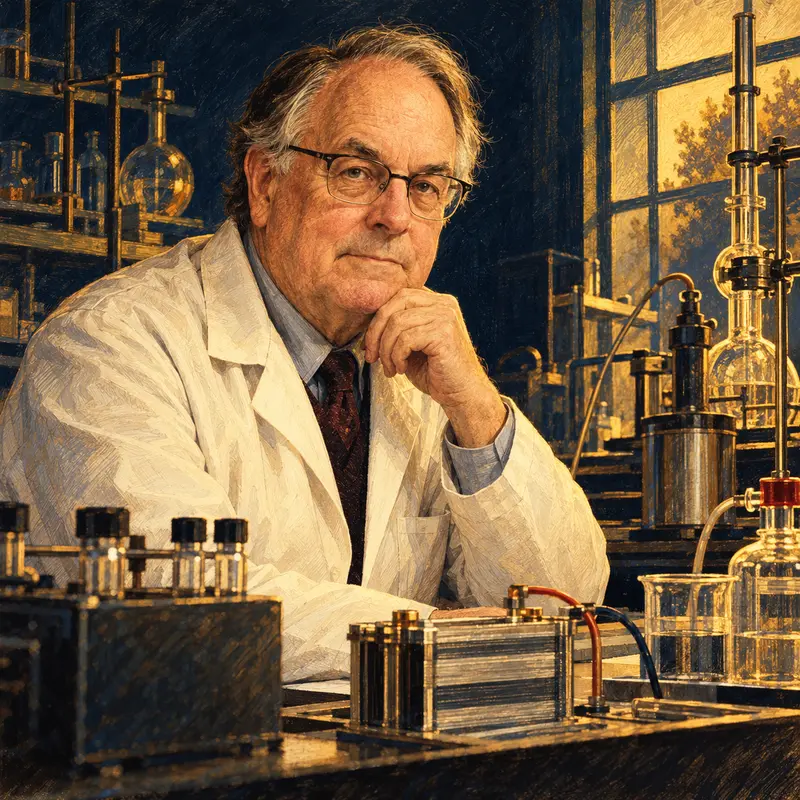
About the chemist
M. Stanley Whittingham
1941- · United Kingdom · Nobel Chemistry 2019
Intercalation lithium battery concept