The discovery, explained · Chemist no. 215 of 350
M. Stanley Whittingham and the First Rechargeable Lithium Battery
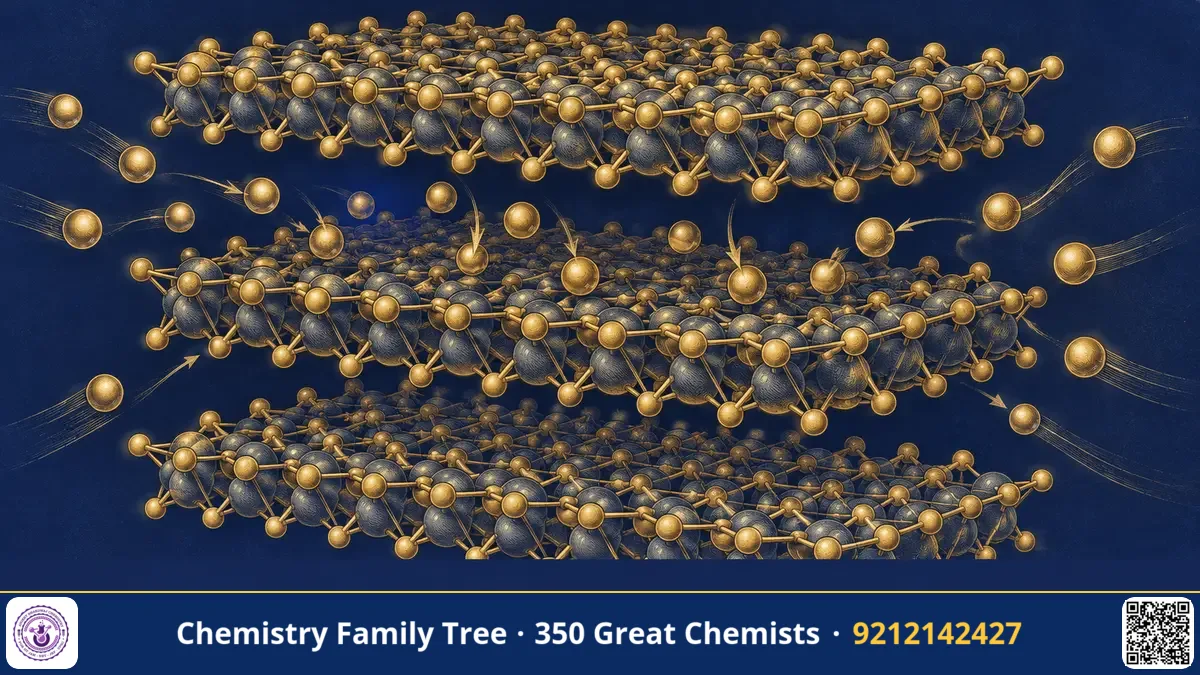
Every lithium-ion battery today traces back to a laboratory in New Jersey in the early 1970s. There, M. Stanley Whittingham, a British chemist working at Exxon, realised that lithium ions could be inserted into and removed from the layers of a solid, titanium disulfide (TiS₂), over and over again. This idea of intercalation electrodes led to the first practical rechargeable lithium battery. For this, Whittingham shared the 2019 Nobel Prize in Chemistry with John B. Goodenough and Akira Yoshino.
The Scientific Problem Before the Discovery
In 1973 the oil crisis made the world think about energy. Exxon, an oil company, wanted to diversify into new energy technologies, and it hired researchers to study alternatives, including batteries. Conventional rechargeable batteries of the day, lead-acid and nickel-cadmium, were heavy and had low energy density. Lithium, with the most negative reduction potential of any metal (about −3.04 V vs SHE) and a very low density, offered the dream of light, high-energy batteries.
Primary (non-rechargeable) lithium batteries already existed. The problem was how to make them rechargeable. Normal cathodes undergo irreversible chemical changes when lithium reacts with them, converting one compound into another. What was needed was a cathode that could accept lithium and then release it again, without changing its structure.
The Discovery: Step by Step
- Study of layered materials. Whittingham knew of work on intercalation compounds, in which guest species slip between layers of a host solid. He studied layered transition-metal dichalcogenides such as tantalum disulfide (TaS₂), which are superconducting when intercalated with certain ions. He realised that such materials could be electrodes.
- Choosing TiS₂. Titanium disulfide has a layered structure (CdI₂ type) with TiS₆ octahedra sharing edges to form sheets held together by weak van der Waals forces. It is light, conducts electrons well and has spaces between layers for lithium ions.
- Building the cell. The cell used a lithium metal anode, TiS₂ as cathode, and a non-aqueous electrolyte containing a lithium salt in an organic solvent.
- Testing. The cell gave about 2 V and could be charged and discharged many times. The structure of TiS₂ stayed nearly intact, just expanding slightly (the layer spacing increases) as lithium inserts.
Cathode (discharge): TiS₂ + x Li⁺ + x e⁻ → LiₓTiS₂   (Ti⁴⁺ → Ti³⁺)
Anode (discharge):   Li → Li⁺ + e⁻
Overall: x Li + TiS₂ ⇌ LiₓTiS₂   (0 ≤ x ≤ 1)
The reaction is almost perfectly reversible. Whittingham's results were published in 1976. Exxon built prototypes, including a button cell for watches, but the project did not become a mass product. The lithium metal anode formed dendrites (needle-like deposits) on charging that could short-circuit the cell, and TiS₂ reacted with moisture to release hydrogen sulfide, a toxic gas, with high manufacturing cost. Also, after a time Exxon's interest in energy research faded, partly because oil prices fell.
The Chemistry Behind It
- Intercalation: Reversible insertion of ions into a layered host. The host lattice acts as a "sponge" for ions.
- Redox in the host: The titanium is reduced from Ti⁴⁺ to Ti³⁺ as lithium is inserted; the electrons occupy the metal d band, and the Li⁺ ions balance the charge.
- Nernst-type behaviour: The voltage depends on the free energy change of the insertion reaction: E = −ΔG/nF.
- Dendrites: Uneven deposition of lithium metal during charging forms branching structures that can pierce the separator. This safety problem was a key reason the later Li-ion cell replaced the metal anode with a carbon intercalation anode.
- Sulfide versus oxide: Sulfide cathodes give lower voltage than oxides, motivating Goodenough's search for oxide cathodes.
Applications Today
- Foundation of Li-ion batteries: Intercalation electrodes in phones, laptops, EVs and power banks.
- Grid storage: Large lithium batteries that smooth out solar and wind power.
- Solid-state and beyond-lithium research: Whittingham later worked on new cathodes with multiple electron transfer, such as vanadium oxides and silicon-based systems, and on materials for sodium-ion cells.
- Space and defence: Light, compact batteries.
- Indian EV mission: Chemistry knowledge of intercalation underlies cell research programmes in India.
It is worth noting how this work fits the larger story. Whittingham provided the concept of the intercalation electrode, Goodenough raised the voltage by replacing sulfide with oxide, and Yoshino removed the dangerous lithium metal anode. Without any one of these three steps, the lithium-ion battery in your phone would not exist in its present form. The Li/TiS₂ cell remains a favourite teaching example, because its half-reactions are simple and its structure is easy to draw.
Exam Corner
- What is intercalation? Reversible insertion of guest ions into a layered host.
- Whittingham's cathode: TiS₂. Anode: lithium metal. Voltage about 2 V.
- Oxidation state of Ti in LiTiS₂: +3.
- Main problem with Li metal anodes: dendrite formation and safety.
- 2019 Chemistry Nobel: Whittingham, Goodenough, Yoshino.
Common Misconceptions
- "Whittingham invented the modern Li-ion battery alone." He created the intercalation concept; Goodenough raised the voltage with oxides, and Yoshino made the safe carbon-anode cell.
- "Intercalation is a chemical decomposition." The host structure stays largely intact.
- "Lithium batteries were invented after smartphones." The key science dates from the 1970s and 1980s.
Quick Revision Box
- Whittingham, Exxon, early 1970s: first rechargeable Li battery with TiS₂ cathode.
- Reaction: TiS₂ + xLi ⇌ LiₓTiS₂.
- Cell voltage about 2 V; lithium metal anode.
- TiS₂ has layered CdI₂-type structure.
- Limits: dendrites, cost and H₂S risk.
- Nobel Prize in Chemistry 2019 (shared).
FAQ
Why was lithium chosen?
It is the lightest metal and has a very negative standard potential, giving high energy per unit weight.
Why did Exxon not sell the battery?
Safety and cost issues, plus changes in the company's priorities as oil prices fell.
What is a dichalcogenide?
A compound MX₂ where X is a chalcogen such as sulfur or selenium, often with a layered structure.
Did Whittingham win in Physics?
No. His Nobel was in Chemistry.
Published by ABC Chemistry — IIT-JAM | CSIR-NET | GATE Chemistry Coaching. Visit abcchemistry.com
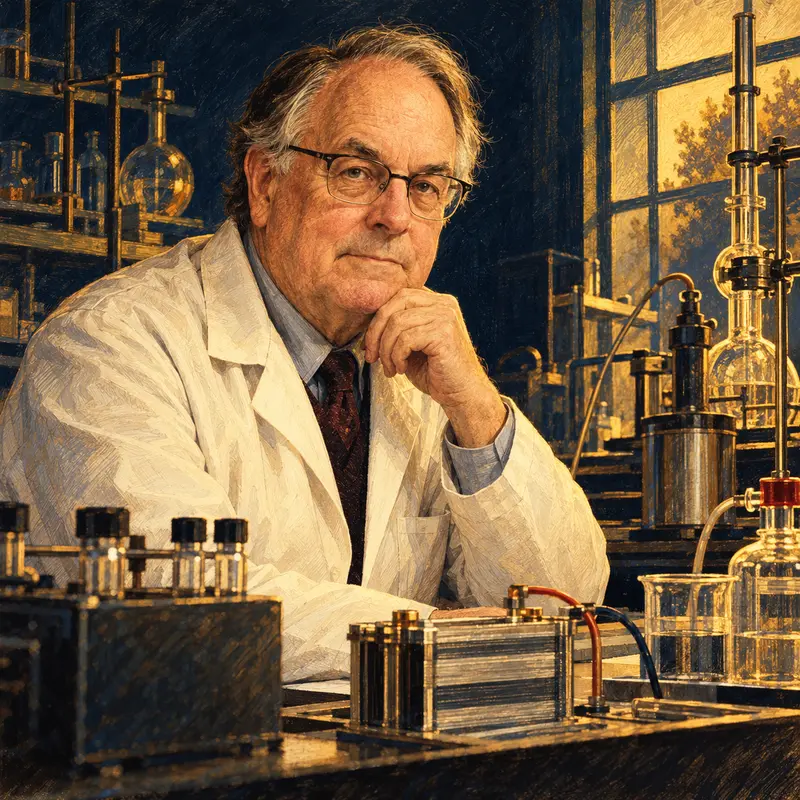
About the chemist
M. Stanley Whittingham
1941- · United Kingdom · Nobel Chemistry 2019
Intercalation lithium battery concept