Biography · Chemist no. 136 of 350
Manfred Eigen (1927-2019): The Chemist Who Timed the Fastest Reactions and Modelled the Origin of Life
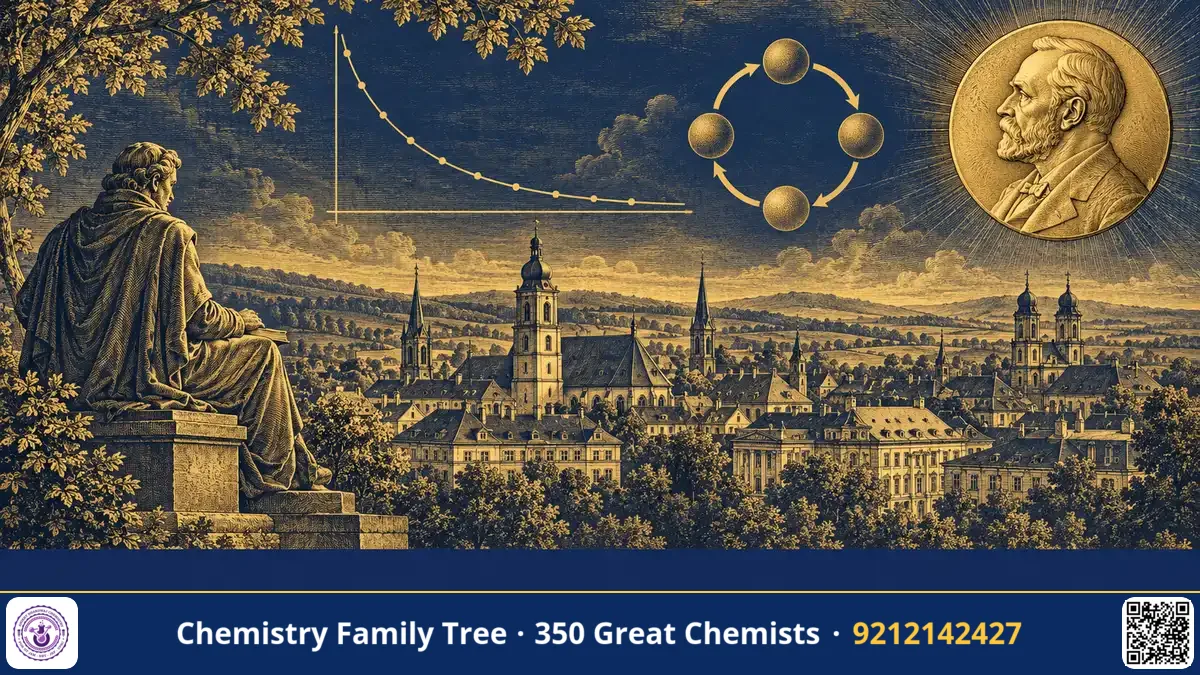
Manfred Eigen was a German physical chemist who changed our idea of how fast a chemical reaction can be measured. By inventing relaxation methods in the 1950s, he showed that reactions finishing in a microsecond or less could be studied quantitatively. He received half of the 1967 Nobel Prize in Chemistry, sharing the award with Ronald Norrish and George Porter. Later he turned to biology, developing theories of molecular evolution, including the quasispecies and hypercycle concepts. His one-line legacy: he made the fastest events in chemistry measurable, and then he asked how life itself might have begun.
Early Life and Family
Eigen was born on 9 May 1927 in Bochum, in the industrial Ruhr region of Germany. His father was a musician (a chamber musician) and his mother loved music, so Eigen grew up in a musical home and became a gifted pianist, a skill he kept throughout his life. He attended school in Bochum. His boyhood was overshadowed by the Second World War: at the end of the war he was drafted as a teenager into anti-aircraft service. After the war, he continued his schooling and was able to begin university studies.
Education and Mentors
Eigen entered the University of Göttingen in 1946 to study physics and chemistry. His doctoral work was done under Arnold Eucken, a well-known physical chemist, and he earned his PhD in 1951 with a thesis on the absorption of sound in aqueous electrolyte solutions, an early step toward his relaxation approach. He then joined the Max Planck Institute for Physical Chemistry in Göttingen, where Karl Friedrich Bonhoeffer was a leading figure. This early research on sound absorption in solutions showed him that disturbances of equilibrium could reveal information about very fast steps.
Career Timeline
| Year | Event |
|---|---|
| 1927 | Born in Bochum, Germany |
| 1946 | Starts studying at the University of Göttingen |
| 1951 | PhD under Arnold Eucken |
| 1953 | Begins to develop relaxation methods |
| 1955 | With Leo De Maeyer, measures H⁺ + OH⁻ recombination |
| 1964 | Becomes a director at the Max Planck Institute for Physical Chemistry in Göttingen |
| 1967 | Shares the Nobel Prize in Chemistry with Norrish and Porter |
| 1971 | Proposes the quasispecies concept of molecular evolution |
| 1977 | With Peter Schuster, proposes the hypercycle |
| 1995 | Retires as director of the Max Planck Institute for Biophysical Chemistry |
| 2019 | Dies in Göttingen |
Major Scientific Contributions
Relaxation methods. By applying a sudden perturbation (temperature, pressure or electric field) to a solution at equilibrium and following its return, Eigen measured reaction times down to microseconds. For a simple equilibrium A ⇌ B the relaxation time follows 1/τ = k_f + k_r.
Proton transfer and diffusion control. He measured the very fast recombination of H⁺ and OH⁻ (about 1.4 × 10¹¹ L mol⁻¹ s⁻¹) and gave a theory of proton transfer in water, introducing the hydrated proton structure, now called the Eigen cation (H₉O₄⁺).
Ligand substitution. The Eigen-Wilkins mechanism, with Ralph Wilkins, showed how metal ions exchange water molecules and explained labile and inert complexes.
Molecular evolution. In 1971 Eigen proposed that early replicating molecules formed a "quasispecies", a cloud of related sequences kept near an optimum by selection, with an error threshold beyond which information is lost. With Peter Schuster he proposed the hypercycle in 1977, a cyclic network in which molecules catalyse each other's replication. These ideas are still discussed in virus evolution (RNA viruses mutate near an error threshold) and in origin-of-life research. Eigen also promoted the idea of evolving molecules in the laboratory by selection, a thought that fed into later work on directed evolution.
See the companion discovery article for the chemistry of relaxation kinetics.
Awards, Honours and Nobel Prize
Eigen received half of the 1967 Nobel Prize in Chemistry "for their studies of extremely fast chemical reactions, effected by disturbing the equilibrium by means of very short pulses of energy". The other half was shared by Ronald G. W. Norrish and George Porter. He was a member of numerous academies and received many honorary doctorates.
Personality, Struggles and Lesser-Known Facts
- Eigen was a skilled pianist and a lover of music throughout his life.
- As a teenager at the end of the war he was drafted for anti-aircraft duties, an experience he shared with many of his generation in Germany.
- His central idea was simple: if a reaction is too fast to follow by mixing, do not mix; disturb an equilibrium instead.
- In later life he enjoyed discussing science with a wide public and wrote popular books about evolution and chance, including Das Spiel (The Game), written with Ruthild Winkler.
Legacy and Influence on Modern Chemistry
Relaxation kinetics is a standard chapter of physical chemistry. Today's pump-probe lasers go far beyond the microsecond, reaching femtoseconds, but the thinking is the same: perturb, then observe. The idea of the quasispecies is central to the understanding of why RNA viruses such as influenza and HIV evolve quickly, and its error threshold concept guides antiviral strategies that push viruses beyond their limit. In coordination chemistry, the Eigen-Wilkins mechanism is an essential part of the study of ligand substitution. For Indian students, relaxation methods, diffusion-controlled reactions and the Eigen-Wilkins mechanism are part of physical chemistry and inorganic chemistry for IIT-JAM, CSIR-NET and GATE.
Lessons for Students
- When a problem seems impossible, change the way you ask the question. Eigen did not race the reaction; he disturbed equilibrium.
- Learn physics, chemistry and biology together; his ideas moved easily between them.
- Do not stop after one great success; he moved from kinetics to evolution.
- Keep a creative hobby such as music; it supports clear thinking.
Quick Facts Box
- Born: 9 May 1927, Bochum, Germany
- Died: 6 February 2019, Göttingen, Germany
- Nationality: German
- Field: Physical chemistry, biophysical chemistry
- Famous for: Relaxation methods; quasispecies and hypercycle theories
- Nobel Prize: Chemistry, 1967 (half; shared with R. G. W. Norrish and G. Porter)
FAQ
Which part of the 1967 Nobel Prize did Eigen receive?
He received one half, and Norrish and Porter shared the other half.
What is a hypercycle?
A self-reinforcing cycle of replicating molecules in which each member helps the replication of the next, proposed as a model for early molecular evolution.
Where did he work?
At Göttingen, in the Max Planck Institute for Physical Chemistry, later the Max Planck Institute for Biophysical Chemistry.
What is the error threshold?
The maximum mutation rate beyond which a population of replicators cannot maintain its genetic information.
Published by ABC Chemistry — IIT-JAM | CSIR-NET | GATE Chemistry Coaching. Visit abcchemistry.com
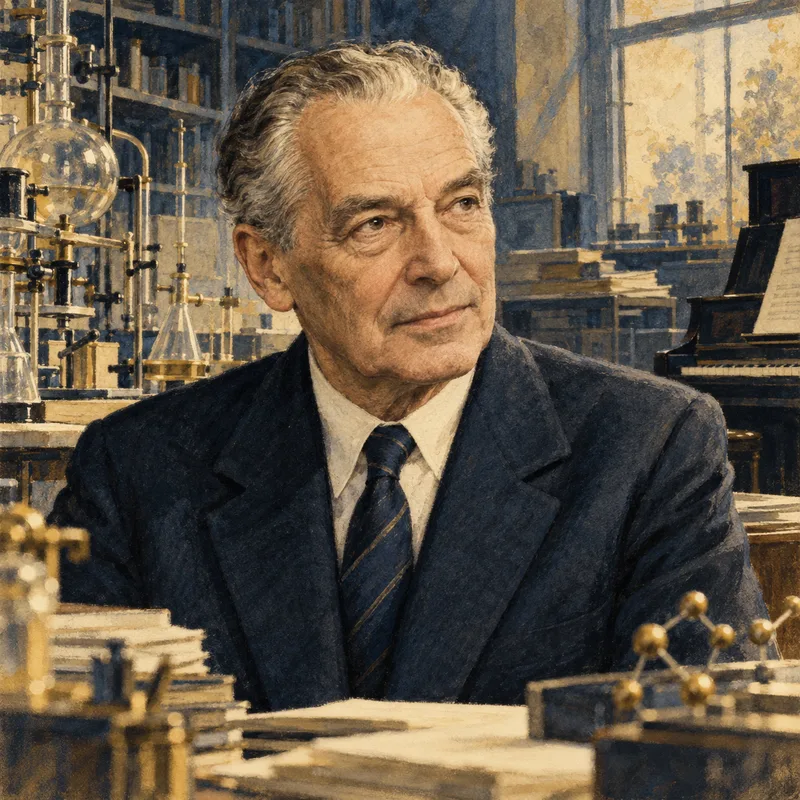
About the chemist
Manfred Eigen
1927-2019 · Germany · Nobel Chemistry 1967
Study of extremely fast reactions