The discovery, explained · Chemist no. 136 of 350
Manfred Eigen and Relaxation Methods: Measuring Reactions Faster Than a Blink
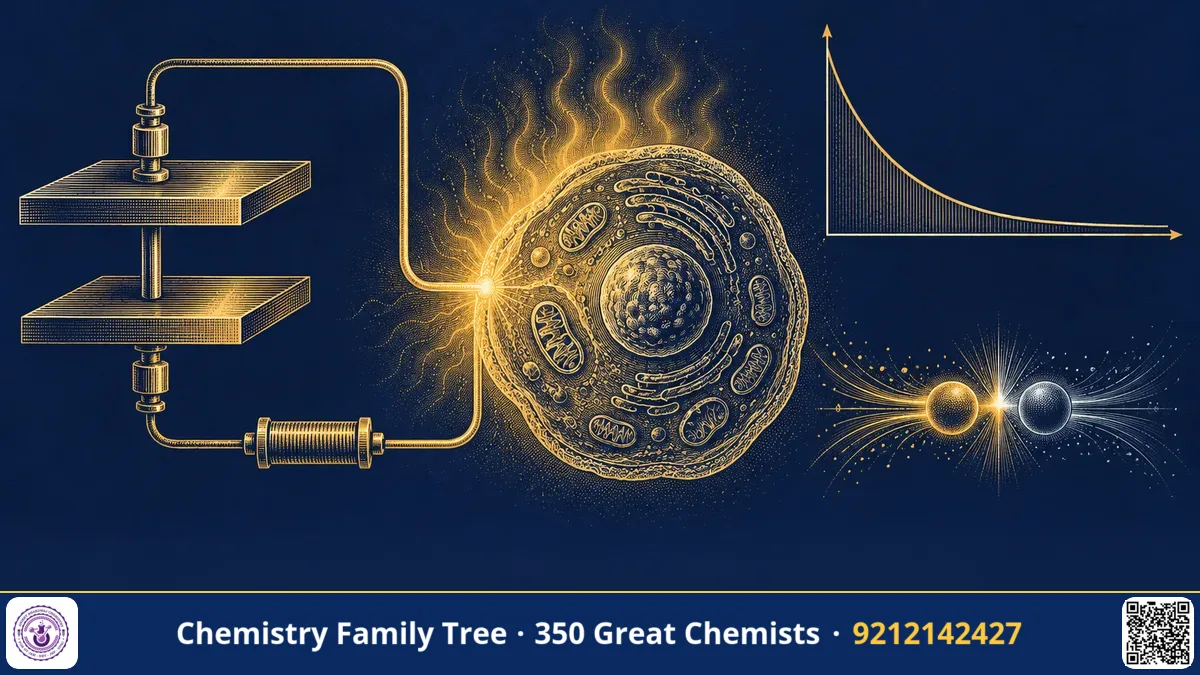
Mix an acid and a base in a beaker, and the reaction seems instant. For a long time chemists believed that such reactions were too fast to measure. The German physical chemist Manfred Eigen proved them wrong. In the 1950s, at Göttingen, he developed relaxation methods: instead of mixing reactants and racing to watch them, he let a system sit at equilibrium, gave it a sudden nudge, and measured how quickly it returned. With this idea he could follow reactions lasting microseconds or even nanoseconds. For this work he received half of the 1967 Nobel Prize in Chemistry; the other half went to Ronald Norrish and George Porter for flash photolysis.
The Scientific Problem Before the Discovery
Classical kinetics relies on mixing reagents and then following concentration over time. This works only when the reaction is slow compared with mixing time. The best flow methods, such as stopped-flow (developed by Britton Chance and Quentin Gibson) could reach times of about a millisecond. But many important reactions are far faster: the neutralisation of acid and base, recombination of ions, proton transfer, and binding of metal ions to ligands. For these, the mixing itself takes longer than the reaction. As a result, chemists could say only that such reactions had enormous rate constants, but had no numbers.
The Discovery: Step by Step
- The key idea. A system at equilibrium has a fixed composition. If a physical parameter, such as temperature, pressure or electric field, is suddenly changed, the equilibrium position shifts. The system then moves to the new equilibrium by a first-order exponential process, with a time constant called the relaxation time (τ).
- Fast perturbation. In the temperature-jump method, a high-voltage capacitor is discharged through a salt solution, heating it by a few degrees in about a microsecond. The perturbation is much faster than the chemical re-equilibration, so the system "relaxes" in a measurable time.
- Fast detection. The change is followed by absorption or conductivity measurement through an oscilloscope or later fast electronics. If the solution contains an indicator, its colour changes as the equilibrium shifts.
- Analysis. From the relaxation time, together with equilibrium constants, both the forward and reverse rate constants are obtained.
- Landmark result. In 1955 Eigen and Leo De Maeyer measured the recombination of H⁺ and OH⁻ in water.
H⁺ + OH⁻ ⇌ H₂O k_f ≈ 1.4 × 10¹¹ L mol⁻¹ s⁻¹ (at 25 °C)
This is one of the fastest known solution reactions, near the limit set by diffusion.
The Chemistry Behind It
For a small perturbation, the deviation of concentration from the new equilibrium decays as Δc = Δc₀ e^(−t/τ). The relaxation time depends on rate constants:
A ⇌ B           1/τ = k_f + k_r
A + B ⇌ C       1/τ = k_f([A]eq + [B]eq) + k_r
For the second case, a plot of 1/τ against ([A]eq + [B]eq) is a straight line, with slope k_f and intercept k_r. Since K = k_f/k_r is known from equilibrium measurements, the data can be cross-checked.
Other relaxation techniques include the pressure-jump method (which exploits the volume change of the reaction), the electric-field jump (useful for ionic and dipolar equilibria, with a dissociation field effect, or Wien effect), and ultrasonic absorption, where sound waves periodically perturb the equilibrium.
Diffusion-controlled reactions. When every encounter between reactants leads to reaction, the rate is limited only by diffusion, and the bimolecular rate constant is of the order of 10⁹ to 10¹⁰ L mol⁻¹ s⁻¹ for ordinary molecules. The H⁺ + OH⁻ reaction is even faster because protons hop along hydrogen-bonded water chains by the Grotthuss mechanism, the proton "jumping" from one water molecule to the next instead of moving as a heavy ion. Eigen also described the hydrated proton as the H₉O₄⁺ ion (now called the Eigen cation), H₃O⁺ solvated by three water molecules.
Metal complex formation. The Eigen-Wilkins mechanism describes ligand substitution in metal ions in two steps: rapid formation of an outer-sphere (ion-pair) complex, followed by the rate-determining loss of a water molecule from the inner coordination sphere of the metal ion. The rates of water exchange differ over many orders of magnitude, from very fast for alkali metals to extremely slow for Cr³⁺ and Rh³⁺. This is why some complexes are labile and others inert, a topic in coordination chemistry that all inorganic students study.
Applications Today
- Enzyme kinetics. Relaxation methods measure binding, conformational changes and catalytic steps in enzymes and receptors on the microsecond scale.
- Protein folding. Laser temperature-jump experiments follow the folding of peptides and proteins in microseconds.
- Coordination chemistry. The lability of metal ions, key to metalloenzymes, catalysts and MRI contrast agents, is known from water exchange rates.
- Biophysics. Studies of nucleic acid base pairing, membrane channels and molecular recognition use relaxation concepts.
- Industry and environment. Rates of acid-base and ion-exchange steps in water treatment and catalysis can be estimated using diffusion-limit calculations.
Exam Corner
- Relaxation methods perturb an equilibrium (T-jump, P-jump, E-field jump) and follow its return; for first-order approach 1/τ = k_f + k_r.
- For A + B ⇌ C: 1/τ = k_f([A]+[B]) + k_r.
- H⁺ + OH⁻ → H₂O has k ≈ 10¹¹ L mol⁻¹ s⁻¹; faster than ordinary diffusion limit because of the Grotthuss mechanism.
- The Eigen-Wilkins mechanism has outer-sphere complex formation followed by rate-determining water loss.
- Eigen shared the 1967 Nobel Prize in Chemistry with Norrish and Porter.
Common Misconceptions
- "Relaxation methods need mixing." No; they work on an already-mixed system at equilibrium, which is why they avoid the mixing-time limit.
- "A fast reaction must have a large equilibrium constant." Rate and equilibrium are separate: K = k_f/k_r, and a fast reaction can still have a small K.
- "Eigen and Norrish-Porter used the same technique." Eigen used relaxation; Norrish and Porter used flash photolysis.
Quick Revision Box
- Relaxation: disturb equilibrium suddenly and follow the return with time constant τ.
- Temperature-jump: capacitor discharge heats the solution in about a microsecond.
- A ⇌ B: 1/τ = k_f + k_r.
- H⁺ + OH⁻ → H₂O: k ≈ 1.4 × 10¹¹ L mol⁻¹ s⁻¹ (Eigen and De Maeyer, 1955).
- Eigen-Wilkins mechanism for ligand substitution.
- Nobel Prize in Chemistry 1967 (half), shared with Norrish and Porter.
FAQ
What is a relaxation time?
The time constant of the exponential return of a perturbed system to its new equilibrium.
Why is the proton-hydroxide reaction so fast?
Because protons move through water by hopping along hydrogen bonds (the Grotthuss mechanism) rather than by simple diffusion.
What did Eigen win the Nobel Prize for?
For studies of extremely fast chemical reactions effected by disturbing the equilibrium with very short pulses of energy.
Is the temperature-jump method still used?
Yes, now with laser heating, to study protein folding and other fast processes.
Published by ABC Chemistry — IIT-JAM | CSIR-NET | GATE Chemistry Coaching. Visit abcchemistry.com
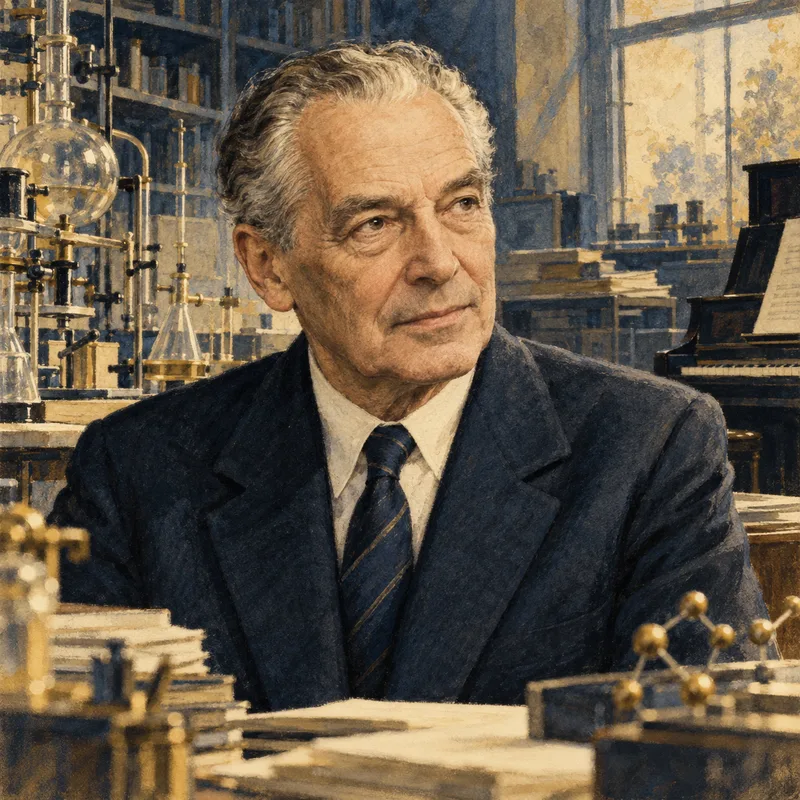
About the chemist
Manfred Eigen
1927-2019 · Germany · Nobel Chemistry 1967
Study of extremely fast reactions