Biography · Chemist no. 272 of 350
Marguerite Perey (1909–1975): From Lab Assistant to Discoverer of Francium
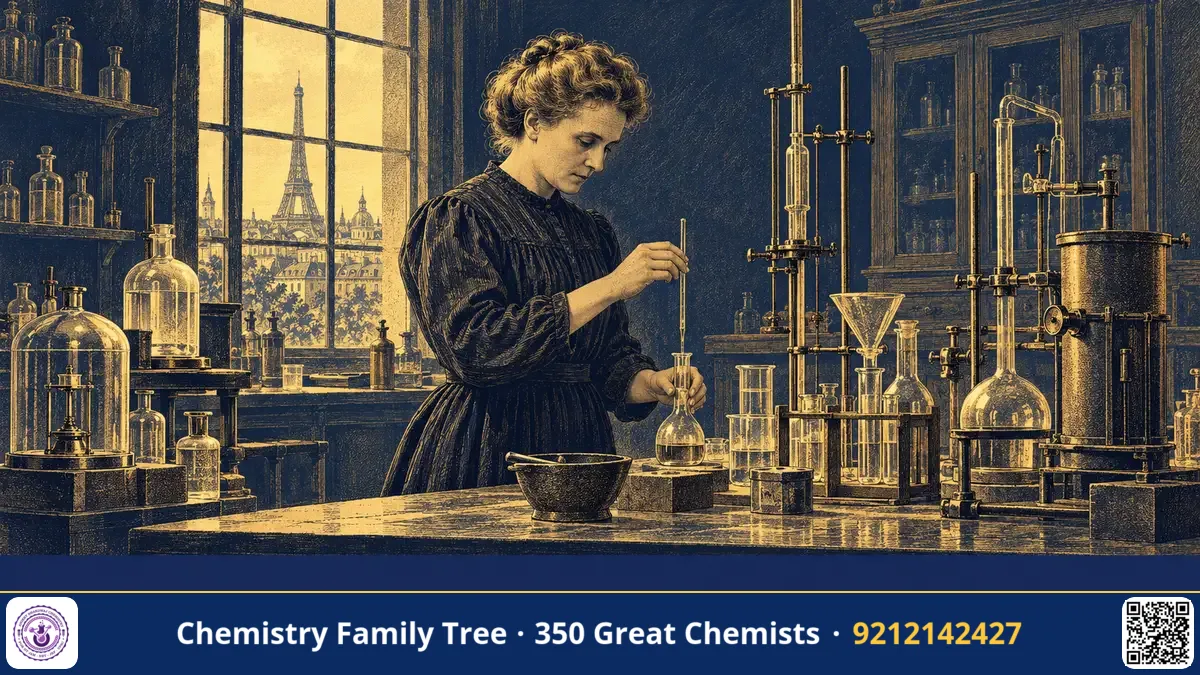
Marguerite Catherine Perey was a French radiochemist who discovered the element francium in 1939 while working at the Curie Institute in Paris. She began as a young assistant to Marie Curie without a university degree, and ended as a professor and the first woman to be elected to the French Academy of Sciences (as a corresponding member). Her life is an inspiring story of talent, hard work and persistence, and also a reminder of the dangers faced by early workers in radiochemistry.
Early Life and Family
Marguerite was born on 19 October 1909 in Villemomble, a suburb of Paris. Her father died when she was young, and her family could not afford the long years of university study. She had hoped to study medicine but had to find work and a shorter route to a career. This financial hardship shaped her path: instead of a university degree, she took a technical course in chemistry.
Education and Mentors
She obtained a chemistry diploma from a technical school for women in Paris in 1929. That same year, she applied to the Radium Institute (Curie Institute) in Paris and was hired by Marie Curie as a laboratory assistant (préparatrice). Marie Curie trained her personally in the handling and purification of radioactive substances. After Marie Curie's death in 1934, Perey worked with André Debierne, who had co-discovered actinium and led the Institute's radiochemistry work, and she also worked closely with Irène Joliot-Curie. Later, she completed her formal education, obtaining her doctorate from the Sorbonne in 1946 with a thesis on element 87, francium.
Career Timeline
| Year | Event |
|---|---|
| 1909 | Born in Villemomble, France (19 October). |
| 1929 | Joins the Radium Institute in Paris as Marie Curie's assistant, at age 19. |
| 1934 | Marie Curie dies; Perey continues work with Debierne on actinium. |
| 1939 | Discovers element 87 in the decay of actinium-227. |
| 1946 | Receives doctorate from the Sorbonne; francium name formally adopted. |
| 1949 | Appointed professor of nuclear chemistry at the University of Strasbourg and head of the Nuclear Chemistry Laboratory. |
| 1962 | Elected corresponding member of the French Academy of Sciences, the first woman to receive this honour. |
| 1975 | Dies in Louveciennes, France (13 May). |
Major Scientific Contributions
Discovery of francium. While purifying actinium-227, Perey observed a weak beta radiation that came from a new substance. She proved by chemical tests that it behaved like an alkali metal, heavier than caesium, and was the product of alpha decay of actinium. This was element 87, completing the Group 1 column of the periodic table in nature.
²²⁷Ac → ²²³Fr + α   (about 1.4% branch)
²²³Fr → ²²³Ra + β⁻  (half-life about 22 min)
Radiochemical methods. She improved methods of purification of actinium and its decay products, and studied the chemistry of francium by tracer methods such as co-precipitation with caesium salts.
Teaching and research leadership. At Strasbourg she built a laboratory of nuclear chemistry that trained many researchers, and studied the alkali elements and radioactive isotopes further.
Awards, Honours and Nobel Prize
Perey was elected a corresponding member of the French Academy of Sciences in 1962. This was a significant moment, because the Academy had not admitted women before, and Marie Curie herself had failed to be elected to the Academy in 1911. She also received other national recognition for her work. She never received a Nobel Prize.
Personality, Struggles and Lesser-Known Facts
- A start at 19. She entered the Curie laboratory at the age of 19 as a technician. Her skill, rather than her degrees, made her a discoverer.
- Naming the element. She first called her discovery actinium K. She suggested the name francium for her homeland, and the name became official in 1946. This also fitted a tradition: polonium (Poland) and gallium (Gaul) were named for countries.
- Exposure to radiation. In the early decades of radiochemistry, protective measures were limited. Perey developed health problems linked to radiation exposure and lived with serious illness, including cancer, for many years of her life, which affected her work.
- Struggle for recognition. She began her career without the usual university degrees and completed her doctorate only in 1946, after the discovery that made her name.
- A teacher. At Strasbourg she trained a new generation of nuclear chemists.
Legacy and Influence on Modern Chemistry
Francium is used today in atomic physics: lasers trap small numbers of atoms to test the Standard Model and measure fundamental constants. Her work established the idea that very small amounts of radioactive material can be identified by chemical behaviour and decay properties alone. As a woman who entered science through technical training, she opened a door for other women in French science, and she is remembered along with Marie Curie, Irène Joliot-Curie and Lise Meitner as one of the pioneers. For Indian students, her story shows that persistence, careful experimental skill and the willingness to trust a small anomaly can lead to a major discovery even without high formal qualifications at the start.
Lessons for Students
- Pure samples and careful technique matter more than expensive equipment.
- Do not ignore tiny signals; a 1.4% decay branch led to a new element.
- Keep learning. She earned her doctorate after her discovery and became a professor.
- Radiation safety is not optional. Learn and follow the rules of your laboratory.
Quick Facts
- Born: 19 October 1909, Villemomble, France.
- Died: 13 May 1975, Louveciennes, France.
- Nationality: French.
- Field: Radiochemistry, nuclear chemistry.
- Famous for: Discovering francium (element 87), 1939.
- Nobel Prize: None.
FAQ
Who trained Marguerite Perey?
Marie Curie hired and trained her at the Radium Institute in Paris; later she worked with André Debierne.
What was special about her election in 1962?
She became the first woman elected as a corresponding member of the French Academy of Sciences.
Why is francium named so?
Perey named it after France, her native country.
How did she die?
She died in 1975 after a long illness, which is widely linked to her exposure to radiation.
Published by ABC Chemistry — IIT-JAM | CSIR-NET | GATE Chemistry Coaching. Visit abcchemistry.com
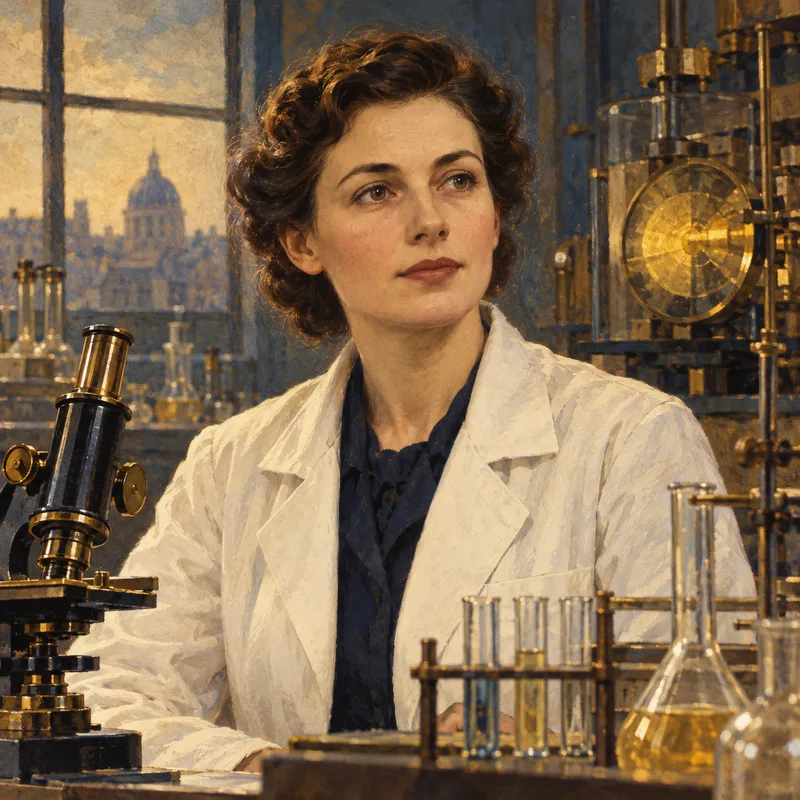
About the chemist
Marguerite Perey
1909-1975 · France
Discovered francium