The discovery, explained · Chemist no. 272 of 350
Marguerite Perey and the Discovery of Francium: The Last Natural Element
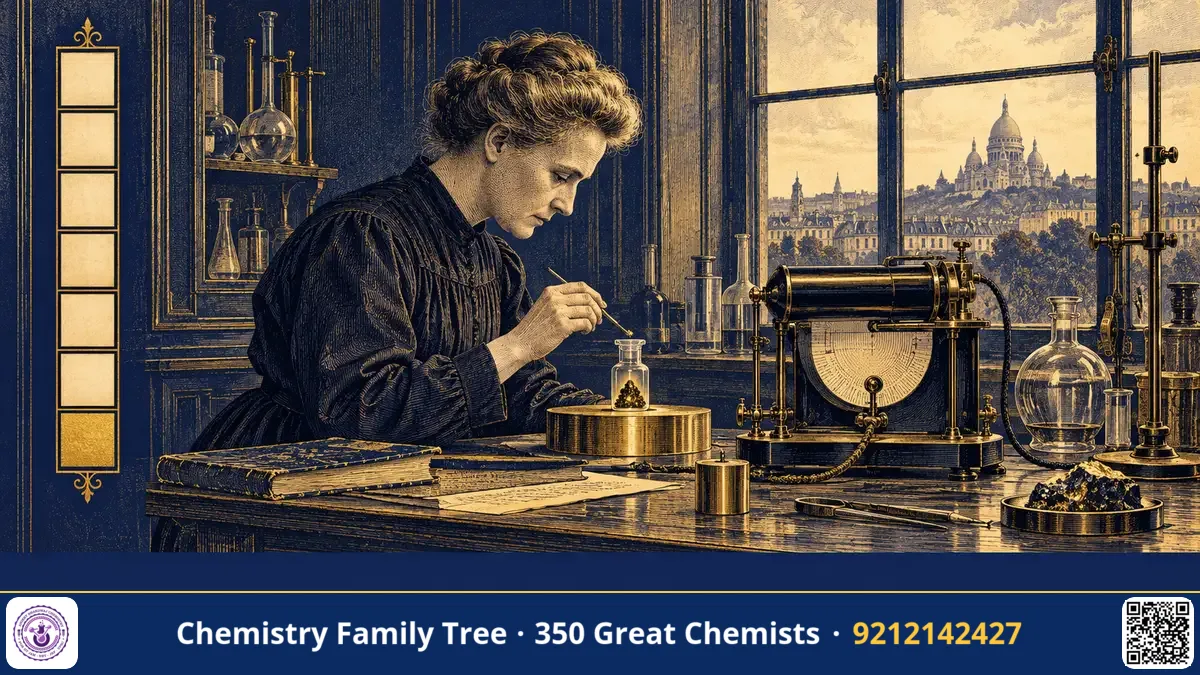
Francium (Fr, atomic number 87) is the heaviest of the alkali metals and one of the rarest elements on Earth. It was discovered in 1939 by a young French radiochemist, Marguerite Perey, at the Curie Institute in Paris. She was only 29, and she was a laboratory technician who had started as Marie Curie's assistant. Francium was the last element to be discovered in nature (rather than made in the laboratory). For students, the story is also a good lesson in how radioactive decay series, branching ratios and the periodic table come together.
The Scientific Problem Before the Discovery
Element 87 was a gap in the periodic table for decades. Mendeleev had called it eka-caesium, and it was expected to be an alkali metal below caesium, with the configuration [Rn] 7s¹. Several research groups claimed to have found it, and gave names such as russium, alkalinium, virginium and moldavium. All of these claims turned out to be wrong. The element was expected to be radioactive and very short lived, so no one could find weighable amounts in ores.
In the decay series of uranium-235 (the actinium series), the isotope actinium-227 (²²⁷Ac) was known. It is mostly a beta emitter, but it was suspected that a small fraction of its decay might go by alpha emission, which would produce a nucleus with Z = 87. The challenge was to prove that this weak branch existed and to identify the product.
The Discovery: Step by Step
Marguerite Perey joined the Curie Institute in 1929 as a laboratory assistant of Marie Curie, and later worked with André Debierne, who had discovered actinium. She was given the task of preparing very pure actinium. This was the key to her success: previous workers had samples contaminated by other radioactive materials, which made small effects invisible.
- Purification: She carefully purified actinium by repeated chemical separation to remove its decay products, such as thorium and radium isotopes, and other contaminants.
- Observation: In the purified actinium she measured a weak beta radiation whose energy and half-life did not match any known substance. The activity could not be explained by the known beta emitters.
- Chemical separation: The unknown activity did not follow actinium, thorium, radium or other known elements in precipitations. It behaved like an alkali metal, being carried by caesium salts, such as caesium perchlorate or caesium chloroplatinate, and not by other precipitates.
- Conclusion (January 1939): The new activity was from an isotope of element 87, formed by alpha decay of ²²⁷Ac. She called it actinium K at first. Later she proposed the name francium after her native France, and it was officially adopted in 1946.
²²⁷₈₉Ac → ²²³₈₇Fr + ⁴₂He        (about 1.4% of decays)
²²⁷₈₉Ac → ²²⁷₉₀Th + ⁰₋₁e        (about 98.6% of decays)
²²³₈₇Fr → ²²³₈₈Ra + ⁰₋₁e + ν̄    (t½ about 22 minutes)
Only about 1.4% of actinium atoms decay by alpha emission, so a weak signal needed a very pure sample, and this made the work so delicate.
The Chemistry Behind It
Francium is placed in Group 1 below caesium, with the configuration [Rn] 7s¹. The longest-lived isotope, ²²³Fr, has a half-life of only about 22 minutes (some artificially made isotopes are of similar length). This means francium has never been seen in visible amounts. At any moment, the whole Earth's crust is estimated to contain only about 20–30 grams of it, continually produced from actinium and decaying again.
Periodic trends predict its properties:
- Expected to have a very large atomic radius and a very low ionisation energy, like the other heavy alkali metals (Cs, Fr).
- Most electropositive and reactive alkali metal; it would react explosively with water to give FrOH, a very strong base.
- Forms Fr⁺ salts that are co-precipitated with large cations: CsClO₄, Cs₂PtCl₆ and similar compounds.
Because only a few atoms exist at a time, francium chemistry is studied by tracer techniques: the behaviour of Fr⁺ is compared with Cs⁺, and the radioactivity is followed. This is the method that Perey used. Scientists have since made francium atoms in particle accelerators, by bombarding gold with oxygen ions, and trapped them with lasers to study atomic spectra.
Applications Today
- Atomic physics: Laser-trapped francium atoms are used to test the Standard Model of particle physics, such as searches for parity violation and for an electric dipole moment of the electron, since francium has a simple one-electron outer shell and a heavy nucleus.
- Medical tracer idea: Francium was once considered for detecting some cancers, because it behaves like potassium and caesium in the body, but it is too short lived and too scarce for practical use.
- Teaching periodicity: It is the standard example of a prediction of a missing element and of the trends in Group 1.
- Radiochemistry methods: The idea of tracing a chemical by its radioactivity is widely used in nuclear medicine and environmental studies, including in India.
Exam Corner
- Francium (Z = 87) was discovered by Marguerite Perey in 1939 as the alpha-decay product of ²²⁷Ac.
- It is the heaviest alkali metal, eka-caesium, with a [Rn] 7s¹ configuration; its longest-lived isotope ²²³Fr has a half-life of about 22 minutes.
- Branching decay of ²²⁷Ac: about 98.6% beta (to Th-227) and about 1.4% alpha (to Fr-223).
- Fr⁺ co-precipitates with Cs⁺ salts, such as CsClO₄; this is a standard tracer technique.
- Francium is the second-rarest naturally occurring element after astatine (a common question).
Common Misconceptions
- "Francium is the most reactive metal, so it is used in industry." It is expected to be very reactive, but it has no commercial use because no one can collect a visible sample.
- "Francium was made by scientists, not found in nature." It was discovered in natural actinium and is a natural element, although artificially produced isotopes are used today in research.
- "All of actinium turns into francium." Only about 1.4% follows the alpha-decay branch.
Quick Revision Box
- Element 87, francium, discovered January 1939 by Marguerite Perey, Curie Institute, Paris.
- Source: ²²⁷Ac alpha branch (about 1.4%), giving ²²³Fr.
- Initially called actinium K; named francium after France.
- ²²³Fr half-life about 22 minutes; beta decay gives ²²³Ra.
- Heaviest alkali metal, eka-caesium, [Rn] 7s¹.
- Last element discovered in nature.
FAQ
Why is francium so rare?
Its isotopes are very short-lived and are formed only in a tiny side branch of actinium decay, so almost none accumulates.
Did Perey win a Nobel Prize?
No. She received other honours, including becoming the first woman to be elected as a correspondent of the French Academy of Sciences.
How was francium recognised as an alkali metal?
It was carried along with caesium salts in precipitation, which showed it was chemically similar to caesium.
What is the symbol for francium?
Fr. Its atomic number is 87 and it lies below caesium in Group 1.
Published by ABC Chemistry — IIT-JAM | CSIR-NET | GATE Chemistry Coaching. Visit abcchemistry.com

About the chemist
Marguerite Perey
1909-1975 · France
Discovered francium