Biography · Chemist no. 4 of 350
Marie Curie: The Life of the Scientist Who Won Two Nobel Prizes
Marie Salomea Skłodowska Curie (1867-1934) was a Polish-born, naturalised-French physicist and chemist who discovered polonium and radium, named the phenomenon of radioactivity and became the first woman to win a Nobel Prize. She is still the only person to have won Nobel Prizes in two different scientific fields. Her legacy in one line: she showed that determination, curiosity and hard experimental work can overcome poverty, prejudice and loss.
Early Life and Family
Maria Skłodowska was born on 7 November 1867 in Warsaw, which at that time was under Russian rule. She was the youngest of five children. Her father, Władysław Skłodowski, taught mathematics and physics, and her mother, Bronisława, was the headmistress of a girls' school. The family lost much of its wealth in the political troubles that followed Polish uprisings against Russian rule. Tragedy struck early: her sister Zofia died of typhus in 1876, and her mother died of tuberculosis in 1878, when Maria was about ten. She turned to her studies and finished school at the top of her class, receiving a gold medal in 1883.
Education and Mentors
Women were not allowed to enrol at the University of Warsaw, so Maria and her sister Bronisława joined the "Floating University", a secret, patriotic network of classes held in private homes. They made a plan: Maria would work as a governess to support Bronisława's medical studies in Paris, and then her sister would help her. After several years, in 1891, Maria arrived in Paris and enrolled at the Sorbonne under the name Marie.
- She studied physics and mathematics, often living in a small attic room, and sometimes going hungry as she focused on her studies.
- She obtained her physics degree in 1893 (ranking first) and her mathematics degree in 1894 (second).
- Her professor Gabriel Lippmann gave her laboratory space, and the physicist Pierre Curie, whom she met in 1894, became her partner in life and in science.
- The physicist Henri Becquerel's discovery of uranium rays in 1896 inspired her doctoral project.
Career Timeline
| Year | Event |
|---|---|
| 1867 | Born in Warsaw on 7 November |
| 1891 | Moves to Paris to study at the Sorbonne |
| 1895 | Marries Pierre Curie (26 July) |
| 1897 | Daughter Irène is born |
| 1898 | Announces polonium (July) and radium (December) |
| 1903 | Receives her doctorate; shares the Nobel Prize in Physics with Pierre Curie and Henri Becquerel |
| 1904 | Daughter Ève is born |
| 1906 | Pierre dies in a road accident (19 April); Marie takes over his professorship, becoming the first woman to teach at the Sorbonne |
| 1910 | Isolates metallic radium with André Debierne |
| 1911 | Receives the Nobel Prize in Chemistry |
| 1914 | The Radium Institute in Paris is completed; First World War begins |
| 1914-1918 | Develops mobile X-ray units and trains radiology technicians |
| 1921 | Visits the United States and is presented with a gram of radium for her research |
| 1934 | Dies on 4 July at a sanatorium in Passy, France |
Major Scientific Contributions
Radioactivity as an atomic property. She proved that the intensity of radiation depends on the amount of the element and not on its chemical state. This was a great step towards the idea of nuclear processes.
Discovery of polonium and radium. By chemical separation of pitchblende, she and Pierre found two new elements. In 1902 she determined radium's atomic mass, and in 1910 she isolated radium metal. See our discovery post on radium and polonium for the experiments and equations.
²²⁶₈₈Ra → ²²²₈₆Rn + ⁴₂He
Radiation measurement and standards. She helped create the first international standard for radium and worked to standardise radioactive measurements.
Medical radiology. During the First World War she helped build radiological vehicles, often called "little Curies", along with fixed X-ray posts in hospitals, which helped surgeons locate bullets and shrapnel in wounded soldiers. She also trained women to operate the equipment. Her elder daughter Irène assisted her.
Awards, Honours and Nobel Prize
- 1903 Nobel Prize in Physics, shared with Pierre Curie and Henri Becquerel, for research on radiation phenomena.
- 1911 Nobel Prize in Chemistry, awarded to her alone, for the discovery of radium and polonium, the isolation of radium and the study of its compounds.
- Davy Medal of the Royal Society (1903, with Pierre Curie).
- Curium (element 96) is named after Marie and Pierre Curie, and the curie is a unit of radioactivity.
- In 1995 her remains, together with Pierre's, were moved to the Panthéon in Paris, making her the first woman to be laid to rest there on her own merits.
Personality, Struggles and Lesser-Known Facts
- Working in a shed. The Curies did their key work in a poorly heated, old wooden shed that had earlier been used for dissections. Marie later called these years the happiest of her life.
- Refusing to patent. The Curies chose not to patent their radium extraction process, as they believed that scientific knowledge should be shared freely.
- Grief and perseverance. After Pierre's death in 1906, she continued their work and also raised her two daughters. Irène later won a Nobel Prize in Chemistry (1935) with her husband Frédéric Joliot.
- Public hostility. In 1911, some newspapers attacked her over a personal matter, and she faced strong press hostility in France. The same period saw her named for the second Nobel Prize, and she was advised by a member of the Nobel committee to stay away from Stockholm. She went anyway to receive her prize.
- Using her prize money and radium. She chose to use radium for research and treatment rather than to make a personal fortune.
- Health price. She handled radioactive materials without proper protection, as the dangers were not known. She died of aplastic anaemia, which is generally linked to long exposure to radiation. Even today, her notebooks and some belongings are radioactive and are kept in lead-lined boxes.
Legacy and Influence on Modern Chemistry
Her work started the era of nuclear science. Rutherford and Soddy explained radioactive decay as the transformation of elements, and later discoveries of artificial radioactivity (by her daughter and son-in-law), nuclear fission and nuclear medicine all rest on the foundation she built. The Radium Institute she established in Paris became a leading research centre, and a sister institute in Warsaw was opened in 1932. She is also remembered as a pioneer for women in science: she showed that women can lead laboratories, win the highest prizes and train future scientists.
Lessons for Students
- Be curious about unexpected results. Pitchblende was too radioactive for its uranium content, and that puzzle led to two elements.
- Measure precisely. Her electrometer readings turned a vague phenomenon into numbers.
- Work with patience. Purifying radium took years and tonnes of ore.
- Share knowledge. She did not patent her method.
- Safety matters. Always follow laboratory safety rules, because her story shows how hidden hazards can harm even great scientists.
Quick Facts Box
- Born: 7 November 1867, Warsaw, Poland (then Russian Empire)
- Died: 4 July 1934, Passy, France
- Nationality: Polish-born, later French
- Field: Radiochemistry and physics
- Famous for: Radioactivity, polonium, radium
- Nobel Prize: Physics 1903 (shared); Chemistry 1911
FAQ
Why did Marie Curie win two Nobel Prizes?
The 1903 Physics prize recognised the discovery of radioactive phenomena, shared with Pierre Curie and Henri Becquerel. The 1911 Chemistry prize recognised her discovery of polonium and radium and her isolation of radium.
What did she do in the First World War?
She developed mobile X-ray units and fixed radiology posts to help doctors treat wounded soldiers, and she trained operators for them.
What caused Marie Curie's death?
She died of aplastic anaemia, which is believed to have been caused by years of exposure to radiation.
Did Marie Curie discover radioactivity?
Becquerel discovered it in 1896. Marie Curie named it, studied it systematically and discovered two radioactive elements.
Published by ABC Chemistry — IIT-JAM | CSIR-NET | GATE Chemistry Coaching. Visit abcchemistry.com
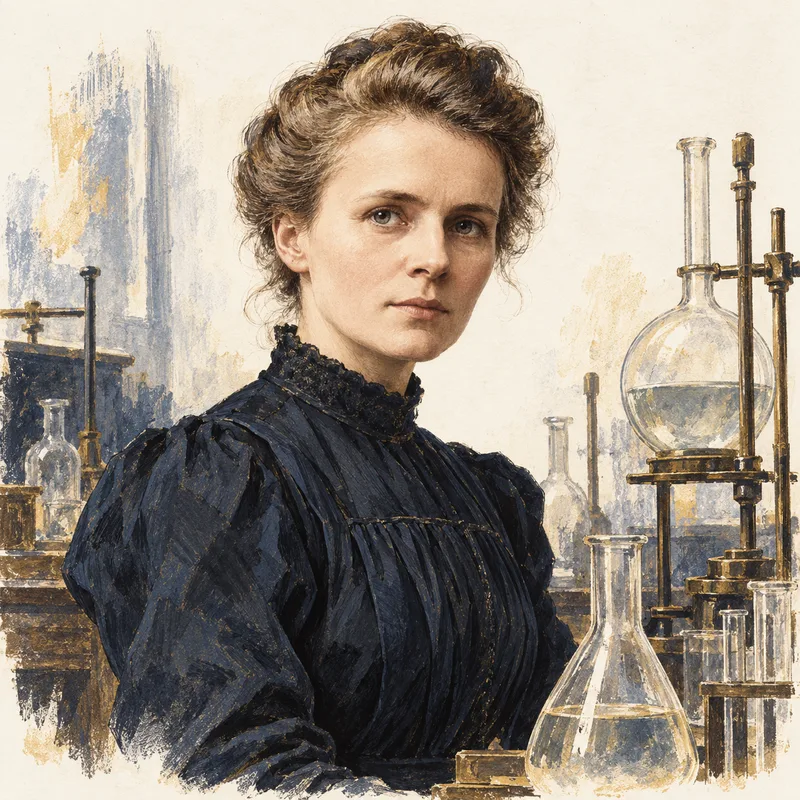
About the chemist
Marie Curie
1867-1934 · Poland/France · Nobel Physics 1903; Chemistry 1911
Radioactivity; discovered polonium and radium