The discovery, explained · Chemist no. 4 of 350
Marie Curie and the Discovery of Polonium, Radium and Radioactivity
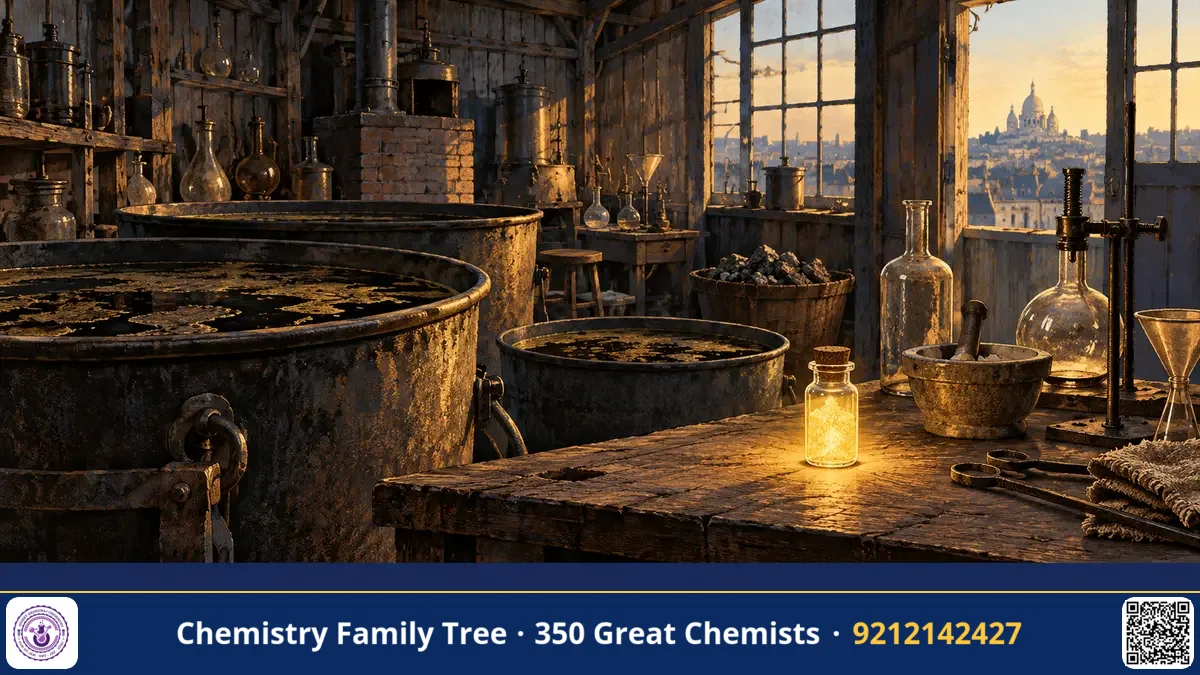
In 1898, in a cold, leaky shed in Paris, Marie Curie and her husband Pierre Curie announced two new elements, polonium and radium, both far more radioactive than uranium. Marie Curie also introduced the word "radioactivity" and showed that the property belongs to the atom itself and not to its chemical combination. Her discoveries opened the door to nuclear science, cancer radiotherapy and modern medical imaging. She remains the only person to have won Nobel Prizes in two different sciences, Physics (1903) and Chemistry (1911). This post explains the problem she faced, her method, the chemistry and the points you need for exams.
The Scientific Problem Before the Discovery
In 1895 Wilhelm Röntgen discovered X-rays. In early 1896, Henri Becquerel found that uranium salts emit penetrating rays that blacken a photographic plate even in the dark, without any external energy source. Nobody knew where this energy was coming from or whether other substances behaved the same way. Marie Curie, then looking for a doctoral research topic, decided to study these "uranium rays" systematically. The key questions were: Is the radiation a property of uranium alone? Does it depend on chemical form, light or temperature? And what is its source?
The Discovery: Step by Step
- Measuring the rays. Using an electrometer, with a piezoelectric quartz balance developed by Pierre and his brother Jacques, she measured the tiny electric current produced when the rays ionise air. This gave her a quantitative way to compare samples, rather than only looking at photographic blackening.
- Radiation depends on the amount of uranium. She found that the intensity of radiation depends only on the quantity of uranium present, regardless of whether it was a pure metal or in a compound, and regardless of temperature or light. She concluded that the property was atomic.
- Testing other elements. She tested many minerals and found that thorium compounds are also active. (G. C. Schmidt in Germany found this as well.) She named the property radioactivity.
- The surprising result. Some uranium minerals, especially pitchblende (uraninite), were much more active than the amount of uranium in them could explain. She reasoned that they must contain a new, more strongly radioactive element.
- Chemical separation of pitchblende. She and Pierre dissolved the ore in acid and separated it into fractions by standard analytical methods, measuring the radioactivity of each. The activity followed two different fractions.
- The fraction that behaved like bismuth contained a new element, which they named polonium in July 1898, in honour of Marie's native Poland.
- The fraction that behaved like barium contained another, which they named radium (from Latin radius, ray) in December 1898.
- Isolation of radium. To convince the scientific world, they needed to produce a visible, weighable sample. Working with tonnes of residue from uranium extraction, which was obtained from the mines at Joachimsthal in Bohemia, they repeated fractional crystallisation of radium-barium chlorides again and again. In 1902 Marie reported an atomic mass of about 225 for radium, using about 0.1 g of nearly pure radium chloride. In 1910, with André Debierne, she isolated the metal itself by electrolysis of radium chloride using a mercury cathode.
The Chemistry Behind It
Why radium follows barium
Radium is in group 2 (alkaline earth metals), just below barium. Its compounds are chemically similar to those of barium, so Ra²⁺ coprecipitates with Ba²⁺ as sulphate or carbonate. Radium chloride is slightly less soluble than barium chloride, and this small difference allowed the Curies to separate the two by fractional crystallisation. This is a good example of the periodic trend that group members are chemically alike.
Types of radiation and decay
Radium-226 undergoes alpha decay:
²²⁶₈₈Ra → ²²²₈₆Rn + ⁴₂He (half-life about 1600 years)
Polonium-210 also decays by alpha emission and has a half-life of about 138 days:
²¹⁰₈₄Po → ²⁰⁶₈₂Pb + ⁴₂He
| Radiation | Nature | Penetration |
|---|---|---|
| Alpha (α) | Helium nucleus (2 protons + 2 neutrons) | Low; stopped by paper |
| Beta (β) | Fast electron | Medium; stopped by aluminium sheet |
| Gamma (γ) | High-energy electromagnetic radiation | High; needs thick lead or concrete |
The law of radioactive decay
Radioactive decay is a first-order process.
N = N₀ e^(−λt)
t½ = 0.693 / λ
Activity A = λN
The SI unit of activity is the becquerel (1 Bq = 1 decay per second). The older unit, the curie (Ci), honours the Curies and equals 3.7 × 10¹⁰ Bq, approximately the activity of 1 g of radium-226.
The important idea
Radioactivity comes from the nucleus. Chemical reactions involve electrons, so the radioactivity of an element does not change when it forms a compound. This fits Marie Curie's first finding that intensity depends only on the amount of uranium.
Applications Today
- Cancer therapy. Radium needles were used in early radiotherapy. Today, cobalt-60 and linear accelerators are used for external therapy, while iodine-131 is used for thyroid disease. India's hospitals use these methods widely.
- Medical imaging. Technetium-99m is used in nuclear medicine scans, and fluorine-18 in PET scans.
- Radiocarbon dating. The decay of carbon-14 helps date archaeological finds.
- Power. Nuclear reactors produce electricity from fission, and India's three-stage nuclear programme is built on the basic science of radioactivity.
- Industry. Radioactive tracers are used to find leaks in pipes, and gamma sources are used for radiography of welds. Americium-241 is found in smoke detectors.
- Safety science. The harm of radiation, including to Marie Curie herself, led to modern radiation protection rules.
Exam Corner
- Polonium was discovered first (July 1898), radium next (December 1898). Polonium is named after Poland, radium from the Latin for "ray".
- Radioactive decay obeys first-order kinetics; t½ = 0.693/λ and is independent of the initial amount.
- Alpha emission lowers mass number by 4 and atomic number by 2; beta emission increases atomic number by 1 without changing mass number.
- Marie Curie won the 1903 Nobel Prize in Physics (with Pierre Curie and Henri Becquerel) and the 1911 Nobel Prize in Chemistry (alone).
- Element 96, curium, is named after Marie and Pierre Curie.
Common Misconceptions
- "Marie Curie discovered X-rays or radioactivity itself." X-rays were found by Röntgen and radioactivity by Becquerel. Curie named the phenomenon, showed it to be an atomic property and discovered two new elements.
- "Radioactive decay is faster when heated or compressed." Decay rate depends on the nucleus, not on temperature, pressure or chemical form.
- "Radium is a harmless glowing material." Radium is highly dangerous. Early products that contained it, such as radium paints and tonics, caused serious harm.
Quick Revision Box
- Marie Curie coined the term radioactivity and discovered polonium and radium (1898).
- Source mineral: pitchblende (uraninite).
- Radium resembles barium (group 2); separated by fractional crystallisation.
- Ra-226 half-life about 1600 years; Po-210 half-life about 138 days.
- 1 curie = 3.7 × 10¹⁰ disintegrations per second.
- Nobel Prizes: Physics 1903, Chemistry 1911.
FAQ
What did Marie Curie discover?
She discovered the elements polonium and radium, introduced the term radioactivity and showed that radioactivity is an atomic property.
Why was pitchblende important?
It was more radioactive than uranium content alone could explain, which led her to suspect new radioactive elements within it.
What is the curie unit?
It is an old unit of radioactivity equal to 3.7 × 10¹⁰ decays per second. The modern SI unit is the becquerel.
How are polonium and radium different?
Polonium follows bismuth chemically and has a short half-life (138 days for Po-210). Radium follows barium chemically in group 2 and has a long half-life (about 1600 years for Ra-226).
Published by ABC Chemistry — IIT-JAM | CSIR-NET | GATE Chemistry Coaching. Visit abcchemistry.com

About the chemist
Marie Curie
1867-1934 · Poland/France · Nobel Physics 1903; Chemistry 1911
Radioactivity; discovered polonium and radium