Biography · Chemist no. 87 of 350
Mario Molina (1943-2020): The Boy with a Bathroom Laboratory Who Helped Save the Ozone Layer
Mario José Molina-Pasquel Henríquez was a Mexican chemist who, together with F. Sherwood Rowland, discovered that chlorofluorocarbons (CFCs) damage the stratospheric ozone layer. His legacy in one line: his 1974 scientific paper started the chain of events that led to the Montreal Protocol, and the slow recovery of the ozone layer. He shared the 1995 Nobel Prize in Chemistry with Rowland and Paul Crutzen, and was the first Mexican-born scientist to receive a Nobel Prize in Chemistry.
Early Life & Family
Molina was born on 19 March 1943 in Mexico City. His father was a lawyer and diplomat, and the family valued education. Even as a child, Mario was fascinated by chemistry. He turned a spare bathroom at home into a small laboratory and used toy chemistry sets and a simple microscope to look at algae and other microscopic organisms. He was helped and encouraged by his aunt Esther, who was a chemist. As a teenager he was sent to a boarding school in Switzerland, where he continued his studies in science, and then he returned to Mexico to begin university. His early experiments at home are a good reminder that curiosity at a young age can lead to a scientific life.
Education & Mentors
Molina studied chemical engineering at the National Autonomous University of Mexico (UNAM) and received his degree in 1965. He then went to the University of Freiburg in Germany for postgraduate study, where he learned about chemical kinetics and polymerisation. He moved to the University of California, Berkeley, for his doctorate, working under George C. Pimentel, a pioneer of chemical lasers and infrared spectroscopy. He earned his PhD in physical chemistry in 1972. As a postdoctoral researcher at the University of California, Irvine, he joined the group of F. Sherwood Rowland in 1973. Their project on the fate of man-made CFCs in the atmosphere led directly to the 1974 discovery.
Career Timeline
| Year | Event |
|---|---|
| 1943 | Born in Mexico City (19 March) |
| 1965 | Degree in chemical engineering, UNAM, Mexico |
| 1965-1967 | Postgraduate study at the University of Freiburg, Germany |
| 1972 | PhD in physical chemistry, University of California, Berkeley |
| 1973 | Joins F. S. Rowland at the University of California, Irvine |
| 1974 | Molina and Rowland publish the CFC-ozone hypothesis in Nature |
| 1982 | Joins the Jet Propulsion Laboratory in Pasadena |
| 1987 | Proposes the ClO dimer mechanism for the Antarctic ozone hole with Luisa Molina |
| 1989 | Becomes professor at the Massachusetts Institute of Technology |
| 1995 | Nobel Prize in Chemistry |
| 2004 | Moves to the University of California, San Diego |
| 2013 | Receives the US Presidential Medal of Freedom |
| 2020 | Dies in Mexico City (7 October) |
Major Scientific Contributions
- CFC-ozone hypothesis (1974): CFCs break down in the stratosphere to release chlorine atoms, which catalytically destroy ozone.
- Chemistry of the ozone hole: understanding of reactions on polar stratospheric clouds and the ClO dimer cycle.
- Urban air pollution: studies of the chemistry of air pollution in Mexico City and other megacities, in a large international project.
- Policy-relevant science: his work was used by negotiators of the Montreal Protocol and later climate agreements.
For the full reaction scheme, see the companion discovery blog on CFCs and ozone depletion.
Awards, Honours & Nobel Prize
The Nobel Prize in Chemistry 1995 was awarded to Paul J. Crutzen, Mario J. Molina and F. Sherwood Rowland "for their work in atmospheric chemistry, particularly concerning the formation and decomposition of ozone". In 2013 President Barack Obama awarded Molina the Presidential Medal of Freedom, the highest civilian honour in the United States. He was also a member of several scientific academies, including the US National Academy of Sciences, and of the Pontifical Academy of Sciences. In Mexico he is honoured as a national hero of science.
Personality, Struggles & Lesser-Known Facts
- He built a childhood laboratory in a bathroom at home, and he was supported by a chemist aunt.
- He was in his early thirties when he made his major discovery, working as a postdoctoral researcher. Young scientists can change the world.
- The 1974 hypothesis faced strong criticism from some industry spokespersons. The ozone hole discovered in 1985 later confirmed the chemical danger, even though it needed additional chemistry beyond the first paper.
- He worked closely with his wife, the chemist Luisa Molina, on atmospheric and urban air pollution.
- After the Nobel Prize he established a centre in Mexico City to carry out research on energy and the environment and to advise on policy. He continued to speak on climate change and air quality.
- He believed that scientists must explain their results to the public and to leaders, not just to other scientists.
Legacy & Influence on Modern Chemistry
The Montreal Protocol is regarded as a rare example of a global environmental success, and it started from a laboratory calculation about a gas that looked harmless. Without it, scientists estimate the ozone layer would have collapsed much further and the number of skin cancers and cataracts would have grown strongly. The CFC story is now a standard case study in chemistry courses, including in India, for topics such as radicals, catalysis, photochemistry and heterogeneous reactions. Molina's later work on urban air pollution and climate change gave young scientists in developing countries a model for combining science with public service.
Lessons for Students
- Ask what happens to a chemical after it is used. Looking at the "end of life" of CFCs led to the discovery.
- Be willing to stand by good science even under pressure.
- Combine skills. Molina brought together kinetics, spectroscopy and atmospheric science.
- Communicate. Science leads to action only when people understand it.
Quick Facts Box
- Born: 19 March 1943, Mexico City, Mexico
- Died: 7 October 2020, Mexico City, Mexico
- Nationality: Mexican (also worked in the United States)
- Field: Atmospheric and physical chemistry
- Famous for: CFC-ozone depletion hypothesis (1974)
- Nobel Prize: Chemistry, 1995 (with P. J. Crutzen and F. S. Rowland)
FAQ
Who worked with Molina on the CFC discovery?
F. Sherwood Rowland, his postdoctoral supervisor at the University of California, Irvine.
Was Molina the first Mexican to win a Nobel Prize?
He was the first Mexican-born scientist to win a Nobel Prize in Chemistry. Mexicans had earlier won Nobel Prizes in Literature and Peace.
Where did Molina do his PhD?
At the University of California, Berkeley, under George Pimentel.
What did Molina do after the Nobel Prize?
He continued research and teaching in the USA, worked on air pollution in Mexico City and on climate policy, and founded a research centre in Mexico.
Published by ABC Chemistry — IIT-JAM | CSIR-NET | GATE Chemistry Coaching. Visit abcchemistry.com
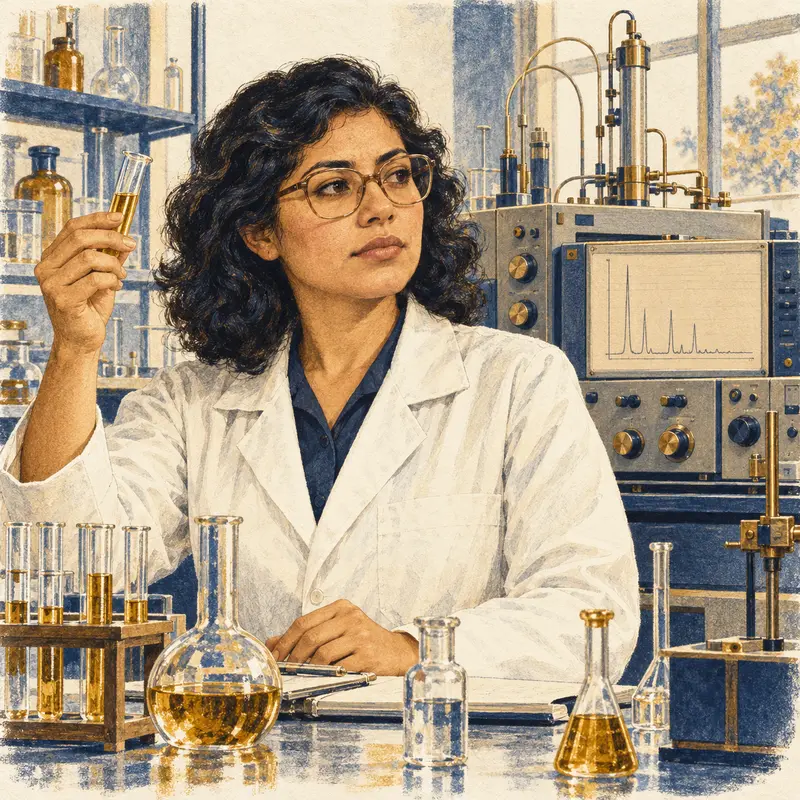
About the chemist
Mario Molina
1943-2020 · Mexico/United States · Nobel Chemistry 1995
CFC depletion of stratospheric ozone