The discovery, explained · Chemist no. 87 of 350
Mario Molina and the CFC Discovery: How a Harmless Gas Began Destroying the Ozone Layer
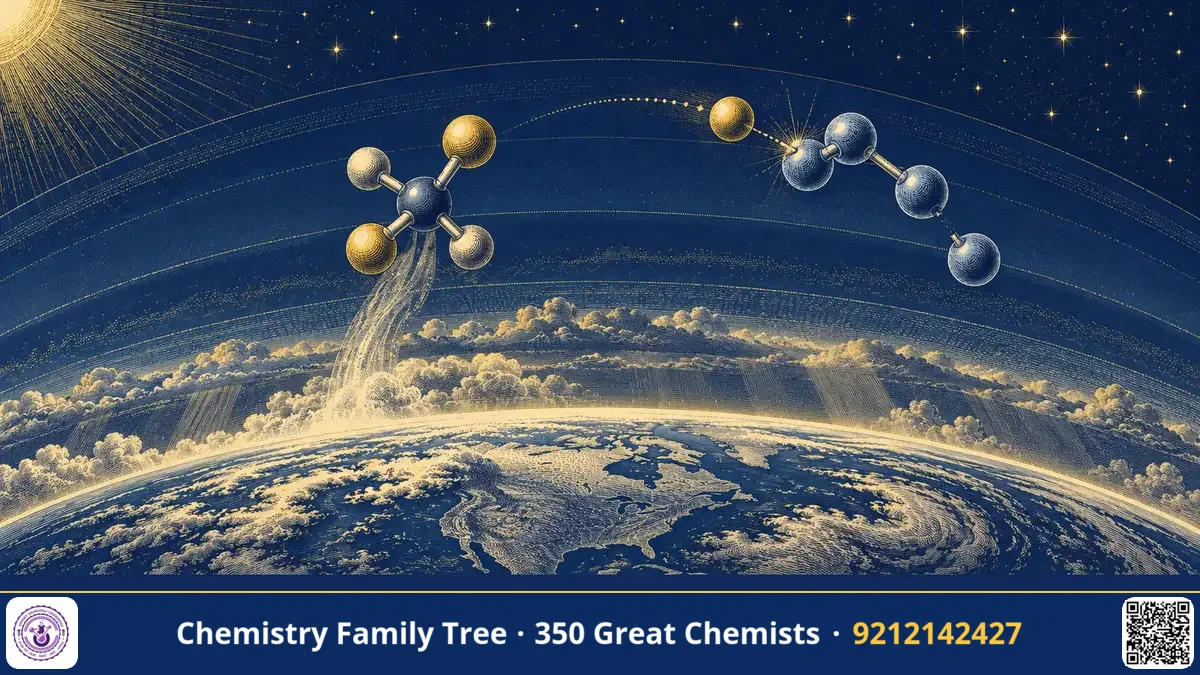
In the 1970s, refrigerators, air conditioners and aerosol spray cans used gases called chlorofluorocarbons, or CFCs. They were non-toxic, non-flammable and cheap, so everyone thought they were perfect. Then, in 1974, a young Mexican chemist, Mario Molina, working with F. Sherwood Rowland at the University of California, Irvine, asked a simple question: where do CFCs go once they are released? Their answer was alarming. CFCs rise to the stratosphere, where sunlight breaks them apart and releases chlorine atoms that destroy the protective ozone layer. This work led to the Montreal Protocol and, in 1995, to the Nobel Prize in Chemistry for Molina, Rowland and Paul Crutzen.
The Scientific Problem Before the Discovery
CFCs such as CFCl3 (CFC-11) and CF2Cl2 (CFC-12) were developed in the 1920s and 1930s by Thomas Midgley Jr. and co-workers as safe refrigerants, replacing toxic gases such as ammonia and sulfur dioxide. They were chemically very stable: they do not burn, do not dissolve in rain and do not react with the usual atmospheric oxidants.
In the early 1970s, James Lovelock built a sensitive electron-capture detector and found CFC-11 in air everywhere, even over the oceans, which showed that CFCs were accumulating in the atmosphere. Lovelock regarded this mainly as a convenient tracer, not a danger. Molina and Rowland asked a different question: if no natural process destroys CFCs near the ground, what eventually does? Without a sink, they would stay in the air for decades.
The Discovery / Experiment — Step by Step
- Check all possible sinks. They examined rain-out, reaction with hydroxyl radicals (OH), ozone, oxygen atoms, absorption by the oceans and photolysis. CFCs did not react with OH, ozone or water in the troposphere. They did not absorb the ultraviolet light that reaches the lower atmosphere (UV above about 290 nm).
- Find the one process that works. In the stratosphere, short-wavelength ultraviolet radiation (below about 220 nm), which is blocked at lower altitudes, can break the C-Cl bond.
CFCl3 + hν (λ less than about 220 nm) → CFCl2 + Cl
CF2Cl2 + hν → CF2Cl + Cl
- Follow the chlorine atom. The released Cl atom attacks ozone in a catalytic cycle:
Cl + O3 → ClO + O2
ClO + O → Cl + O2
-------------------------
Net:   O3 + O → 2 O2
- Estimate the effect. Using the known rate constants, they calculated that one Cl atom could destroy about 100,000 ozone molecules before it is removed, for example by reacting with methane to form HCl:
Cl + CH4 → HCl + CH3. The lifetime of CFC-11 is around 50 years, and that of CFC-12 around 100 years, so the damage would continue for a very long time, even after emissions stop. - Publish. Their paper in Nature in June 1974, titled "Stratospheric sink for chlorofluoromethanes: chlorine atom-catalysed destruction of ozone", predicted ozone loss. At that time there was no observation of damage, so many industry spokespersons and some scientists criticised the work.
The ozone hole (1985) and its chemistry
In 1985, Joseph Farman, Brian Gardiner and Jonathan Shanklin of the British Antarctic Survey reported a large seasonal ozone loss over Antarctica in spring. Gas-phase chlorine chemistry alone could not explain this. Molina and others showed that the answer lies in cold polar stratospheric clouds (PSCs). In the dark Antarctic winter, the air inside a polar vortex falls below about −78 °C. PSC particles form, and chemical reactions occur on their surfaces:
ClONO2 + HCl → Cl2 + HNO3      (on ice surface)
Cl2 + hν (spring sunlight) → 2 Cl
This converts the "reservoir" species HCl and ClONO2 into active chlorine. In 1987, Mario Molina and Luisa Molina proposed the ClO dimer cycle, which works at the low temperature and low oxygen-atom concentration of the polar spring:
ClO + ClO + M → Cl2O2 + M
Cl2O2 + hν → Cl + ClOO
ClOO + M → Cl + O2 + M
2 (Cl + O3 → ClO + O2)
-------------------------
Net:   2 O3 → 3 O2
The Chemistry Behind It
The key ideas are stability, photolysis and catalysis. CFCs are inert near the Earth because their C-F and C-Cl bonds are strong and they have no low-energy absorption. In the stratosphere, short-wavelength UV provides enough energy (the C-Cl bond energy is about 330 kJ/mol). The chlorine atom is a radical, and radical chain reactions are efficient. Finally, "reservoir" species such as HCl and ClONO2 temporarily store chlorine; heterogeneous reactions on cloud surfaces release it.
| Species | Role |
|---|---|
| CFCs, CCl4, CH3CCl3 | Source gases of chlorine |
| Cl, ClO | Active chlorine (catalysts) |
| HCl, ClONO2 | Reservoir species (inactive) |
| PSC particles | Surfaces for heterogeneous reactions |
Applications Today
- Montreal Protocol (1987): a treaty that phased out CFCs, halons and other ozone-depleting substances. It is often called the most successful environmental treaty. India joined in 1992 and phased out CFC production and consumption according to the schedule for developing countries.
- Replacement gases: HCFCs, then HFCs (which do not harm ozone but are strong greenhouse gases), and now low-global-warming alternatives. The Kigali Amendment (2016) controls HFCs.
- Ozone recovery: measurements show that the ozone layer is slowly recovering, with full recovery of the Antarctic hole expected around the middle of this century.
- Air quality: Molina later studied pollution in Mexico City and other megacities, including air pollution in developing countries.
- Policy model: the ozone story is used as a model for how science, industry and governments can act together on climate.
Exam Corner — 5 Likely Points
- CFCs photolyse in the stratosphere (UV below about 220 nm) to give Cl atoms.
- Cl + O3 → ClO + O2; ClO + O → Cl + O2: Cl is a catalyst.
- Reservoir species: HCl and ClONO2; PSCs convert them to active chlorine.
- Ozone hole: Antarctic spring, cold polar vortex, ClO dimer cycle; net 2O3 → 3O2.
- Montreal Protocol 1987; Kigali Amendment 2016 for HFCs.
Common Misconceptions
- "CFCs are heavier than air, so they cannot reach the stratosphere." Atmospheric mixing is strong, and CFCs are carried up by air currents. Measurements confirm them at high altitude.
- "The ozone hole is a hole in the sky." It is a region of strongly reduced ozone concentration, not an empty space.
- "The ozone hole causes global warming." They are separate problems, though CFCs are also greenhouse gases.
Quick Revision Box
- 1974: Molina and Rowland link CFCs to chlorine-catalysed ozone loss.
- One Cl atom can destroy about 105 ozone molecules.
- 1985: Antarctic ozone hole reported by Farman, Gardiner and Shanklin.
- Polar stratospheric clouds allow heterogeneous reactions that free chlorine.
- Montreal Protocol (1987) phased out ozone-depleting substances.
- Nobel Prize in Chemistry 1995: Crutzen, Molina, Rowland.
FAQ
Why are CFCs so stable in the lower atmosphere?
The C-F and C-Cl bonds are strong, and CFCs do not absorb the UV light that reaches the lower atmosphere, nor do they dissolve in water or react with OH radicals.
Which part of the atmosphere is the ozone layer in?
Mainly the stratosphere, between about 15 and 35 km above the ground.
Is the ozone hole healing?
Yes, slowly. Since the ban, the concentrations of CFCs have declined, and ozone is gradually recovering, although CFCs live for decades, so the process is slow.
Who is Luisa Molina?
She is a chemist and Mario Molina's wife, who worked with him on air pollution and collaborated on atmospheric chemistry research.
Published by ABC Chemistry — IIT-JAM | CSIR-NET | GATE Chemistry Coaching. Visit abcchemistry.com

About the chemist
Mario Molina
1943-2020 · Mexico/United States · Nobel Chemistry 1995
CFC depletion of stratospheric ozone