The discovery, explained · Chemist no. 259 of 350
Markovnikov's Rule: Why the Hydrogen Goes Where the Hydrogens Are
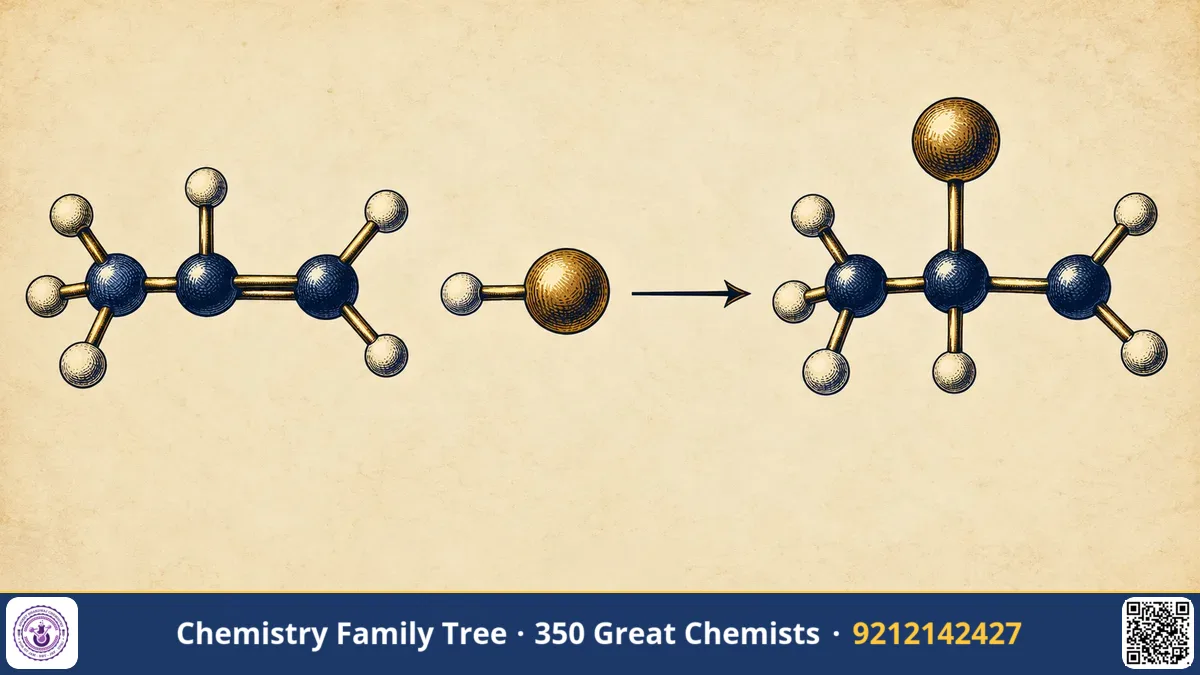
Every student of organic chemistry meets this rule early: when HBr adds to propene, the product is 2-bromopropane, not 1-bromopropane. This is Markovnikov's rule, named after the Russian chemist Vladimir Vasilyevich Markovnikov, who stated it in 1869. In its first form it says that when an unsymmetrical reagent HX adds to an unsymmetrical alkene, the hydrogen goes to the carbon that already has more hydrogen atoms. Today we explain it using carbocation stability, but Markovnikov found it purely by observation and experiments, years before electrons were known. This post covers the rule, the mechanism, exceptions and exam points.
The Scientific Problem Before the Discovery
By the 1860s, Butlerov's structural theory had shown that isomers exist and that structure fixes properties. A natural question was: when an alkene like propene (CH₃–CH=CH₂) reacts with HX, two products are possible, CH₃CHXCH₃ and CH₃CH₂CH₂X. Which one forms? Do both form equally? Chemists had examples, but no general rule. For synthesis, a rule was needed in order to predict the product and plan a route.
The Discovery: What Markovnikov Did
Markovnikov, a student of Butlerov in Kazan, studied the addition of hydrogen halides to alkenes and the elimination of halogen acids from alkyl halides. He gathered examples and in 1869 he published the rule in a paper on the mutual influence of atoms in chemical compounds. He compared many additions and found a regular pattern.
Statement of the rule (modern form): In the addition of HX to an unsymmetrical alkene, the negative part (X) attaches to the carbon atom with the fewer hydrogen atoms (the more substituted carbon), and the hydrogen attaches to the carbon with more hydrogen atoms.
CH3–CH=CH2 + HBr → CH3–CHBr–CH3      (2-bromopropane, major)
(CH3)2C=CH2 + HCl → (CH3)3C–Cl        (tert-butyl chloride)
CH3–CH=CH2 + H2O (H+) → CH3–CH(OH)–CH3  (propan-2-ol)
The Chemistry Behind It
The modern explanation is the mechanism of electrophilic addition, with a carbocation intermediate. Taking propene and HBr:
- Step 1 (slow): The π electrons of the double bond attack the H of HBr (the electrophile). H bonds to one carbon, and a carbocation forms on the other. Two carbocations are possible: the secondary CH₃–CH⁺–CH₃ (H adds to terminal carbon) or the primary CH₃–CH₂–CH₂⁺ (H adds to middle carbon).
- The secondary carbocation is more stable, because of +I effect and hyperconjugation from the methyl groups. The order of stability is: 3° > 2° > 1° > methyl. So the secondary one forms faster.
- Step 2 (fast): Bromide ion attacks the carbocation, giving 2-bromopropane.
This is why the modern statement of the rule is: the electrophile adds so as to give the more stable carbocation. The rule also works for hydration (acid catalysed addition of water), hydrohalogenation and addition of HOCl (where Cl is the electrophile positive part and OH goes to the more substituted carbon).
Rearrangements: Because carbocations are intermediates, they can rearrange. For 3-methylbut-1-ene with HCl, the secondary carbocation shifts a hydride to form a tertiary carbocation, and the major product is 2-chloro-2-methylbutane. This is a favourite exam question.
Anti-Markovnikov addition (peroxide or Kharasch effect): In 1933 Kharasch and Mayo showed that in the presence of peroxides, HBr (but not HCl or HI) adds in the opposite sense. The reaction goes by a free-radical chain mechanism, in which Br• adds first to give the more stable (secondary or tertiary) radical:
CH3–CH=CH2 + HBr --(R–O–O–R)--> CH3–CH2–CH2Br (1-bromopropane)
HCl does not show this because the H–Cl bond is too strong for the chain step, and HI does not because the iodine radical adds to the alkene too slowly or reversibly. Another important route: hydroboration-oxidation gives anti-Markovnikov alcohols (propene gives propan-1-ol), but by a different, concerted syn-addition mechanism, while oxymercuration-demercuration gives Markovnikov alcohols without rearrangement.
Applications Today
- Industrial alcohols: Hydration of propene to isopropanol follows Markovnikov's rule. Isopropanol is used as a disinfectant and sanitiser; its use grew greatly during the COVID-19 period.
- Synthesis planning: Chemists use the rule to plan routes to alkyl halides, alcohols and ethers.
- Petrochemicals: Acid-catalysed additions to isobutene produce tert-butyl ethers and other compounds used in fuel additives.
- Pharmaceuticals: Many drug intermediates are made by regioselective additions to alkenes, and the same logic works in Indian pharmaceutical process chemistry.
- Polymers: Cationic polymerisation of isobutene to polyisobutylene (used in butyl rubber) follows the stability of tertiary carbocations.
Exam Corner
- HBr + propene gives 2-bromopropane (Markovnikov); with peroxide gives 1-bromopropane (anti-Markovnikov).
- Peroxide effect works only for HBr.
- Carbocation stability: 3° > 2° > 1° > CH₃⁺.
- Hydroboration-oxidation: anti-Markovnikov, syn addition, no rearrangement. Oxymercuration: Markovnikov, no rearrangement.
- Symmetrical alkenes such as ethene or but-2-ene do not show the regiochemistry question.
Common Misconceptions
- "The rule says the halogen goes to the carbon with more hydrogens." It is opposite: hydrogen goes to the carbon with more hydrogens ("the rich get richer").
- "Peroxides reverse all HX additions." Only HBr.
- "Markovnikov explained it by carbocations." He stated it empirically; the carbocation explanation came in the 20th century.
Quick Revision Box
- Rule published 1869 by V. V. Markovnikov.
- H adds to the carbon with more H; X to the carbon with fewer H.
- Reason: more stable carbocation intermediate.
- Peroxide (Kharasch) effect: anti-Markovnikov only with HBr, radical mechanism.
- Rearrangements possible in carbocation pathway.
- Oxymercuration is Markovnikov; hydroboration is anti-Markovnikov.
FAQ
What is Markovnikov's rule in simple words?
When HX adds to an unsymmetrical alkene, the hydrogen goes to the carbon that already has more hydrogens.
Why does the rule work?
Because the reaction goes through the most stable carbocation, which is the more substituted one.
What is the peroxide effect?
In the presence of peroxides, HBr adds to alkenes in an anti-Markovnikov way through a free-radical chain mechanism.
Does the rule apply to ethene?
Ethene is symmetrical, so only one product is possible, and the rule is not needed.
Published by ABC Chemistry — IIT-JAM | CSIR-NET | GATE Chemistry Coaching. Visit abcchemistry.com
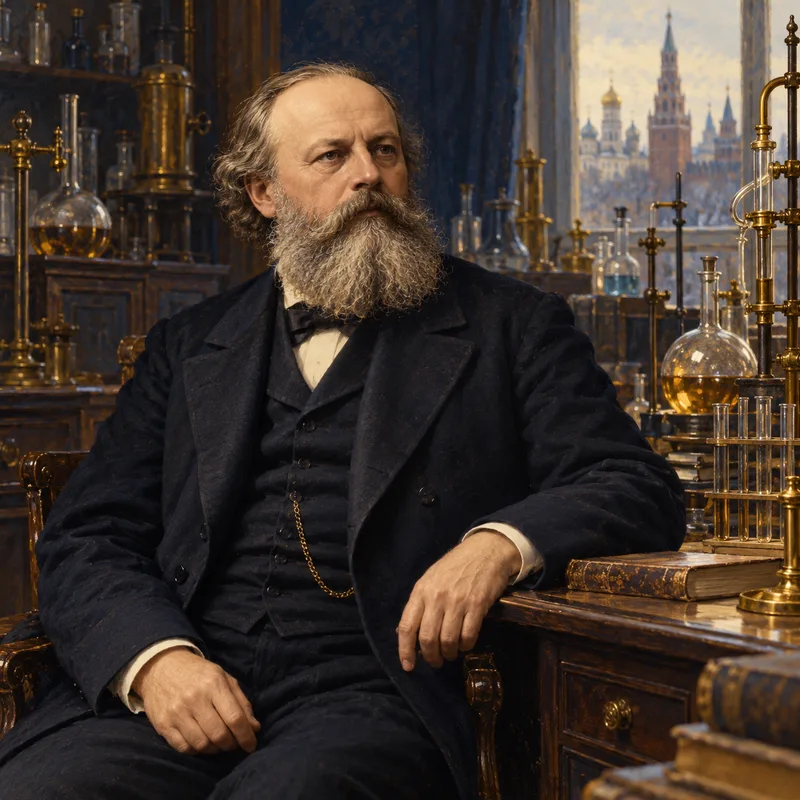
About the chemist
Vladimir Markovnikov
1838-1904 · Russia
Markovnikov's rule