Biography · Chemist no. 259 of 350
Vladimir Vasilyevich Markovnikov (1838-1904): The Chemist Behind a Famous Rule
Introduction
Vladimir Vasilyevich Markovnikov was a Russian organic chemist and professor at Kazan, Odessa and Moscow. He is known to every chemistry student for Markovnikov's rule on addition to alkenes, and he also made pioneering studies of the chemistry of petroleum, discovering a new class of hydrocarbons in Caucasian oil. His legacy in one line: he found the pattern that tells us where atoms add to a double bond, and he opened up the chemistry of oil.
Early Life and Family
Markovnikov was born on 25 December 1837 (Old Style; 6 January 1838 New Style) in the village of Knyaginino in the Nizhny Novgorod governorate. His father was an army officer from a family of the minor nobility. The boy first studied at the Nizhny Novgorod Noble Institute, where he showed an early talent for study. His father died when he was young, and the family faced money problems, but he continued his education and attended Kazan University.
Education and Mentors
He entered Kazan University in 1856 and studied under Alexander Butlerov, the founder of the theory of chemical structure, who became his closest mentor. Markovnikov was a model student, and he finished in 1860. He remained at Kazan as Butlerov's assistant. Butlerov sent him abroad to study; between 1865 and 1867 he worked in Germany in the laboratories of Hermann Kolbe in Leipzig, Emil Erlenmeyer in Heidelberg and Adolf von Baeyer in Berlin. This gave him wide training in German methods, but he always kept faith in Butlerov's structural ideas.
Career Timeline
| Year | Event |
|---|---|
| 1838 | Born in Knyaginino, Nizhny Novgorod governorate |
| 1860 | Graduated from Kazan University |
| 1865-67 | Studied in Germany (Leipzig, Heidelberg, Berlin) |
| 1865 | Defended his master's thesis on isomerism of organic acids |
| 1869 | Stated the rule on addition to alkenes; doctoral thesis on mutual influence of atoms |
| 1871 | Moved from Kazan to Odessa |
| 1873 | Professor at Moscow University |
| 1880s | Studied Caucasian (Baku) petroleum and identified naphthenes |
| 1893 | Left Moscow University after a conflict with the administration |
| 1904 | Died in Moscow, 11 February |
Major Scientific Contributions
- Markovnikov's rule (1869): The regiochemistry of addition of HX to unsymmetrical alkenes. See our discovery blog for mechanism and exceptions.
- Naphthenes: In studies of Caucasian oil he found cyclic saturated hydrocarbons, which he named "naphthenes" (today cycloalkanes), such as cyclohexane and its homologues.
- Petroleum chemistry: He proposed that Baku oil differs in composition from American oil, and his work supported the growth of the Russian oil industry.
- Isomerism and mutual influence of atoms: In 1869 he published a major theoretical work on the mutual influence of atoms in molecules. This idea develops Butlerov's theory and predicts how substituents affect reactivity, a forerunner of modern electronic effects.
- Elimination: He also studied the elimination of HX from alkyl halides, parallel to the rule discovered by his student Zaitsev.
Awards, Honours and Nobel Prize
Markovnikov was a respected member of the Russian Chemical Society and a professor at three major universities. His greatest honour is that his rule carries his name in every organic chemistry textbook in the world. He did not receive a Nobel Prize; the first prizes were awarded in 1901, when he was already in his sixties.
Personality, Struggles and Lesser-Known Facts
- His rule was little noticed outside Russia at first. It was published in a Russian-language paper in 1869 and then spread through a German paper in 1870.
- He was a loyal student of Butlerov and defended the structural theory against critics, even when this cost him support.
- He was independent and outspoken, and he left Kazan for Odessa in 1871.
- In 1893 he left Moscow University after a conflict with the administration, an act seen by many as a defence of academic freedom.
- He insisted on laboratory teaching and trained many chemists who became professors in Russia, among them Nikolay Kizhner, famous for the Wolff-Kishner reduction.
Legacy and Influence on Modern Chemistry
The rule that carries his name is among the first ideas on regioselectivity. In the 20th century, Ingold, Hughes and others explained it with carbocation theory, and later Kharasch added the peroxide effect, bringing a more complete picture. In India, any Class 11 or Class 12 student who studies hydrocarbons meets his rule, and JAM, NET and GATE papers frequently ask about regioselectivity of additions, hydroboration, oxymercuration and carbocation rearrangements. His petroleum work is also the beginning of understanding cycloalkane content in crude oil, which is important for refining in places like Jamnagar and Mathura.
Markovnikov's Rule in Exam Preparation
A quick way for students to apply the rule is to ask which carbon becomes the better carbocation. For propene plus HBr, the secondary cation gives 2-bromopropane. For 2-methylpropene plus HCl, the tertiary cation gives tert-butyl chloride. Remember the three exceptions that examiners love: the peroxide effect with HBr gives the anti-Markovnikov product through free radicals, hydroboration-oxidation gives the anti-Markovnikov alcohol without any carbocation, and oxymercuration-demercuration gives the Markovnikov alcohol without rearrangement. Linking these to the history of the rule makes them easier to remember.
Lessons for Students
- Look for patterns in your data. Markovnikov collected many examples and saw the rule.
- Build on your teachers' ideas and extend them with your own experiments.
- Stand for principles. He left his post rather than accept what he considered unjust.
- Chemistry has practical roots. His oil studies served industry.
- Publish widely. Language barriers slowed recognition of his rule.
Quick Facts Box
- Born: 25 December 1837 (O.S.) / 6 January 1838, Knyaginino, Russia
- Died: 11 February 1904, Moscow
- Nationality: Russian
- Field: Organic chemistry; petroleum chemistry
- Famous for: Markovnikov's rule; naphthenes
- Nobel Prize: None
FAQ
Who was Markovnikov's teacher?
Alexander Butlerov at Kazan University.
What did Markovnikov discover in petroleum?
He identified naphthenes, cyclic saturated hydrocarbons, in Caucasian oil.
When was Markovnikov's rule published?
In 1869, with a German version following in 1870.
Which famous Russian chemist studied under Markovnikov?
Nikolay Kizhner, known for the Wolff-Kishner reduction, was among his students.
Published by ABC Chemistry — IIT-JAM | CSIR-NET | GATE Chemistry Coaching. Visit abcchemistry.com
About the chemist
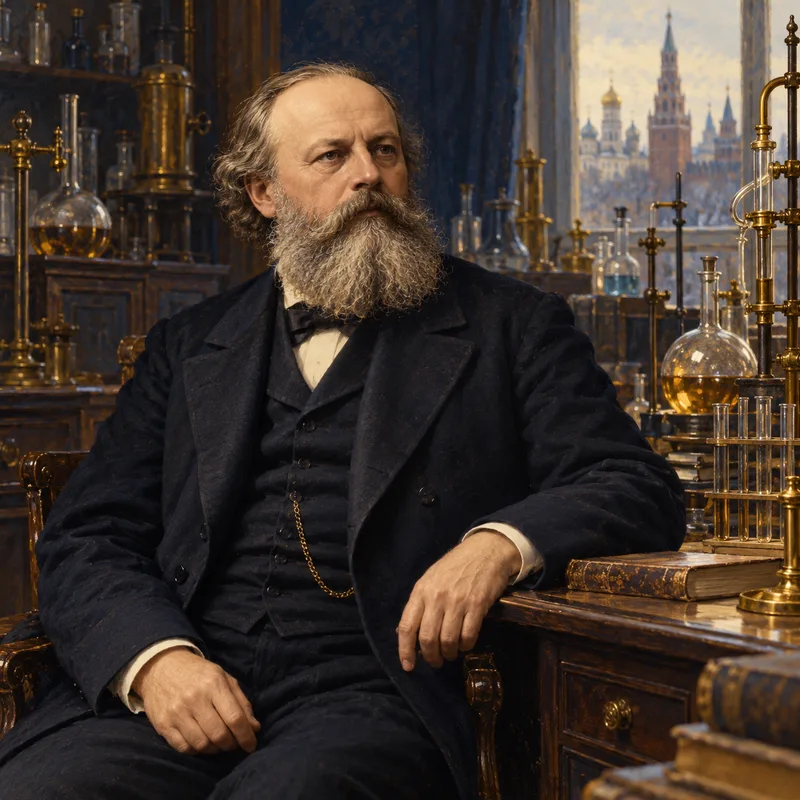
Vladimir Markovnikov
1838-1904 · Russia
Markovnikov's rule