Biography · Chemist no. 240 of 350
Martin Heinrich Klaproth: From Apothecary's Apprentice to Berlin's First Chemistry Professor
Martin Heinrich Klaproth (1743–1817) was a German chemist who became the leading mineral analyst of his age. Starting as an apothecary's apprentice, he went on to discover uranium and zirconium, to name titanium and tellurium, and to be appointed the first professor of chemistry at the new University of Berlin. His one-line legacy: he taught chemists to weigh everything, report honestly and trust the balance.
Early Life and Family
He was born on 1 December 1743 in Wernigerode, a town in the Harz Mountains of Germany. His father was a tailor, and the family was not well off. He attended the local Latin school but had to leave early to earn a living. Records of his early years are sparse, and the details are limited to this outline.
Education and Mentors
At sixteen he began an apothecary apprenticeship in Quedlinburg. He then worked as an assistant in pharmacies in Hanover, Berlin and Danzig (Gdańsk). In Berlin he worked in the pharmacy of Valentin Rose, where he came into contact with the chemist Andreas Sigismund Marggraf, who had discovered sugar in beet and was the leading German chemist of the time. Marggraf's attention to quantitative analysis and use of the microscope was a major influence. After Rose's death in 1771, Klaproth took over the management of the pharmacy and later became its owner, using the profits to fund his laboratory work. He had no university degree in chemistry; his training was entirely practical.
Career Timeline
| Year | Event |
|---|---|
| 1743 | Born in Wernigerode. |
| 1759 | Begins apothecary training in Quedlinburg. |
| 1766–1771 | Works in pharmacies in Hanover, Berlin and Danzig. |
| 1771 | Takes over the Rose pharmacy in Berlin after Valentin Rose's death. |
| 1780 | Opens his own pharmacy in Berlin and publishes mineral analyses. |
| 1788 | Becomes a member of the Berlin Academy of Sciences. |
| 1789 | Discovers uranium and zirconium. |
| 1795 | Names titanium after confirming Gregor's discovery. |
| 1798 | Names tellurium. |
| 1803 | Identifies cerium oxide (independently of Berzelius and Hisinger). |
| 1810 | Appointed the first professor of chemistry at the newly founded University of Berlin. |
| 1817 | Dies in Berlin on 1 January. |
Major Scientific Contributions
- Uranium (1789): from pitchblende, named after Uranus; details in our discovery blog.
- Zirconium (1789): found as the oxide zirconia in zircon from Ceylon.
- Naming titanium and tellurium: confirming the discoveries of Gregor and Müller von Reichenstein.
- Cerium (1803): identified at about the same time as Berzelius and Hisinger.
- Other minerals: he analysed a very large number of minerals and published the results in his multi-volume Beiträge zur chemischen Kenntniss der Mineralkörper, which became a standard reference.
- Analytical method: he introduced systematic habits, such as drying precipitates to constant weight, reporting the percentage of each constituent, and accounting for the total, even when it did not reach 100%.
- Supporting Lavoisier: in Germany he helped to test and spread the new oxygen-based chemistry.
Awards, Honours and Nobel Prize
Nobel Prizes did not exist in his lifetime. His honours came as memberships and posts: he was a member of the Prussian Academy of Sciences in Berlin and of other learned societies in Europe, and his appointment in 1810 as the first professor of chemistry at the new University of Berlin was the peak of his career. The mineral klaprothite and the Klaproth name in scholarly literature recall him, but the main honour is the lasting use of his analytical standards.
Personality, Struggles and Lesser-Known Facts
- A scrupulous experimenter. He reported failures and discrepancies as well as successes. Many later chemists praised his honesty in listing losses in an analysis.
- Late to academic life. He became a professor at 66. For most of his career, he was a practising apothecary who did science in his spare time.
- Not a theorist. He tended to avoid speculation, preferring to give the analysis and let others generalise.
- Supporter of new ideas. He was among the first German chemists to publicly test Lavoisier's claims and confirm them with his own experiments, which helped to end the phlogiston era in Germany.
- Broad interests. He analysed ancient coins and glass, studying their composition, which was an early contribution to archaeological chemistry.
- Passing of the torch. His son Heinrich Julius Klaproth became a well-known orientalist, a scholar of Asian languages, in his own right.
Legacy and Influence on Modern Chemistry
Uranium became the key element of nuclear science after the discoveries of Becquerel, the Curies and Hahn, and today it fuels reactors, including those operated in India. Zirconium alloys protect nuclear fuel rods, and titanium is a modern structural metal. In addition, the habit of full mass balance, of reporting sum totals and being open about errors, is one of the foundations of analytical chemistry, and it is still a requirement of good laboratory practice. The University of Berlin that he served became one of the leading chemistry schools in the world within a few decades.
Lessons for Students
- Weigh and record everything. Missing mass often points to a discovery or an error.
- Honesty builds trust. Report what you actually observed.
- It is never too late. His professorship came late, after decades of careful work.
- Name with care. Naming an element after a planet, a Titan or a goddess connected chemistry to wider culture.
Quick Facts Box
- Born: 1 December 1743, Wernigerode, Germany
- Died: 1 January 1817, Berlin
- Nationality: German (Prussian)
- Field: Analytical chemistry, mineralogy
- Famous for: Uranium, zirconium, naming of titanium and tellurium
- Nobel Prize: None (pre-dates the prize)
FAQ
Did Klaproth discover radioactivity?
No. He discovered uranium as an element, but radioactivity was found by Becquerel in 1896.
Why is he called a father of analytical chemistry?
Because he established careful quantitative mineral analysis with complete accounting of constituents.
Who was Marggraf?
Andreas Sigismund Marggraf was an influential Berlin chemist who discovered sugar in beet and taught Klaproth the importance of precise analysis.
Which elements did he name?
He named uranium, zirconium (in the sense of discovering its oxide), titanium, tellurium and cerium.
Published by ABC Chemistry — IIT-JAM | CSIR-NET | GATE Chemistry Coaching. Visit abcchemistry.com
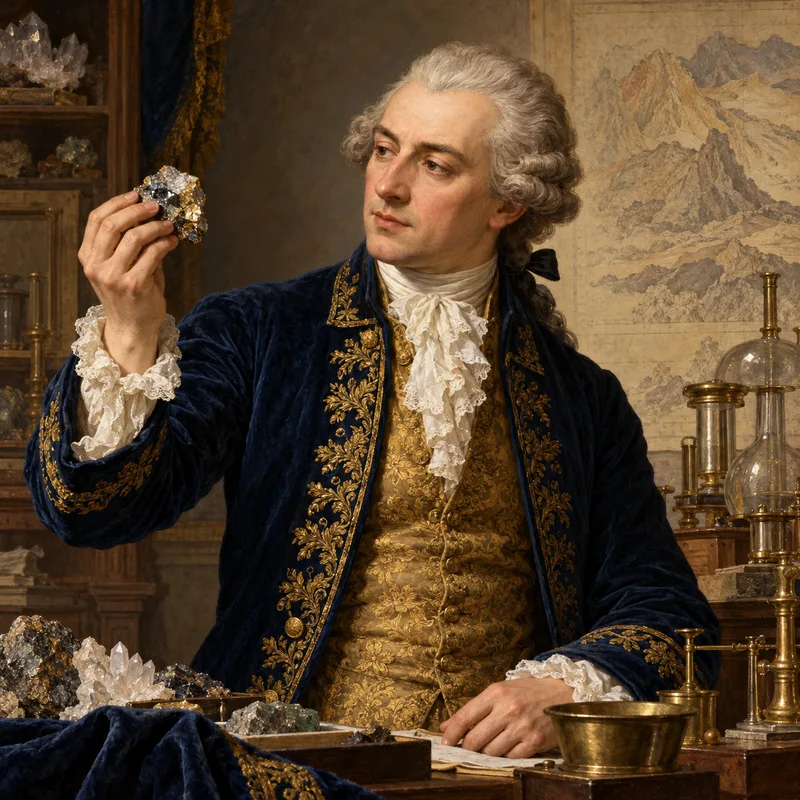
About the chemist
Martin Heinrich Klaproth
1743-1817 · Germany
Discovered uranium and zirconium