The discovery, explained · Chemist no. 240 of 350
Martin Heinrich Klaproth: The Analyst Who Found Uranium
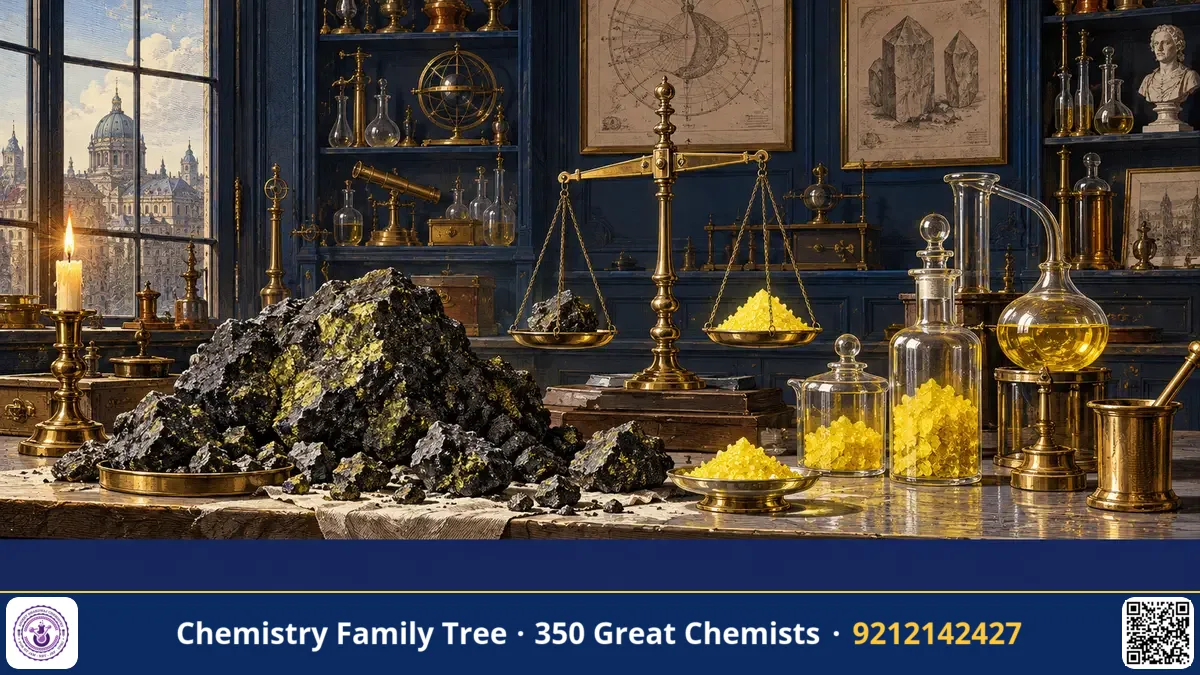
In 1789, a German analytical chemist in Berlin dissolved a heavy black mineral from the silver mines of Saxony in acid and found, to his surprise, that it contained a new metal. He named it uranium, after the planet Uranus, discovered only eight years earlier. The chemist was Martin Heinrich Klaproth. Uranium would later become central to radioactivity, nuclear fission and nuclear power, though Klaproth himself knew nothing of that. He also identified zirconium, characterised titanium and cerium, and set high standards for quantitative analysis. In this post we trace his methods and what they mean for chemistry students today.
The Scientific Problem Before the Discovery
By the 1780s, Lavoisier's definition of elements had made chemists eager to find out which minerals contained unknown substances. The analytical procedure was to dissolve a mineral, precipitate components one by one and weigh each. But the totals often did not add up to 100%, and chemists were not always careful about this. A dense black mineral called pitchblende (from German Pechblende) from the mines of Johanngeorgenstadt in Saxony was thought to be a mixture of iron, zinc and tungsten ores. Another mineral, the jargon of Ceylon (now Sri Lanka), was thought to contain only known earths. Klaproth wanted to resolve these by accurate analysis.
The Discovery: Step by Step
Step 1: Dissolving pitchblende (1789)
Klaproth dissolved pitchblende in nitric acid. This gave a yellow solution. Neutralising the solution with alkali gave a yellow precipitate, which was not like any known compound:
U₃O₈ + 8HNO₃ → 3UO₂(NO₃)₂ + 2NO₂ + 4H₂O (balanced form of oxidation to the uranyl ion)
He considered the yellow precipitate (a diuranate) to be the oxide of a new metal.
Step 2: Trying to get the metal
He heated the yellow oxide with charcoal and obtained a black powder that he believed was the metal. He named it uranium in 1789, after Uranus (found by William Herschel in 1781). In fact, what he had obtained was uranium dioxide (UO₂), not the metal. The pure metal was isolated in 1841 by the French chemist Eugène-Melchior Péligot, who reduced uranium tetrachloride with potassium: UCl₄ + 4K → U + 4KCl.
Step 3: Zirconium (1789)
The same year, he analysed the gem zircon (or jargon) from Ceylon and found a new "earth" that was neither alumina nor lime. This was zirconia, ZrO₂. The element zirconium (from the Arabic or Persian word zargun, gold-coloured) was isolated as the metal in 1824 by Berzelius.
Step 4: Titanium and cerium
In 1795 he examined rutile and confirmed that it contained the same metal as the one William Gregor had found in 1791 in Cornwall, and he named it titanium, after the Titans of Greek myth. In 1803 he identified cerium oxide in a heavy mineral from Bastnäs in Sweden at the same time as Berzelius and Hisinger (who worked independently). He named it after the asteroid Ceres. He also did important work on tellurium, which Franz-Joseph Müller von Reichenstein had found in 1782; Klaproth confirmed it and gave it its name in 1798, from the Latin tellus, earth.
The Chemistry Behind It
- Uranium: atomic number 92, [Rn] 5f³ 6d¹ 7s², an actinoid. Most common oxidation states are +4 and +6. In water, uranium(VI) exists as the yellow uranyl ion UO₂²⁺.
- Diuranate precipitation: 2UO₂²⁺ + 6OH⁻ + 2Na⁺ → Na₂U₂O₇ + 3H₂O. This is the "yellow cake" type of precipitate, named after the colour of the compound.
- Zirconium: Group 4, [Kr] 4d² 5s². Zr and Hf have nearly identical radii due to the lanthanoid contraction, so they are extremely hard to separate. This is a very common exam point.
- Titanium: TiO₂ is the white pigment used in paints. Ti has a strong affinity for oxygen, so it is made by the Kroll process: TiCl₄ + 2Mg → Ti + 2MgCl₂.
- Radioactivity: uranium-238 decays with a half-life of about 4.5 × 10⁹ years: ²³⁸U → ²³⁴Th + ⁴He. In 1896 Becquerel discovered radioactivity in uranium salts, and in 1938 Hahn and Strassmann discovered fission in Berlin, in the same city where Klaproth worked.
Applications Today
Uranium-235, about 0.72% of natural uranium, is the fuel for nuclear reactors, including India's pressurised heavy water reactors, which use natural uranium oxide. The country's uranium mines include Jaduguda in Jharkhand. Zirconium alloys (zircaloy) are used for cladding nuclear fuel because they absorb few neutrons and resist corrosion. Titanium is used in aircraft, implants and sports equipment; TiO₂ is in paints, sunscreens and as a photocatalyst. Cerium compounds serve as catalysts in car exhausts and as polishing powders for glass; ceric ammonium sulfate is a common oxidising titrant in volumetric analysis. Klaproth's careful gravimetric methods are an ancestor of modern analytical chemistry, including the analysis of ores for trade and taxation.
Exam Corner
- Uranium was discovered by Klaproth in 1789 in pitchblende and named after Uranus. The metal was isolated by Péligot in 1841.
- Klaproth named titanium (1795) and tellurium (1798), and discovered zirconium (1789) and cerium (1803, with Berzelius and Hisinger).
- Zr and Hf are nearly identical in size because of lanthanoid contraction, so they occur together and are hard to separate.
- Uranyl ion UO₂²⁺ is yellow; U is an actinoid with 5f electrons; natural uranium is 99.27% U-238 and 0.72% U-235.
- Kroll process: TiCl₄ + 2Mg → Ti + 2MgCl₂ under inert atmosphere.
Common Misconceptions
- "Klaproth isolated uranium metal." He obtained the oxide; the metal came in 1841.
- "Uranium was always known as radioactive." Radioactivity was found in 1896. Klaproth's discovery was purely chemical.
- "Klaproth discovered titanium." Gregor found it first in 1791; Klaproth rediscovered it and named it.
Quick Revision Box
- Klaproth (1743–1817): German analytical chemist in Berlin.
- Uranium (1789) from pitchblende; named after Uranus.
- Zirconium (1789) from zircon; titanium named 1795; tellurium named 1798.
- Uranium metal isolated by Péligot, 1841.
- Zr/Hf similarity: lanthanoid contraction.
- Insisted on weighing everything and reporting the totals, including losses.
FAQ
Why uranium?
Klaproth named it after Uranus, discovered in 1781, in the same spirit as other planet-themed names such as cerium (from the asteroid Ceres).
Was Klaproth a pharmacist?
Yes. He trained as an apothecary and later became a professor of chemistry in Berlin.
Did he know about radioactivity?
No. Radioactivity was discovered by Becquerel in 1896.
Is "yellow cake" connected to his work?
The name now refers to uranium concentrate (mostly U₃O₈ or diuranates), which has a link with the yellow diuranate he first precipitated.
Published by ABC Chemistry — IIT-JAM | CSIR-NET | GATE Chemistry Coaching. Visit abcchemistry.com
About the chemist
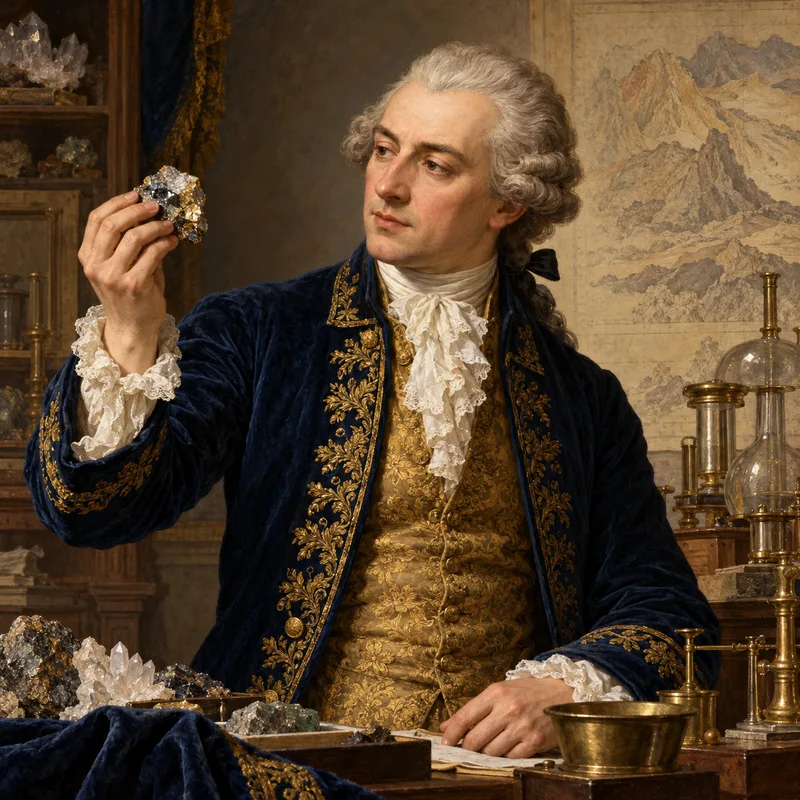
Martin Heinrich Klaproth
1743-1817 · Germany
Discovered uranium and zirconium