Biography · Chemist no. 197 of 350
Martin Karplus (1930-2024): Refugee, Theoretician and Pioneer of Computational Chemistry
Introduction
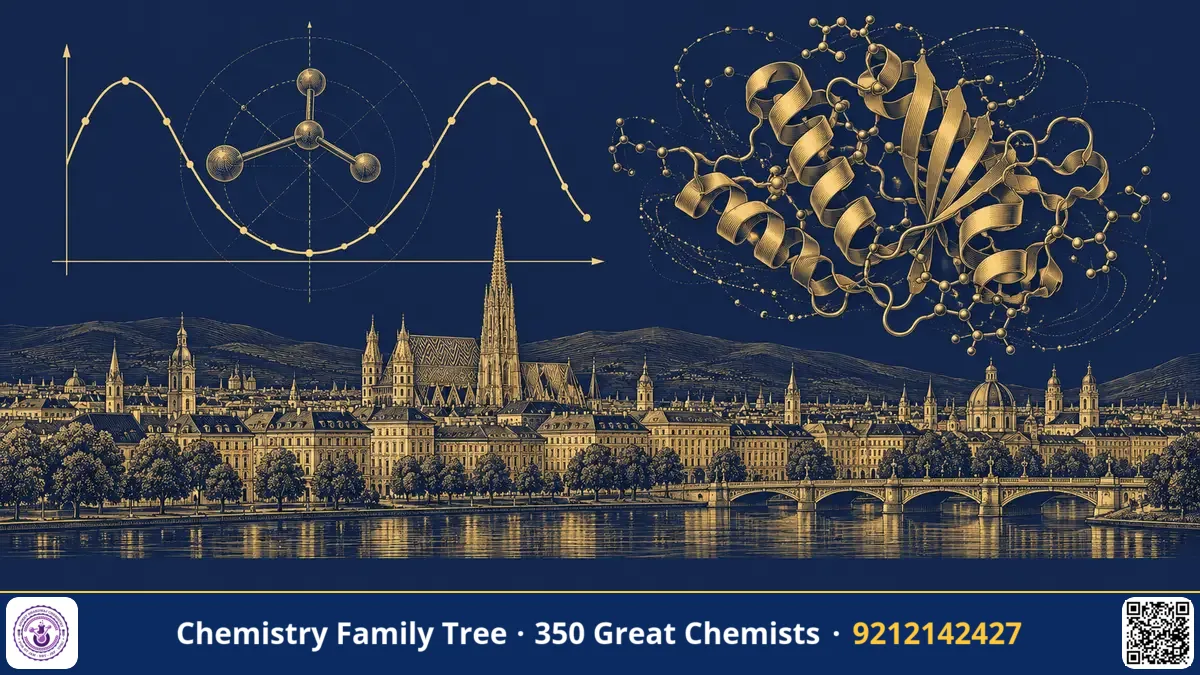
Martin Karplus was an Austrian-American theoretical chemist who spent most of his career at Harvard University. His name is attached to one of the best-known equations in NMR spectroscopy, but his greatest influence lies in computer simulation of molecules, especially proteins. In 2013 he shared the Nobel Prize in Chemistry with Michael Levitt and Arieh Warshel for multiscale models of complex chemical systems. His life, which began in Vienna and was reshaped by the Second World War, shows how theory and computing can transform the way chemists see molecules.
Early Life and Family
Karplus was born on 15 March 1930 in Vienna, Austria, into a Jewish family. His father, Hans Karplus, was a physician and his mother, Ethel Pollack, came from a family involved in business. His grandfather was a leading neurologist. In March 1938 Germany annexed Austria, and his family had to flee, losing their home and property. The Karplus family left through Switzerland, and in 1938 they reached the United States. He grew up in the Boston area and has said that he developed an early love of science, spending time as a boy with simple experiments and with collecting items from nature, and later in life with painting and mountain walking.
Education and Mentors
Karplus attended Harvard College, graduating in 1950 with a degree in chemistry and physics. He moved to the California Institute of Technology (Caltech) for graduate work, where he earned his PhD in 1953 under the famous chemist Linus Pauling, who won the 1954 Chemistry Nobel Prize and the 1962 Peace Prize. Pauling's emphasis on chemical bonding and structure influenced him greatly, though Karplus was more drawn to mathematics and quantum theory. He then went to the University of Oxford as a postdoctoral fellow, working with Charles Coulson, the theoretical chemist, from 1953 to 1955.
Career Timeline
| Year | Event |
|---|---|
| 1930 | Born in Vienna, Austria |
| 1938 | Family flees after the Anschluss and reaches the USA |
| 1950 | Graduated from Harvard College |
| 1953 | PhD at Caltech under Linus Pauling |
| 1953-1955 | Postdoctoral work at Oxford with Charles Coulson |
| 1955-1960 | Assistant professor at the University of Illinois |
| 1959 | Published the Karplus equation |
| 1960-1966 | Columbia University |
| 1966 | Moved to Harvard University |
| 1977 | First molecular dynamics simulation of a protein (BPTI) with McCammon and Gelin |
| 2013 | Nobel Prize in Chemistry |
| 2024 | Died on 28 December in Brookline, Massachusetts |
Major Scientific Contributions
Karplus's early work dealt with electron spin resonance and NMR theory, and with theory of chemical reactivity. His most famous early result was the Karplus equation (1959), which relates the proton-proton coupling constant over three bonds to the dihedral angle. From 1966 at Harvard he turned toward biology. With his students and collaborators, he used the computer to simulate protein dynamics and developed the CHARMM program. He also contributed to the theory of protein folding, the mechanism of hemoglobin and the study of the vision pigment retinal. In the 1970s his work with Warshel on hybrid quantum-classical approaches contributed to QM/MM, which was later developed also by Levitt and Warshel. For a fuller explanation, read our companion discovery post.
Awards, Honours and Nobel Prize
- Nobel Prize in Chemistry 2013, shared with Michael Levitt and Arieh Warshel, "for the development of multiscale models for complex chemical systems".
- Membership of the US National Academy of Sciences and the American Academy of Arts and Sciences.
- Long-time Theodore William Richards Professor of Chemistry at Harvard, and a professor at the University of Strasbourg, where he led a laboratory of biophysical chemistry.
Personality, Struggles and Lesser-Known Facts
- A refugee child. He fled Vienna as a boy of eight, and he later said that this experience shaped his view of how fragile civilisation can be.
- Pauling's student. He studied under one of the greatest chemists of the century, yet moved toward his own interests in theory and computing.
- Computers as a new microscope. He argued that simulation could show motions that no experiment could capture in real time.
- Two homes. He divided his time between Harvard in the USA and the University of Strasbourg in France, and he also held French affiliations.
- Credit to a community. After the Nobel announcement he emphasised that the award recognised a whole community of researchers working on simulation.
Legacy and Influence on Modern Chemistry
Karplus's equation remains a daily tool for NMR spectroscopists. His CHARMM program and the idea of molecular dynamics of proteins created a field now called computational biophysics. Present-day drug discovery, enzyme design and protein engineering rely on methods that grew from his group. The students and postdocs who trained with him, including J. Andrew McCammon, went on to lead major research programs. The Nobel committee noted that computers now stand alongside test tubes as essential instruments in chemistry.
Lessons for Students
- Combine physics and chemistry. Karplus's strength lay in using quantum mechanics to answer chemical questions.
- Be ready to change fields. He moved from NMR theory to biological simulation in mid-career.
- Do not be afraid of approximations. Useful models do not have to be exact; they have to capture the key physics.
- Resilience. A childhood displaced by war did not stop him from becoming a world leader in science.
Quick Facts Box
- Born: 15 March 1930, Vienna, Austria
- Died: 28 December 2024, Brookline, Massachusetts, USA
- Nationality: Austrian-born American (also associated with France)
- Field: Theoretical and computational chemistry, biophysics
- Famous for: Karplus equation; CHARMM; molecular dynamics of proteins; QM/MM concepts
- Nobel: Chemistry 2013 (with Michael Levitt and Arieh Warshel)
FAQ
Was Karplus a student of Pauling?
Yes. He earned his PhD at Caltech in 1953 under Linus Pauling.
Why is the Karplus equation useful?
It allows chemists to estimate dihedral angles from measured proton coupling constants, which helps to determine conformation of rings, sugars and peptides.
What is CHARMM?
Chemistry at HARvard Macromolecular Mechanics, a computer program and force field used to simulate proteins, nucleic acids and lipids.
Did Karplus win in Physics or Chemistry?
In Chemistry, in 2013, jointly with Michael Levitt and Arieh Warshel.
Published by ABC Chemistry — IIT-JAM | CSIR-NET | GATE Chemistry Coaching. Visit abcchemistry.com
About the chemist
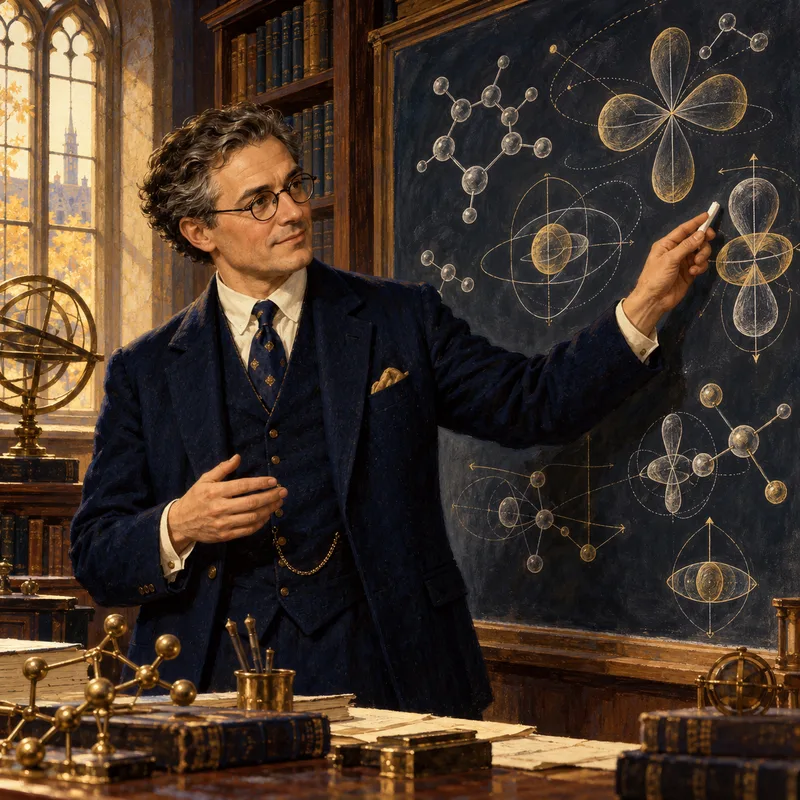
Martin Karplus
1930-2024 · United States · Nobel Chemistry 2013
Multiscale models for complex chemical systems