The discovery, explained · Chemist no. 197 of 350
Martin Karplus: From the Karplus Equation to Simulating Life on a Computer
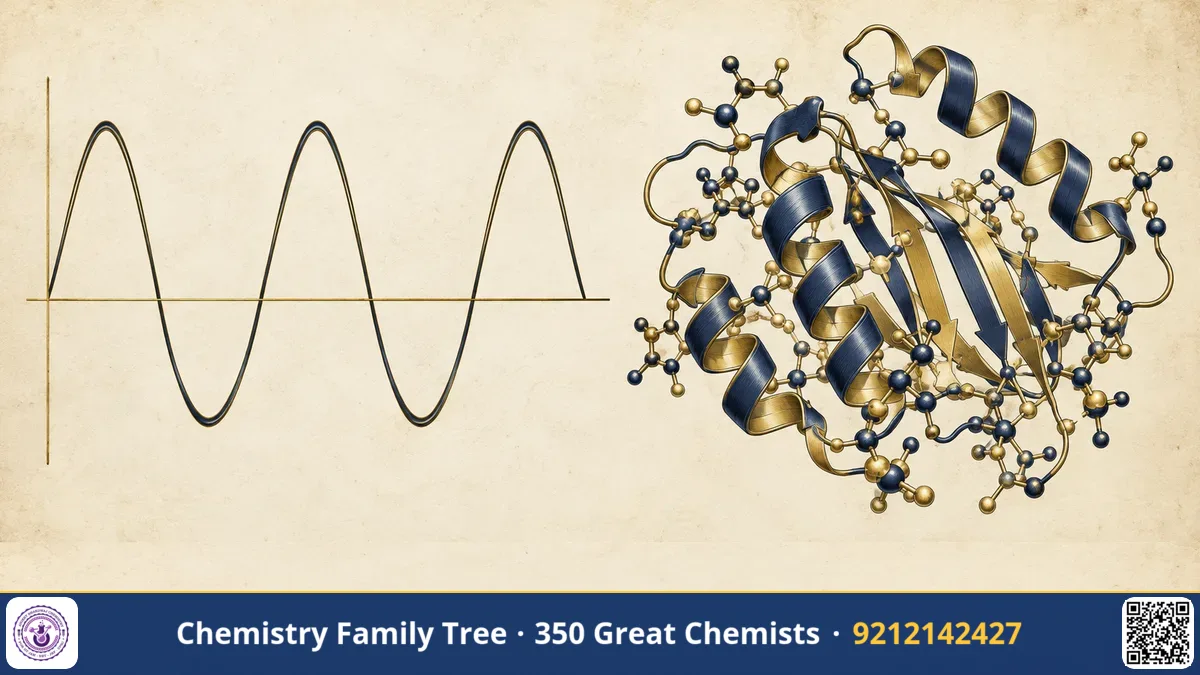
If you have studied NMR, you have already met Martin Karplus: the Karplus equation links the coupling constant between two protons to the angle between their C-H bonds. This single formula, published in 1959, lets chemists read three-dimensional shape from a spectrum. But it is only the first of his big ideas. From the 1970s Karplus, with Michael Levitt and Arieh Warshel, helped to build computer methods that treat molecules as moving, reacting objects, including the multiscale (QM/MM) approach and the CHARMM program for biomolecular simulation. The three shared the 2013 Nobel Prize in Chemistry "for the development of multiscale models for complex chemical systems". Here is how it all works.
The Scientific Problem Before the Discovery
By the 1950s NMR spectroscopy had become a powerful tool, and spin-spin coupling (J coupling) was well known. Two protons on neighbouring carbons split each other's signals, and the splitting J, measured in hertz, depends on the molecule. Chemists observed that J varied between conformers, but there was no simple rule connecting J to geometry. Interpreting NMR of rings and chains needed such a rule.
Later, the problem was bigger. How do enzymes catalyse reactions? How does a protein fold or move? Quantum mechanics (Schrödinger equation) describes bond breaking and electrons accurately, but its cost rises steeply with the number of electrons: a protein with thousands of atoms was far beyond the computers of the 1960s. Classical Newtonian mechanics can handle thousands of atoms, but it cannot describe bond breaking or electron rearrangement. Neither method alone could simulate a chemical reaction in an enzyme.
The Discovery: Step by Step
- The Karplus equation (1959). Using valence-bond theory, Karplus calculated the vicinal coupling constant (³J) between two H atoms on adjacent carbons as a function of the dihedral angle φ (H-C-C-H). The result was a curve with maxima near 0° and 180° and a minimum near 90°.
- Applying it. Chemists used measured ³J values to find the dihedral angles in rings, sugars and, later, peptide backbones in proteins.
- A hybrid quantum-classical method (1972). Karplus and Arieh Warshel developed a method for conjugated molecules in which the π electrons are treated quantum mechanically and the σ framework with classical mechanics. This was a first step towards multiscale modelling; Warshel later applied such ideas to retinal, the light-sensing molecule of vision.
- The first protein simulation (1977). At Harvard, Karplus with J. Andrew McCammon and Bruce Gelin simulated the dynamics of a small protein, bovine pancreatic trypsin inhibitor (BPTI), with a computer solving Newton's equations. It showed that proteins are not rigid, but wiggle and breathe.
- CHARMM. Karplus's group developed CHARMM (Chemistry at HARvard Macromolecular Mechanics), a program and force field for simulating proteins, nucleic acids and lipids. It is still widely used.
- QM/MM. Later work, including the famous 1976 paper of Warshel and Levitt on lysozyme and the combined methods developed with Karplus's group, made it standard to treat the reacting region with quantum mechanics and the surroundings with molecular mechanics.
The Chemistry Behind It
The Karplus equation in its general form is:
³J(φ) = A cos²φ + B cos φ + C
where φ is the H-C-C-H dihedral angle and A, B and C are empirical constants that depend on the substituents (typical values for the simple hydrocarbon case are around A ≈ 7 Hz, B ≈ -1 Hz and C ≈ 5 Hz). Typical results: J is large (about 10-13 Hz) for an anti arrangement (φ = 180°), such as two axial hydrogens on a cyclohexane chair, and small (about 2-4 Hz) for gauche arrangements (axial-equatorial or equatorial-equatorial). This is why axial-axial couplings in cyclohexane and in sugars are easily recognised.
In molecular mechanics, the potential energy is a sum of simple terms:
E = Σ ½kb(r - r₀)² + Σ ½kθ(θ - θ₀)² + Σ (Vn/2)[1 + cos(nφ - δ)] + Σ [4ε((σ/r)¹² - (σ/r)⁶) + qiqj/(4πε₀r)]
These terms represent bond stretching, angle bending, torsion, van der Waals (Lennard-Jones) and electrostatic interactions. Molecular dynamics then integrates Newton's law F = ma for every atom in small time steps (about 1-2 femtoseconds). In QM/MM, the total energy is:
E(total) = E(QM region) + E(MM region) + E(QM/MM interaction)
The QM region contains the atoms undergoing bond changes, such as an enzyme's active site and substrate; the MM region contains the rest of the protein and water. This idea cuts the cost enormously while retaining accuracy where it matters.
Applications Today
- Structure determination by NMR. Dihedral angles from Karplus-type relations help to solve protein and carbohydrate structures.
- Drug design. Simulations show how drug candidates bind to targets, including how flexible proteins adjust to ligands.
- Enzyme mechanisms. QM/MM calculations explain how enzymes lower activation energy.
- Materials and catalysis. Multiscale methods are used for catalysts, membranes and solar-cell materials.
- Protein folding and membrane channels. Modern supercomputers run microsecond to millisecond simulations of ion channels and receptors, an extension of the original ideas.
Exam Corner
- Karplus equation: ³J = A cos²φ + B cos φ + C; maximum J near 180° and 0°, minimum near 90°.
- Axial-axial protons in a chair cyclohexane (φ ≈ 180°) show large J (about 8-13 Hz); axial-equatorial and equatorial-equatorial (φ ≈ 60°) show small J (2-5 Hz).
- Nobel Prize in Chemistry 2013: Karplus, Levitt and Warshel, for multiscale models of complex chemical systems.
- QM/MM: quantum mechanics for the reactive centre, molecular mechanics for the environment.
- CHARMM is a force-field program; MD time steps are of order 1 fs.
Common Misconceptions
- "The Karplus equation works for all couplings." It is for three-bond (vicinal) couplings; other couplings (geminal, long-range) follow different dependencies.
- "Computer simulations replace experiments." They complement them; force fields are validated and corrected against experimental data.
- "Karplus won the prize for the Karplus equation." The Nobel citation refers to multiscale modelling, not to NMR coupling constants.
Quick Revision Box
- Karplus equation (1959): vicinal J depends on dihedral angle.
- Large J for anti (180°), small for gauche (60°), near zero around 90°.
- First protein MD simulation (BPTI): 1977.
- CHARMM: force field program from Harvard.
- QM/MM: hybrid method combining quantum and classical models.
- Nobel Prize in Chemistry 2013 (with Levitt and Warshel).
FAQ
What is a dihedral angle?
It is the angle between two planes defined by H-C-C and C-C-H atoms, seen when looking along the C-C bond (as in a Newman projection).
Why use QM only for part of the system?
Because quantum methods are expensive. Using them only where electrons rearrange keeps the calculation affordable.
What is a force field?
A set of mathematical functions and parameters that describes how potential energy depends on atom positions in classical simulations.
Which exams ask about the Karplus equation?
It is a common topic in NMR sections of JAM, NET and GATE, particularly for questions about coupling constants and stereochemistry in cyclohexanes and sugars.
Published by ABC Chemistry — IIT-JAM | CSIR-NET | GATE Chemistry Coaching. Visit abcchemistry.com
About the chemist
Martin Karplus
1930-2024 · United States · Nobel Chemistry 2013
Multiscale models for complex chemical systems