Biography · Chemist no. 323 of 350
Maurice Wilkins: Complete Life and Legacy
Maurice Hugh Frederick Wilkins (1916-2004) was a New Zealand-born British physicist and molecular biologist whose X-ray diffraction work on DNA at King's College London provided crucial evidence for the double helix. He shared the 1962 Nobel Prize in Physiology or Medicine with James Watson and Francis Crick. A quiet and reserved man, he is often overshadowed by his two co-laureates and by the controversy over Rosalind Franklin, but his work as a leader of biophysics in Britain, and as a campaigner for social responsibility in science, is a worthy legacy.
Early Life and Family
Maurice Wilkins was born on 15 December 1916 in Pongaroa, a small town in New Zealand. His father, Edgar Henry Wilkins, was a doctor of Irish descent, and his mother was Eveline Constance Jane Whittaker. When Maurice was about six years old, the family moved to England, to Birmingham, where his father wanted to give the children a better education. He attended King Edward's School, Birmingham. As a boy he was shy and interested in engineering and gadgets. The turbulent interwar period and an interest in the social effects of science influenced his later views.
Education and Mentors
Wilkins studied physics at St John's College, Cambridge, graduating in 1938. He then moved to the University of Birmingham for his Ph.D., working under John Randall on the theory of phosphorescence and thermoluminescence of solids (the way crystals store and release light energy), and later on the electron traps in crystals. This training in the physics of solids gave him an excellent foundation for crystallography. He received his Ph.D. in 1940. Randall was the key mentor of his career, and later invited him to join the new Biophysics group at King's College London.
Career Timeline
| Year | Event |
|---|---|
| 1916 | Born in Pongaroa, New Zealand |
| 1938 | Graduated in physics, Cambridge |
| 1940 | Ph.D., Birmingham, under John Randall |
| 1940-1943 | Worked on radar and on uranium isotope separation in Britain |
| 1944-1945 | Worked on the Manhattan Project at the University of California, Berkeley |
| 1945-1946 | Lecturer at St Andrews, with Randall |
| 1946 | Joined the MRC Biophysics Unit at King's College London |
| 1950-1952 | X-ray diffraction of DNA with Gosling and Franklin |
| 1953 | Supported and confirmed the Watson-Crick model |
| 1955 | Deputy director of the Biophysics Unit |
| 1962 | Nobel Prize in Physiology or Medicine |
| 1970 | Became Professor of Molecular Biology; later director of the Unit |
| 1980 | Retired as director; continued to study |
| 2004 | Died in London on 5 October |
Major Scientific Contributions
- Experimental evidence for DNA helices: Wilkins's fibre diffraction of DNA, using Signer's gel, produced the crucial early patterns.
- Confirmation of the model: He and his colleagues, including Alex Stokes and Herbert Wilson, showed that the diffraction patterns of DNA from many sources fit the Watson-Crick structure.
- Structure of RNA and chromatin: In later years, his group studied the structure of RNA, ribosomes and nucleoproteins, using X-rays.
- Interference microscopy and cell biology: He developed techniques in microscopy, and studied living cells, nerve fibres and chromosomes with biophysical methods.
- Building a department: His unit became one of the leading centres of molecular biophysics in Britain.
See our discovery blog for the physics and chemistry of the DNA diffraction work.
Awards, Honours and Nobel Prize
The 1962 Nobel Prize in Physiology or Medicine was shared by Wilkins, Crick and Watson "for their discoveries concerning the molecular structure of nucleic acids and its significance for information transfer in living material". Wilkins was elected a Fellow of the Royal Society in 1959 and was made a Companion of Honour in 2002. He also received honorary degrees from several universities and he remained a Fellow of King's College until the end of his life.
Personality, Struggles and Lesser-Known Facts
- A conscience about weapons: Wilkins worked on the atomic bomb project but was deeply disturbed by the bombing of Hiroshima and Nagasaki. He later became involved in the Campaign for Nuclear Disarmament and in the British Society for Social Responsibility in Science, of which he was president.
- Shy and gentle: Colleagues described him as reserved, modest and slow to speak in public. He was reluctant to claim credit.
- The Franklin tension: There was a lasting misunderstanding between him and Rosalind Franklin about their roles at King's. He was frustrated, and she thought she was working independently. Wilkins later regretted that the working relationship was so bad and wrote in his memoir that the split harmed both of them.
- The Third Man of the Helix: His autobiography, The Third Man of the Double Helix (2003), gave his version of events and his feelings about the treatment of Franklin and the way the discovery was told, including in Watson's book.
- Family: He was married twice: first to Ruth, an art student, then in 1959 to Patricia Chidgey, with whom he had four children.
- Interest in art: His first wife Ruth was an art student, and he kept a lifelong interest in art and design alongside science.
Legacy and Influence on Modern Chemistry
Wilkins gave the world the experimental foundation for the greatest structure in biology. His work shows how physics, particularly diffraction, can answer chemical and biological questions. X-ray crystallography, the tool he used, has produced dozens of Nobel Prizes and underlies drug design today. His unit at King's College trained scientists who moved around the world and spread the methods of molecular biophysics. His life is also a case study in scientific ethics: the proper acknowledgement of data, collaboration among colleagues, and the social responsibility of scientists to society. Students of X-ray diffraction, Bragg's law and solid-state chemistry in India benefit from the methods he helped to develop.
Lessons for Students
- Good physics helps biology and chemistry. A physicist of crystals opened the structure of life's molecule.
- Get the sample right. Pure, well-ordered DNA fibres made the whole experiment possible.
- Communicate and share fairly. Poor teamwork can cost credit and harm friendships, so discuss roles early.
- Remember your responsibility. Wilkins used his scientific voice for peace.
Quick Facts Box
- Born: 15 December 1916, Pongaroa, New Zealand
- Died: 5 October 2004, London
- Nationality: British (New Zealand-born)
- Field: Biophysics, molecular biology
- Famous for: X-ray diffraction studies of DNA at King's College London
- Nobel: 1962, Physiology or Medicine (with Watson and Crick)
FAQ
Was Maurice Wilkins a chemist?
No, he was a physicist who became a molecular biologist, but his X-ray work on DNA is important in chemistry courses.
What did Wilkins do in the Second World War?
He worked on radar and then on isotope separation for the atomic bomb, including at Berkeley, as part of the Manhattan Project.
What is the name of Wilkins's memoir?
The Third Man of the Double Helix: The Autobiography of Maurice Wilkins, published in 2003.
Did Wilkins work with Rosalind Franklin?
They worked in the same unit at King's College London, but separately and with difficulty, which is now seen as one of the sad episodes of the story.
Published by ABC Chemistry — IIT-JAM | CSIR-NET | GATE Chemistry Coaching. Visit abcchemistry.com
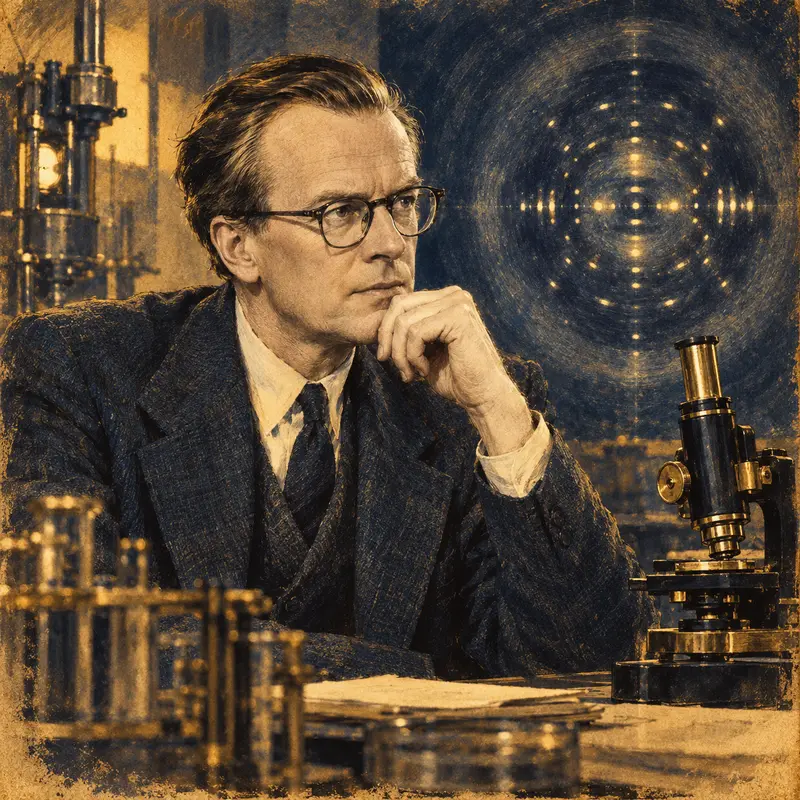
About the chemist
Maurice Wilkins
1916-2004 · United Kingdom · Nobel Physiology/Medicine 1962
X-ray diffraction studies of DNA