Biography · Chemist no. 68 of 350
Max Perutz: The Patient Scientist Who Solved Haemoglobin
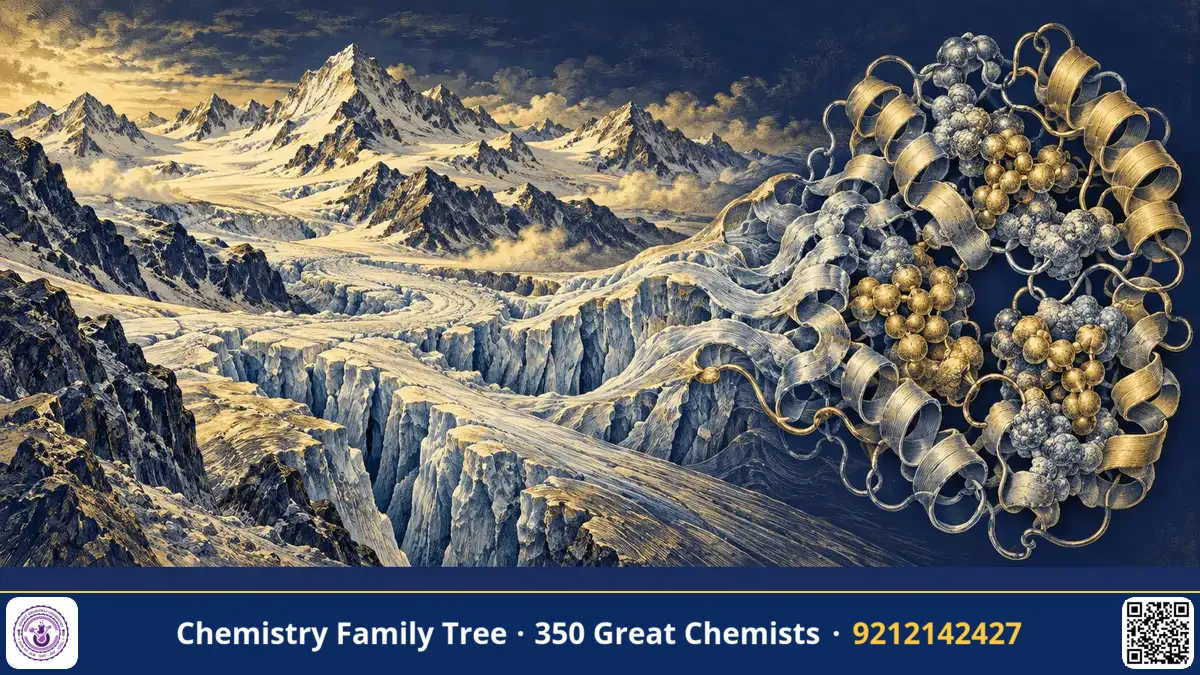
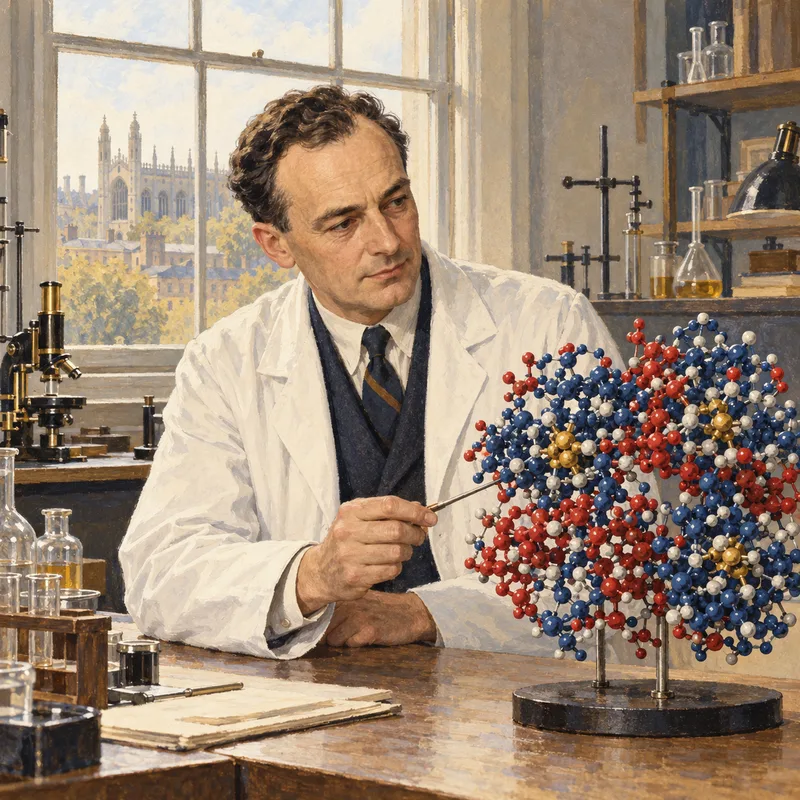
Max Ferdinand Perutz (1914-2002) was an Austrian-born British molecular biologist and chemist who worked for more than two decades to reveal the three-dimensional structure of haemoglobin, the oxygen-carrying protein of blood. He shared the Nobel Prize in Chemistry in 1962 with John Kendrew. He also founded one of the world's great research centres, the Medical Research Council Laboratory of Molecular Biology in Cambridge. His legacy in one line: he proved that the structure of a protein explains its function.
Early Life and Family
Max Perutz was born on 19 May 1914 in Vienna, Austria, into a wealthy Jewish family that owned textile businesses. His parents, Hugo and Adele Perutz, expected their son to study law and join the family trade. However, as a young boy he was attracted to mountains and nature, and he became an enthusiastic skier and climber. This love of the mountains later turned into a scientific interest in glaciers, and he made important studies on how glaciers flow. His comfortable childhood ended when political events in Europe in the 1930s made life dangerous for Jewish families in Austria.
Education and Mentors
Perutz studied chemistry at the University of Vienna from 1932. An interest in biochemistry drew him towards Cambridge, and in 1936 he went to Cambridge to work with J. D. Bernal at the Cavendish Laboratory. Bernal taught him X-ray crystallography. Perutz began studying haemoglobin crystals almost immediately and chose this problem for his PhD, which he completed in 1940. Later, he worked under W. L. Bragg, who encouraged him through the long years when progress was slow.
Career Timeline
| Year | Event |
|---|---|
| 1914 | Born in Vienna |
| 1936 | Joins Bernal's group at Cambridge |
| 1937 | First X-ray photographs of haemoglobin |
| 1940 | Interned as an enemy alien and sent to Canada |
| 1941-44 | Works on the wartime ice-ship project (Habakkuk) with Geoffrey Pyke |
| 1947 | Heads the MRC Unit for Molecular Biology at Cambridge |
| 1953 | Discovers the heavy-atom (isomorphous replacement) method for proteins |
| 1959 | First 3D model of haemoglobin |
| 1962 | Nobel Prize in Chemistry; becomes first chairman of the MRC Laboratory of Molecular Biology |
| 1970 | Proposes a stereochemical mechanism for cooperativity |
| 2002 | Dies in Cambridge |
Major Scientific Contributions
Perutz's main contribution was the solution of the structure of haemoglobin using X-ray crystallography. His technique of isomorphous replacement with heavy atoms became the general way to solve the phase problem for proteins. Later, he used the structure to explain the cooperative binding of oxygen through the transition between the T (tense) and R (relaxed) states, the role of the heme iron moving into the porphyrin plane, the Bohr effect, and the genetic disease sickle cell anaemia. The detailed chemistry appears in our discovery post. He also contributed to the physics of glaciers, and in his last years studied Huntington's disease and related protein aggregation.
Awards, Honours and Nobel Prize
- Nobel Prize in Chemistry, 1962, shared with John Kendrew, for studies of the structures of globular proteins.
- Fellow of the Royal Society (1954).
- Royal Society's Copley Medal (1979).
- Appointed Companion of Honour (1975) and Order of Merit (1988).
- Founding chairman of the MRC Laboratory of Molecular Biology (1962-1979).
Personality, Struggles and Lesser-Known Facts
- Internment: In 1940, as an Austrian national in Britain, he was classified as an enemy alien and shipped to Canada on a ship. He later returned to Britain and resumed research.
- Ice ship idea: He worked on a secret wartime project called Habakkuk, which explored using a mixture of ice and wood pulp (pykrete) to build floating platforms. His glacier knowledge was useful.
- Long wait: He started photographing haemoglobin in 1937 and was not able to publish a structure until 1959. Many colleagues told him the problem would never be solved.
- Great manager: He believed that good science needs a friendly environment. At his laboratory, many future Nobel winners worked, including Sanger and Klug.
- Writer: He wrote clear essays for the public, collected in books such as "Is Science Necessary?" and "I Wish I'd Made You Angry Earlier".
- Mountains: He kept a love of skiing and climbing all his life.
Legacy and Influence on Modern Chemistry
Haemoglobin was the first protein with a complex quaternary structure to be solved, and this changed how chemists think about proteins. The idea that the shape of a molecule changes when a ligand binds, passing information from one site to another, is the foundation of allosteric regulation, which is vital in enzyme control and drug discovery. The laboratory he founded produced a long list of Nobel Prize winners. Today's structural biologists, whether using X-rays or cryo-electron microscopy, follow the path that he and his colleagues opened.
Lessons for Students
- Choose a big problem and keep going when others say it is impossible.
- Technique matters: the heavy-atom method turned an unsolvable problem into a solvable one.
- Build teams that support each other; science grows in friendly places.
- Communicate science clearly to the public.
Quick Facts Box
- Born: 19 May 1914, Vienna, Austria
- Died: 6 February 2002, Cambridge, England
- Nationality: Austrian-born, British
- Field: Molecular biology, X-ray crystallography
- Famous for: Structure of haemoglobin; mechanism of cooperativity
- Nobel: Chemistry 1962 (with John Kendrew)
FAQ
Who shared the 1962 Chemistry Nobel with Perutz?
John Kendrew, who solved the structure of myoglobin.
How long did the haemoglobin structure take?
About 22 years from his first photographs in 1937 to the first 3D model in 1959.
What is the MRC Laboratory of Molecular Biology?
It is a research institute in Cambridge, founded in 1962 with Perutz as chairman, that has produced many Nobel Prize winners.
Did Perutz study anything other than proteins?
Yes. He studied how glaciers flow, an interest that came from his love of mountaineering.
Published by ABC Chemistry — IIT-JAM | CSIR-NET | GATE Chemistry Coaching. Visit abcchemistry.com
About the chemist
Max Perutz
1914-2002 · Austria/United Kingdom · Nobel Chemistry 1962
Structure of haemoglobin