Biography · Chemist no. 70 of 350
Melvin Calvin: The Chemist Who Mapped the Path of Carbon in Photosynthesis
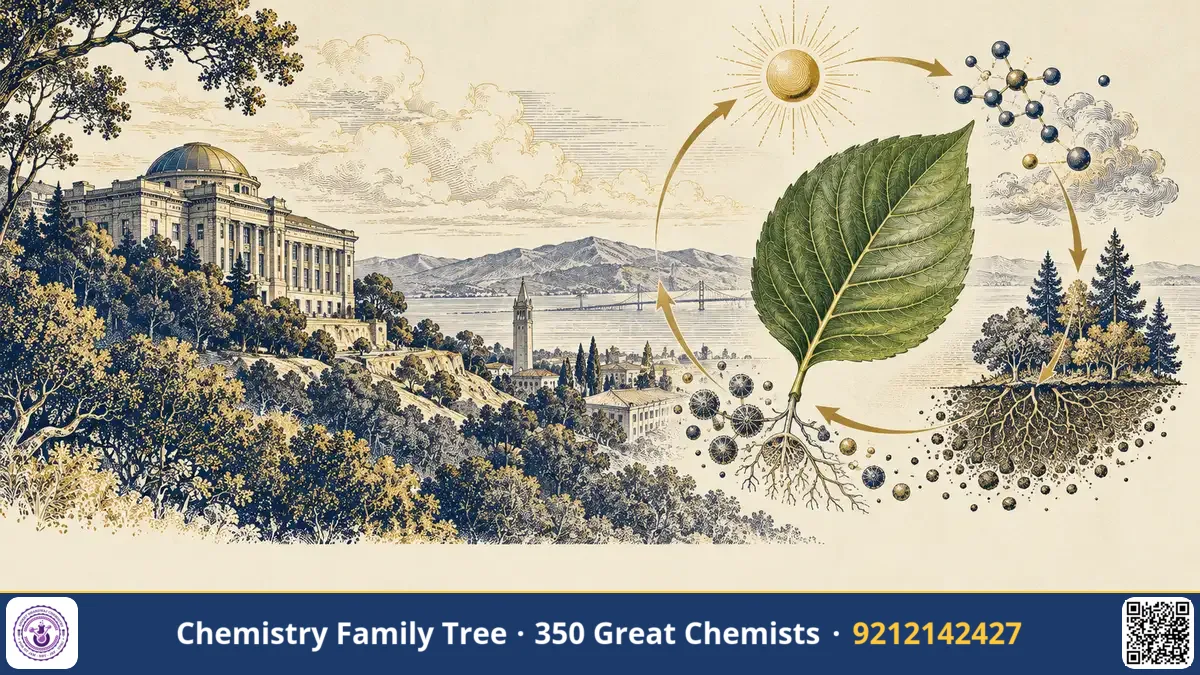
Melvin Calvin (1911-1997) was an American biochemist who discovered how plants build sugar from carbon dioxide. Using radioactive carbon-14 and paper chromatography at the University of California, Berkeley, he led the team that worked out the cycle now named after him. For this he received the Nobel Prize in Chemistry in 1961. His legacy in one line: he showed that the chemistry of life can be followed atom by atom.
Early Life and Family
Melvin Ellis Calvin was born on 8 April 1911 in St. Paul, Minnesota, the son of Jewish immigrants from Eastern Europe. His parents later moved to Detroit, Michigan, where they ran a small grocery store. The family was not wealthy, and young Melvin grew up in a busy household where hard work and learning were valued. He studied at Detroit's Central High School, where good teachers pushed him toward chemistry.
Education and Mentors
Calvin earned his Bachelor of Science degree from the Michigan College of Mining and Technology (now Michigan Technological University) in 1931. He then went to the University of Minnesota for graduate work and received his PhD in 1935 under George Glockler, with a thesis on electron affinity of halogens. He then worked for two years at the University of Manchester, England, with Michael Polanyi, a great physical chemist. Polanyi's wide interest in chemistry, from kinetics to biology, strongly influenced Calvin and taught him to look for questions across boundaries. In 1937 he joined the University of California, Berkeley, where he remained for the rest of his career.
Career Timeline
| Year | Event |
|---|---|
| 1911 | Born in St. Paul, Minnesota |
| 1931 | BS, Michigan College of Mining and Technology |
| 1935 | PhD, University of Minnesota |
| 1935-37 | Research with Michael Polanyi at Manchester |
| 1937 | Joins the Chemistry Department at Berkeley |
| 1942-45 | Contributes to wartime research including the Manhattan Project |
| 1946 | Begins carbon-14 photosynthesis studies at the Radiation Laboratory |
| 1957 | Calvin cycle pathway largely completed |
| 1961 | Nobel Prize in Chemistry |
| 1963 | Directs the Laboratory of Chemical Biodynamics at Berkeley |
| 1997 | Dies in Berkeley, California |
Major Scientific Contributions
Calvin's most important work was the discovery of the path of carbon in photosynthesis, using 14CO2, the green alga Chlorella, two-dimensional paper chromatography and autoradiography. He showed that the first stable product is 3-phosphoglyceric acid and that the CO2 acceptor is ribulose-1,5-bisphosphate. The cycle, with its carboxylation, reduction and regeneration stages, is described fully in our discovery post. Earlier in his career he worked on coordination compounds, metal chelates and the transport of oxygen by synthetic complexes. Later he studied chemical evolution, asking how organic compounds might have formed on the early Earth, and he explored plant-derived fuels, for example from the Euphorbia plant, as a renewable energy source.
Awards, Honours and Nobel Prize
- Nobel Prize in Chemistry, 1961, "for his research on the carbon dioxide assimilation in plants". He received the prize alone.
- Elected to the National Academy of Sciences (1954).
- Davy Medal of the Royal Society (1964).
- National Medal of Science (1989).
- Priestley Medal of the American Chemical Society (1978).
Personality, Struggles and Lesser-Known Facts
- Team leader: Calvin ran a large, interdisciplinary group of chemists, botanists and physicists, and encouraged his co-workers to contribute ideas. He worked with Andrew Benson and James Bassham on the cycle.
- Tracer pioneer: Carbon-14 had been discovered shortly before by Martin Kamen and Sam Ruben, and Calvin was among the first to use it widely in biology.
- Open laboratory: He designed a circular building at Berkeley, the Laboratory of Chemical Biodynamics, to encourage interaction between scientists in different fields.
- Wartime service: During the Second World War he worked on projects related to the Manhattan Project, including chemistry connected to plutonium.
- Big questions: In later life he studied how life began and wrote on chemical evolution.
- Writer: He wrote an autobiography, "Following the Trail of Light".
Legacy and Influence on Modern Chemistry
Every biology and biochemistry textbook in the world includes the Calvin cycle. Its discovery launched the use of radioactive isotopes in metabolic research and helped build the modern field of biochemistry. It also teaches a lesson about science and society: because the cycle describes how carbon enters the biosphere, it is central to climate science, crop improvement and attempts to design artificial photosynthesis. In India, where food security and renewable energy are major concerns, the principles he revealed continue to guide research on crop yield, algae-based fuels and carbon capture.
It is useful to remember how the Calvin cycle project actually worked day to day. Each experiment produced a sheet of filter paper covered with radioactive spots, and the group had to identify every spot by comparing it with known chemicals, degrading molecules and counting radioactivity at each carbon atom. It was patient and often repetitive work, and it took the efforts of many chemists and technicians over about ten years. Calvin's talent was to keep this large team focused on a single question, which is a skill every young scientist can learn.
Lessons for Students
- Combine ideas from chemistry, physics and biology to solve difficult problems.
- New tools, such as isotopes and chromatography, can open entire fields.
- Great science is often teamwork; share credit and build strong groups.
- Do not be afraid to move into new areas as you grow.
Quick Facts Box
- Born: 8 April 1911, St. Paul, Minnesota, USA
- Died: 8 January 1997, Berkeley, California, USA
- Nationality: American
- Field: Biochemistry, photosynthesis, chemical evolution
- Famous for: The Calvin cycle
- Nobel: Chemistry, 1961
FAQ
Who worked with Calvin on the cycle?
Andrew Benson, James Bassham and several others in his Berkeley group.
Why is it called the Calvin-Benson cycle sometimes?
Because Andrew Benson played a key role in the experiments. Many books use the names Calvin cycle or Calvin-Benson-Bassham cycle.
Which institution did Calvin spend his career in?
The University of California, Berkeley, including its Radiation Laboratory.
Did he win the Nobel Prize alone?
Yes. The 1961 Nobel Prize in Chemistry was awarded to him alone.
Published by ABC Chemistry — IIT-JAM | CSIR-NET | GATE Chemistry Coaching. Visit abcchemistry.com
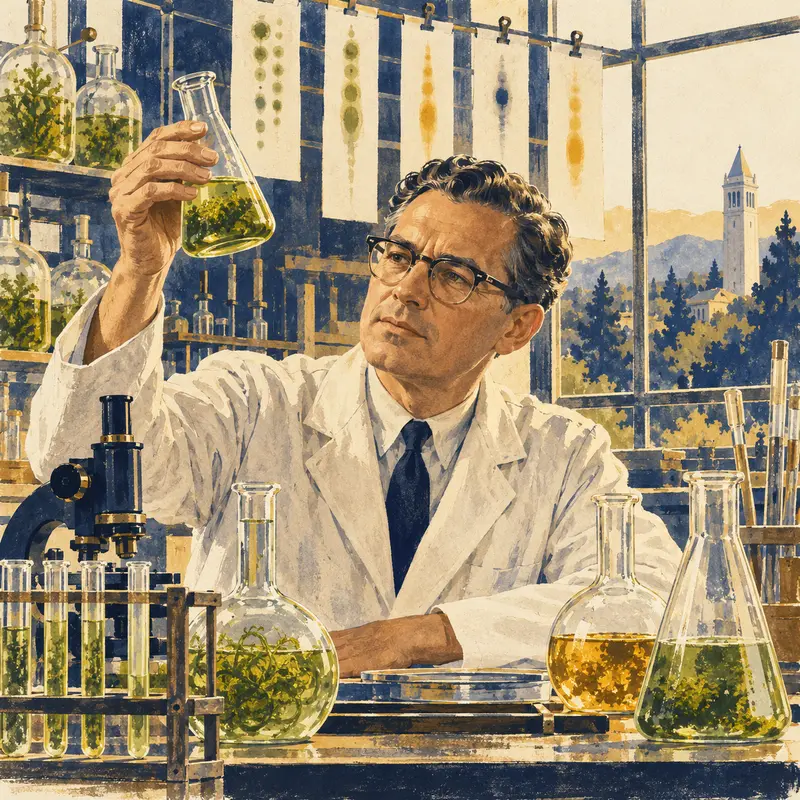
About the chemist
Melvin Calvin
1911-1997 · United States · Nobel Chemistry 1961
Calvin cycle of photosynthesis