The discovery, explained · Chemist no. 70 of 350
Melvin Calvin and the Calvin Cycle: How Plants Turn CO2 into Sugar
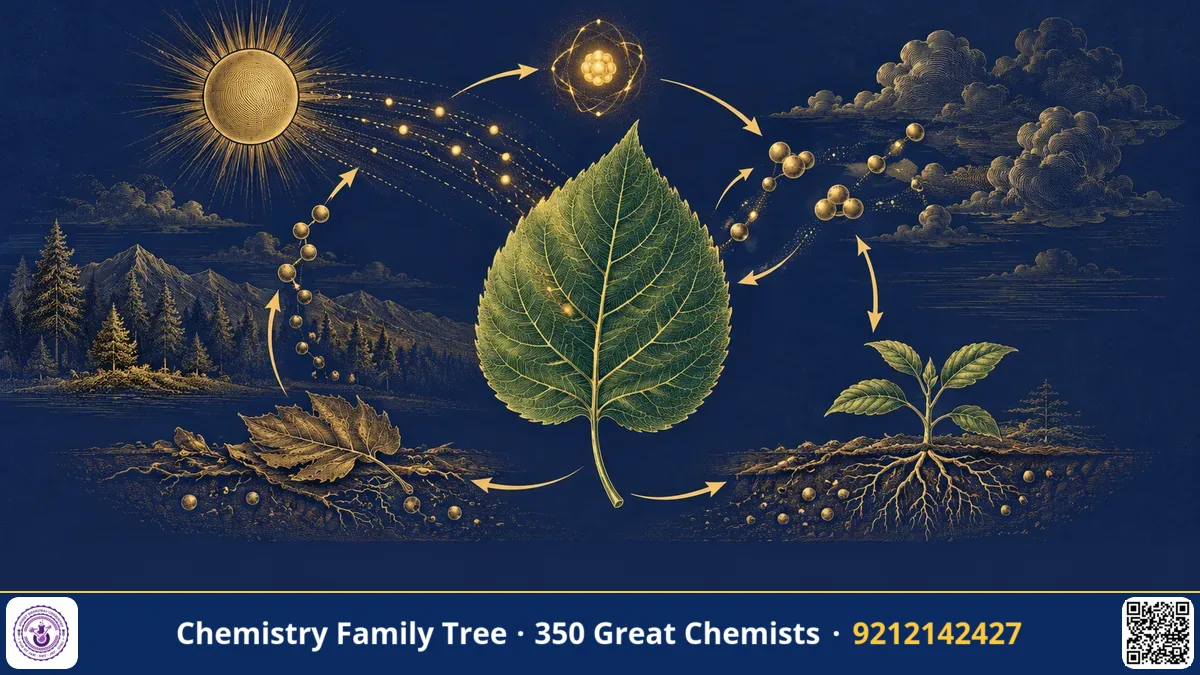
Every grain of rice, every wheat roti and every banana on your table started as carbon dioxide in the air. Plants convert this gas into sugar through a cycle of reactions, now called the Calvin cycle, and the man who mapped it was the American chemist Melvin Calvin. Working at the University of California, Berkeley, with Andrew Benson, James Bassham and others, he used radioactive carbon-14 to follow carbon atoms as they moved through a living cell. The work took about a decade and earned him the Nobel Prize in Chemistry in 1961. It is one of the best examples of how a new tool, in this case a radioactive tracer, can solve a problem that traditional chemistry cannot.
The Scientific Problem Before the Discovery
The overall equation of photosynthesis had been known for a long time:
6CO2 + 6H2O → C6H12O6 + 6O2 (light, chlorophyll)
But this summary hides hundreds of steps. A simple idea at the time was that CO2 is first reduced to formaldehyde (HCHO), and six formaldehyde units then join to make glucose. No one had found it. Another question was how light energy is connected to carbon fixation. Scientists such as Robin Hill had shown that isolated chloroplasts can release oxygen in light, and later work separated "light reactions" from "dark reactions", the carbon-fixing steps which do not need light directly. The problem was to find the first stable product and the pathway that follows. Carbon intermediates in a cell are present in tiny amounts and change within seconds, so ordinary analysis was impossible.
The Discovery: Step-by-Step
- A tracer becomes available. Carbon-14, discovered by Martin Kamen and Sam Ruben in 1940, was produced in large quantities at Berkeley's accelerator and reactor facilities after the war. It could be supplied as 14CO2.
- A fast, simple system. The green alga Chlorella was grown in a flat, thin glass vessel, which looked like a lollipop. Algae were illuminated and fed 14CO2 for a precisely controlled time.
- Killing the reaction quickly. After seconds, the algae were dropped into boiling alcohol, which stopped all enzyme action and preserved the labelled compounds.
- Separation by paper chromatography. The extract was spotted on filter paper and separated in two dimensions, with different solvents in each direction.
- Autoradiography. The paper was placed against X-ray film. Radioactive compounds exposed the film and appeared as dark spots, which were identified by comparison with known compounds.
After only a few seconds of exposure, most of the radioactivity was in a three-carbon acid, 3-phosphoglyceric acid (3-PGA). Shorter times showed it as the earliest product. Longer times showed sugar phosphates, then glucose and other compounds. By varying time and conditions and by degrading labelled molecules to find which carbon atom contained 14C, the team pieced together the complete cycle.
The Chemistry Behind It
The Calvin cycle takes place in the stroma of the chloroplast and has three stages.
Stage 1: Carboxylation. The enzyme ribulose-1,5-bisphosphate carboxylase/oxygenase (RuBisCO) adds CO2 to the five-carbon sugar ribulose-1,5-bisphosphate (RuBP). The six-carbon intermediate splits immediately into two molecules of 3-PGA:
RuBP (C5) + CO2 → [C6 intermediate] → 2 × 3-PGA (C3)
Stage 2: Reduction. 3-PGA is phosphorylated by ATP to 1,3-bisphosphoglycerate, and then reduced by NADPH to glyceraldehyde-3-phosphate (G3P):
3-PGA + ATP → 1,3-BPG + ADP
1,3-BPG + NADPH + H⁺ → G3P + NADP⁺ + Pi
Stage 3: Regeneration. Most G3P is rearranged through a series of sugar-phosphate reactions (involving 4-, 5-, 6- and 7-carbon sugars) to regenerate RuBP, a step that uses additional ATP.
For every three CO2 molecules fixed, six G3P molecules are formed, but only one G3P leaves the cycle as net gain; the other five are used to regenerate three RuBP. The total cost of fixing three CO2 into one G3P is:
3 CO2 + 9 ATP + 6 NADPH → 1 G3P + 9 ADP + 8 Pi + 6 NADP⁺
So making one glucose (two G3P) needs six turns, 18 ATP and 12 NADPH. Some plants, such as sugarcane and maize, are C4 plants that first fix CO2 into a four-carbon acid (oxaloacetate) using PEP carboxylase, which reduces wasteful photorespiration in hot climates.
Applications Today
- Agriculture: Understanding RuBisCO and C4 photosynthesis guides the breeding of crops for yield and heat tolerance, which is important for Indian farming.
- Climate science: The cycle is the basis of carbon sinks in forests and crops.
- Bioenergy: Calvin himself explored plant oils as renewable fuels, and today biofuel research continues in this direction.
- Tracer methods: Isotope tracing is a standard technique in biochemistry and medicine, including PET imaging.
- Artificial photosynthesis: Researchers study how to copy the natural process for solar fuels.
Exam Corner
- The first stable product of CO2 fixation in C3 plants is 3-phosphoglyceric acid (3-PGA), a three-carbon compound.
- CO2 acceptor is ribulose-1,5-bisphosphate (RuBP), and the enzyme is RuBisCO.
- For one glucose, the cycle needs 6 CO2, 18 ATP and 12 NADPH.
- The Calvin cycle occurs in the chloroplast stroma; light reactions occur in the thylakoid membranes.
- Calvin used 14C, paper chromatography and autoradiography; Nobel Prize in Chemistry 1961.
Common Misconceptions
- "The dark reaction happens only at night." No. It does not need light directly, but it uses ATP and NADPH made in the light, so it runs mostly in the day.
- "Oxygen comes from CO2." The oxygen released comes from water in the light reactions, not from CO2.
- "RuBisCO only fixes CO2." It can also react with O2, which starts photorespiration.
Quick Revision Box
- Calvin cycle: carboxylation, reduction, regeneration.
- RuBP (C5) + CO2 → 2 × 3-PGA (C3), catalysed by RuBisCO.
- 3 CO2 → 1 G3P needs 9 ATP and 6 NADPH.
- Method: 14CO2, Chlorella, 2D paper chromatography.
- Location: chloroplast stroma.
- Nobel Prize in Chemistry 1961.
FAQ
Why did Calvin use Chlorella?
It is a single-celled alga that grows fast, is easy to illuminate and can be killed very quickly for sampling.
Who worked with Calvin?
Important co-workers included Andrew Benson and James Bassham, along with many other members of his Berkeley group.
Why is the cycle called a cycle?
Because the CO2 acceptor, RuBP, is regenerated at the end of the process so that the sequence can repeat.
What is the difference between C3 and C4 plants?
In C3 plants the first stable product is a 3-carbon acid (3-PGA). In C4 plants the first product is a 4-carbon acid, and the Calvin cycle then runs in bundle sheath cells.
Published by ABC Chemistry — IIT-JAM | CSIR-NET | GATE Chemistry Coaching. Visit abcchemistry.com
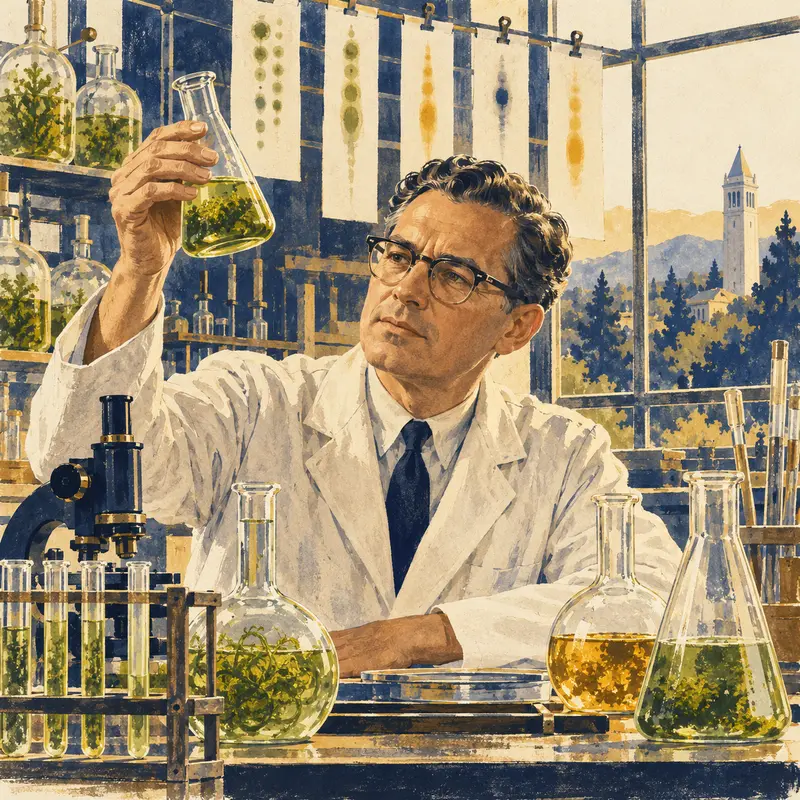
About the chemist
Melvin Calvin
1911-1997 · United States · Nobel Chemistry 1961
Calvin cycle of photosynthesis