Biography · Chemist no. 301 of 350
Michael Polanyi (1891-1976): A Chemist Who Became a Philosopher
Introduction
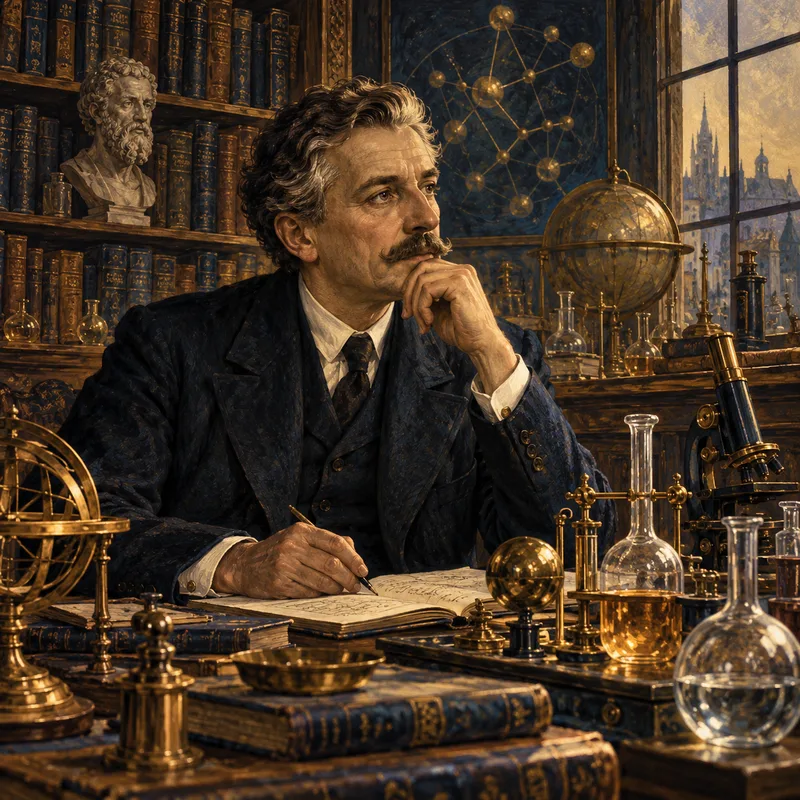
Michael Polanyi was a Hungarian-born polymath who first trained as a physician, then became a leading physical chemist, and finally a renowned philosopher of science. In chemistry he helped create transition state theory, developed a potential theory of adsorption, formulated the Bell-Evans-Polanyi principle, and studied the structure of fibres with X-rays. In philosophy he introduced the idea of tacit knowledge, summed up in his phrase "we can know more than we can tell". His legacy in one line: a scientist who showed that skill, judgement and personal commitment lie at the heart of discovery.
Early Life and Family
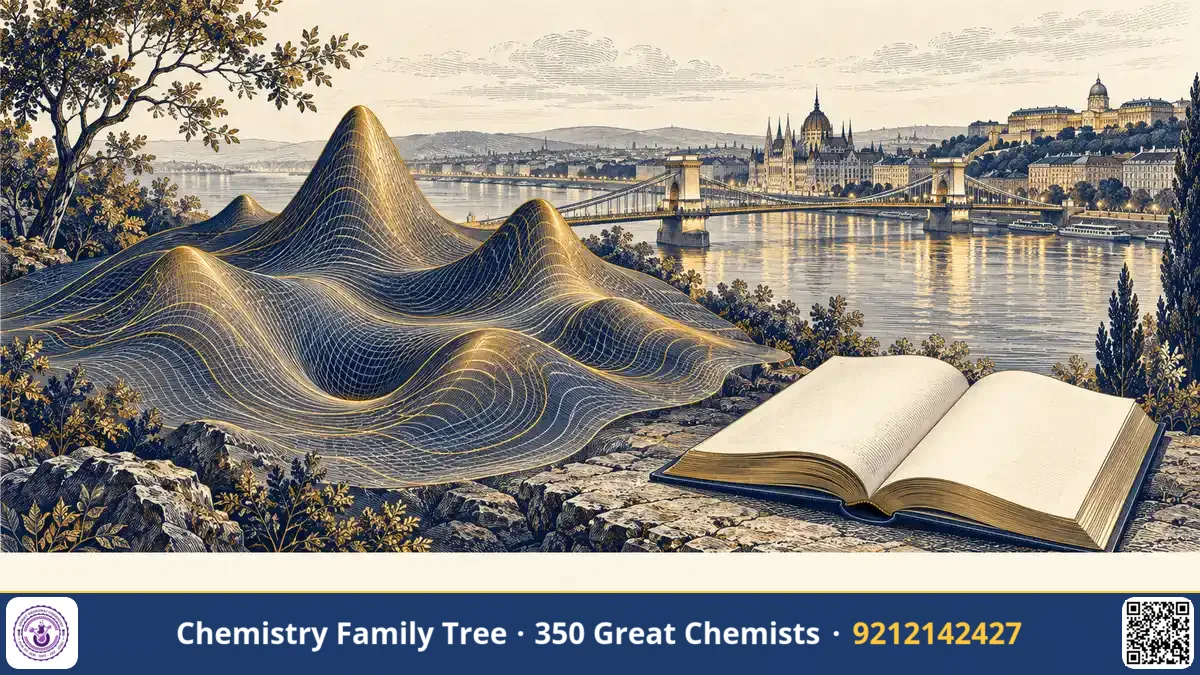
Michael (Mihály) Polanyi was born on 11 March 1891 in Budapest, then part of the Austro-Hungarian Empire. His family was of Jewish origin, later converted to Christianity, and was intellectually lively. His father, Mihály Pollacsek, was a railway engineer, and his mother, Cecília, hosted a famous literary and intellectual salon in Budapest. The family changed its name from Pollacsek to Polányi. His elder brother Karl Polanyi became a well-known economic historian and social thinker, author of The Great Transformation. Growing up in this household, Michael was exposed to debate on science, politics and art from an early age.
Education and Mentors
Polanyi studied medicine at the University of Budapest and qualified as a physician in 1913. During his studies he became interested in physical chemistry, and during the First World War, while serving as a medical officer in the Austro-Hungarian army, he wrote a doctoral thesis on the thermodynamics of adsorption. He received his PhD in chemistry from Budapest in 1917. His early work on adsorption attracted the attention of Albert Einstein, but many chemists of the time were sceptical of the theory, and it was only later that its value was recognised.
Career Timeline
| Year | Event |
|---|---|
| 1891 | Born in Budapest |
| 1913 | Qualifies as a medical doctor |
| 1914 | Proposes the potential theory of adsorption |
| 1917 | Doctorate in chemistry at Budapest |
| 1920 | Moves to Berlin, joining the Kaiser Wilhelm Institute for Fibre Chemistry |
| 1923 | Moves to the Kaiser Wilhelm Institute for Physical Chemistry under Fritz Haber |
| 1920s | Studies X-ray analysis of fibres, rolled metals and reaction kinetics, including highly dilute flames |
| 1931 | With Henry Eyring, calculates the potential energy surface of H + H₂ |
| 1933 | Leaves Germany after the Nazi rise to power; becomes professor of physical chemistry in Manchester |
| 1935 | Publishes transition state theory with M. G. Evans |
| 1948 | Takes a chair in social studies at Manchester, reflecting his shift to philosophy |
| 1958 | Publishes Personal Knowledge |
| 1966 | Publishes The Tacit Dimension |
| 1976 | Dies in Northampton, England |
Major Scientific Contributions
1. Adsorption potential theory
Polanyi suggested that molecules near a solid surface experience an attractive potential field, and that adsorption is the filling of equipotential layers. This led to the Dubinin-Polanyi equation, used for activated carbons.
2. X-ray analysis of materials
In Berlin, he and colleagues used X-ray diffraction to study the structure of cellulose fibres and the deformation of metal crystals, contributing to the understanding of dislocations in plastic deformation. This was a pioneering link between physics and materials chemistry.
3. Reaction kinetics
His work on reactions of alkali metal vapours with halogens ("highly diluted flames") helped to clarify elementary reaction steps. The potential energy surface for H + H₂ (with Eyring) and the transition state theory (with Evans) laid the foundation of modern kinetics. For a full discussion, see our companion article on his discovery.
4. Philosophy of science
From the 1940s onwards he turned to the question of how science works. He argued that scientific knowledge depends on personal commitment, skills and intuition that cannot be completely written as rules. This was his concept of tacit knowledge. It influenced the philosophy of science, education and management theory.
Awards, Honours and Nobel Prize
Polanyi did not win a Nobel Prize, but he was elected a Fellow of the Royal Society in 1944 and held honorary degrees from several universities. In a remarkable family connection, his son John C. Polanyi shared the 1986 Nobel Prize in Chemistry with Dudley Herschbach and Yuan T. Lee for work on reaction dynamics, a field that grew directly from the potential energy surface ideas his father helped to start. Among those who worked with or alongside him were future Nobel laureates such as Eugene Wigner and Melvin Calvin.
Personality, Struggles and Lesser-Known Facts
- Physician first. He started as a doctor, and his curiosity took him into chemistry, then into metallurgy and fibres, then into philosophy.
- Forced to leave. When the Nazis came to power in 1933, he left Berlin for Manchester, as did many scientists of Jewish origin.
- Shift from the laboratory. He felt that central planning of science, as proposed by some in the 1930s, would damage free inquiry, and he became an active defender of scientific freedom.
- Family of thinkers. His brother Karl was a leading economic historian, and his son John a Nobel-winning chemist.
- A master of crossing fields. His work on both chemistry and the social aspects of science makes him unusual among chemists.
Legacy and Influence on Modern Chemistry
Every time a chemist draws a reaction coordinate diagram, calculates an activation barrier on a computer or uses the Eyring plot to extract ΔH‡ and ΔS‡, they are using ideas that Polanyi helped create. The Evans-Polanyi principle supports the Hammond postulate, the Brønsted relation and catalyst design through the Sabatier principle. The Dubinin-Polanyi theory remains widely used for porous materials. Beyond chemistry, the idea of tacit knowledge is now a core concept in studies of learning, craftsmanship and knowledge management.
Lessons for Students
- Cross boundaries between disciplines: medicine, chemistry, physics and philosophy all fed his ideas.
- Keep an open mind when your ideas are criticised; time may prove them valuable.
- Skills matter: reading is not enough. Laboratory skill is partly learned by doing, which is what he meant by tacit knowledge.
- Defend the freedom to ask questions.
- Remember that family and community nurture talent.
Quick Facts Box
- Born: 11 March 1891, Budapest, Hungary
- Died: 22 February 1976, Northampton, England
- Nationality: Hungarian-born, later British
- Field: Physical chemistry, philosophy of science
- Famous for: Transition state theory, Evans-Polanyi principle, adsorption potential, tacit knowledge
- Nobel Prize: None (his son John Polanyi won in 1986)
FAQ
Was Michael Polanyi a chemist or a philosopher?
He was both. He worked as a physical chemist for about three decades, and then devoted the second half of his career to philosophy, especially the philosophy of science.
What is tacit knowledge?
It is knowledge that we possess but cannot fully put into words, such as the skill to ride a bicycle or to recognise a face. Polanyi argued that all science relies on it.
Is John Polanyi related to Michael Polanyi?
Yes. John C. Polanyi, who shared the 1986 Nobel Prize in Chemistry, is Michael Polanyi's son.
Why is he important for exam preparation?
The Eyring equation, transition state theory, the Evans-Polanyi relation and adsorption models are core topics in physical chemistry papers for IIT-JAM, CSIR-NET and GATE.
Published by ABC Chemistry — IIT-JAM | CSIR-NET | GATE Chemistry Coaching. Visit abcchemistry.com
About the chemist
Michael Polanyi
1891-1976 · Hungary
Transition state theory; philosophy of science