The discovery, explained · Chemist no. 301 of 350
Michael Polanyi and the Chemistry of the Transition State
Why do some reactions need so much energy to start, while others run easily at room temperature? How do the energies of reactants and products determine the height of the energy barrier between them? These are central questions of chemical kinetics. The Hungarian-born scientist Michael Polanyi (1891-1976) made fundamental contributions to answering them. With Henry Eyring in 1931 he calculated a potential energy surface for a chemical reaction, which led to the transition state theory and the Eyring-Polanyi equation. With M. G. Evans he proposed the Bell-Evans-Polanyi principle, which links activation energy and reaction enthalpy. He also developed an early theory of adsorption and took part in the chain-mechanism of the hydrogen-bromine reaction.
The Scientific Problem Before the Discovery
In 1889 Arrhenius had proposed that the rate constant of a reaction depends on temperature through k = A·e^(-Ea/RT), where Ea is the activation energy and A is the pre-exponential factor. This equation fitted data well, but did not explain what Ea or A actually meant in molecular terms. Collision theory could estimate A for simple gases, but failed for many reactions and gave no way to calculate Ea. Chemists did not have a picture of what happens during a collision, how the bonds break and form, and how high the barrier is.
The arrival of quantum mechanics in the late 1920s changed this. London, Heitler and others had explained the H₂ molecule. In 1928 Fritz London proposed an approximate formula for the energy of three atoms, such as H + H₂, as a function of the distances between them. This opened the door to a theoretical study of the simplest chemical reaction.
The Discovery: Step-by-Step
1. The potential energy surface (1931)
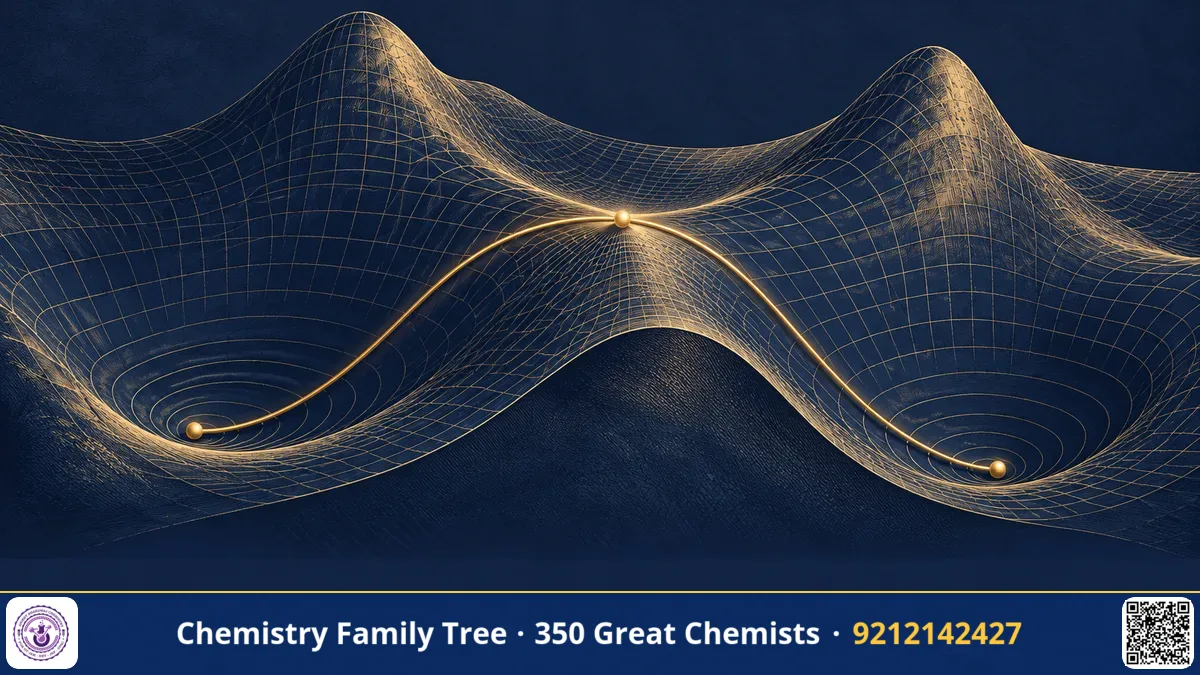
Polanyi was then working in Berlin at Fritz Haber's institute, and Henry Eyring visited him as a young postdoctoral researcher. Using London's equation, they computed the energy for the reaction H + H₂ → H₂ + H as a function of two bond distances (with the three atoms in a straight line). The result is a three-dimensional surface:
- Two valleys: one for H + H₂ (reactants) and one for H₂ + H (products).
- A pass between them: the saddle point, the lowest-energy route from reactants to products.
- The reaction path is the minimum-energy path through the pass. The energy at the saddle point relative to the reactants gives the activation energy.
The configuration at the saddle point is the activated complex or transition state, [H···H···H]‡.
2. Transition state theory (1935)
Eyring, and independently Polanyi with Evans, then treated the activated complex as if it were in a quasi-equilibrium with the reactants, and the rate as the frequency with which it passes over the barrier. This leads to the Eyring equation:
k = (k_B T / h) · K‡ = (k_B T / h) · exp(-ΔG‡ / RT) = (k_B T / h) · exp(ΔS‡/R) · exp(-ΔH‡/RT)
Here k_B is Boltzmann's constant, h is Planck's constant, K‡ is the equilibrium constant for formation of the transition state, and ΔG‡, ΔH‡ and ΔS‡ are the free energy, enthalpy and entropy of activation. A plot of ln(k/T) against 1/T gives a straight line with slope -ΔH‡/R and intercept ln(k_B/h) + ΔS‡/R.
3. The Bell-Evans-Polanyi principle (1936)
Evans and Polanyi (and independently R. P. Bell) observed that, in a family of similar reactions, the activation energy changes linearly with the reaction enthalpy:
Ea = E₀ + α ΔH (0 < α < 1)
A more exothermic reaction has a lower barrier. This principle is the foundation of linear free-energy relationships, the Hammond postulate and the Brønsted catalysis law (log k = α log K + constant).
The Chemistry Behind It
Meaning of the entropy of activation. A negative ΔS‡ means the transition state is more ordered than the reactants (for example, in bimolecular association). A positive ΔS‡ indicates a looser transition state, as in unimolecular dissociation. This interpretation is widely used in mechanism problems.
| Quantity | Arrhenius | Eyring |
|---|---|---|
| Rate constant | k = A exp(-Ea/RT) | k = (k_BT/h) exp(-ΔG‡/RT) |
| Temperature plot | ln k vs 1/T | ln(k/T) vs 1/T |
| Barrier term | Ea | ΔH‡ (for a unimolecular process, Ea = ΔH‡ + RT) |
| Pre-exponential | A | (k_BT/h) exp(ΔS‡/R) |
The Hammond postulate. George Hammond later stated that in an exothermic step the transition state resembles the reactants (early), while in an endothermic step it resembles the products (late). This is an application of the Bell-Evans-Polanyi idea. For radical halogenation, bromination is more selective than chlorination because the H-abstraction by Br· is endothermic with a late transition state, in which the stability of the developing radical matters more.
Adsorption and catalysis. In 1914, Polanyi proposed a potential theory of adsorption, in which the adsorbed layer on a solid is held by an attractive potential field around the surface. This theory is the basis of the Dubinin-Polanyi equation for micropore filling in activated carbons.
Fast reactions. Polanyi also studied "highly diluted flames", the rapid reactions of sodium vapour with halogens at low pressure, which gave direct information about elementary reaction steps.
Applications Today
- Computational chemistry: Finding transition states on potential energy surfaces is a routine task in modern quantum chemistry software.
- Catalyst design: The Evans-Polanyi relation underlies the Sabatier principle and the volcano plot: best catalysts bind reactants neither too weakly nor too strongly.
- Pharmaceutical kinetics: The Eyring equation is used to find ΔH‡ and ΔS‡ from temperature studies of drug stability and enzyme reactions.
- Environmental science: Rate constants for atmospheric reactions are estimated using transition state theory.
- Gas separation and storage: The Dubinin-Polanyi approach is used to design activated carbons for adsorbing gases and vapours.
Exam Corner
- Eyring equation: k = (k_BT/h) exp(-ΔG‡/RT); a plot of ln(k/T) versus 1/T has slope -ΔH‡/R.
- The saddle point on the potential energy surface is the transition state; the reaction coordinate is the minimum-energy path.
- Evans-Polanyi: Ea varies linearly with ΔH in a family of related reactions (α between 0 and 1).
- For gas-phase unimolecular reactions Ea = ΔH‡ + RT, and for bimolecular gas reactions Ea = ΔH‡ + 2RT.
- Polanyi's adsorption potential theory led to the Dubinin-Polanyi equation.
Common Misconceptions
- "The transition state is an intermediate." It is not. It is a maximum along the reaction coordinate that cannot be isolated, while an intermediate sits in a local energy minimum.
- "Ea equals ΔH‡." They differ by a term of RT (or 2RT for bimolecular gas reactions).
- "A lower ΔH always means a faster reaction." It does so only within a series of related reactions; the entropy and other factors also matter.
Quick Revision Box
- 1931: Eyring and Polanyi compute a potential energy surface for H + H₂.
- Transition state theory: activated complex in quasi-equilibrium with reactants.
- Eyring equation: k = (k_BT/h) exp(ΔS‡/R) exp(-ΔH‡/RT).
- Bell-Evans-Polanyi: Ea = E₀ + αΔH within a family of reactions.
- Polanyi adsorption potential theory (1914); Dubinin-Polanyi equation.
- Polanyi was also a major philosopher of science (tacit knowledge).
FAQ
What is the Eyring-Polanyi equation?
It is the rate expression of transition state theory, k = (k_BT/h)exp(-ΔG‡/RT). It links the rate constant to the free energy of activation, and allows the determination of ΔH‡ and ΔS‡ from temperature-dependent data.
What does the Evans-Polanyi principle say?
Within a series of similar reactions, the more exothermic reaction has the lower activation energy. The relationship is approximately linear.
Why is the saddle point important?
It is the highest point on the lowest-energy path from reactants to products. Its energy determines the activation barrier, and its geometry is the transition state structure.
How is Polanyi related to a Nobel Prize?
Michael Polanyi did not win a Nobel Prize himself, but his son John C. Polanyi shared the 1986 Nobel Prize in Chemistry for the dynamics of elementary chemical reactions.
Published by ABC Chemistry — IIT-JAM | CSIR-NET | GATE Chemistry Coaching. Visit abcchemistry.com

About the chemist
Michael Polanyi
1891-1976 · Hungary
Transition state theory; philosophy of science