Biography · Chemist no. 308 of 350
Mikhail Tsvet (1872–1919): The Botanist Who Gave Chemistry Chromatography
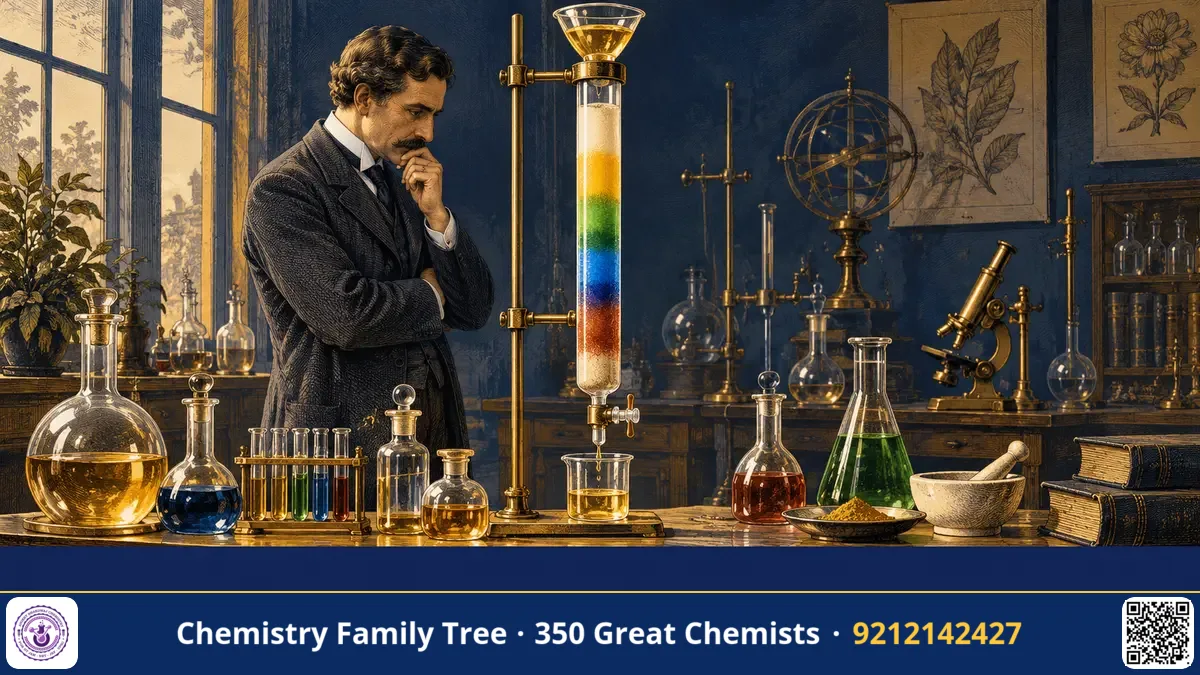
Mikhail Semyonovich Tsvet (also written Tswett) was a Russian botanist and biochemist, born in Italy, who invented chromatography. His life was short and often difficult, and he did not see his method become a worldwide tool. Today, however, chromatography is used in nearly every laboratory, and several Nobel Prizes have been awarded for work based on it. His legacy in one line: he showed how to separate a mixture by letting its components race through a column.
Early Life and Family
Tsvet was born on 14 May 1872 (according to the modern calendar) in Asti, in northern Italy. His father, Semyon Tsvet, was Russian, and his mother, Maria Dorozza, was Italian. His mother died soon after his birth, and he was raised in Switzerland. He spent his childhood in Lausanne and Geneva, where he went to school. This background meant that he grew up speaking several languages, including French, Russian, Italian and German, which helped him later in his scientific career.
Education and Mentors
Tsvet studied at the University of Geneva, where he specialised in botany and plant physiology. He earned his doctorate there in 1896 with research on the physiology of the cell. After that, he moved to Russia, where the family had ties, in the hope of working in a Russian university. He worked in St Petersburg and then at the University of Warsaw, in what was then part of the Russian Empire. As a foreign-trained scientist, he faced difficulty in having his Swiss degree recognised in Russia.
Career Timeline
| Year | Event |
|---|---|
| 1872 | Born in Asti, Italy |
| 1896 | Doctorate at the University of Geneva |
| 1896 | Moves to Russia and works in St Petersburg |
| 1901 | Takes up work in Warsaw |
| 1903 | Presents the chromatographic method at a meeting of the Warsaw Society of Naturalists |
| 1906 | Publishes the main papers on adsorption analysis of plant pigments in German botanical journals |
| 1910 | Publishes the monograph "Chromophylls in the plant and animal world" |
| 1915 | Leaves Warsaw during the First World War as the front approaches; his work is disrupted |
| 1917 | Works at the University of Tartu (Dorpat) |
| 1918 | Becomes professor at the University of Voronezh |
| 1919 | Dies in Voronezh on 26 June |
Major Scientific Contributions
1. Chromatography. Tsvet's greatest contribution was the invention of the column adsorption method to separate plant pigments. He showed that a leaf extract contained several different pigments, including carotenes, xanthophylls and at least two chlorophylls (a and b). The details of the method, the equations and the exam points are covered in our companion discovery article.
2. Understanding chlorophyll. By separating the pigments gently, Tsvet showed that chlorophyll is not one compound. He also studied how chlorophyll exists in the living leaf, suggesting that it is associated with proteins or other components in the cell.
3. A general principle. He understood that the method was general. He wrote that the same approach could be used for colourless substances, and he tested a range of adsorbents and solvents, systematically comparing their power. He also drew attention to the need to avoid destroying sensitive molecules by harsh chemical treatment.
Awards, Honours and Nobel Prize
Tsvet did not win a Nobel Prize and did not receive major international honours in his lifetime. Soon after his death, however, the technique he created started to bring others great success. Richard Kuhn received the Nobel Prize in Chemistry in 1938 for work on carotenoids and vitamins, which relied on chromatography. Archer Martin and Richard Synge shared the Nobel Prize in Chemistry in 1952 for partition chromatography, and chromatographic methods have contributed to many other Nobel-winning projects. Later honours bearing his name are not listed here, since they cannot be confirmed.
Personality, Struggles and Lesser-Known Facts
- The name coincidence. In Russian, tsvet means "colour", yet he coined the word chromatography from Greek. The coincidence is often retold, but it is only a coincidence.
- A dispute with Willstätter. Richard Willstätter, who won the 1915 Nobel Prize in Chemistry for his work on chlorophyll, did not accept Tsvet's finding that there were two chlorophylls separate from other pigments. Later work proved Tsvet right.
- Language barrier. Much of his work appeared in Russian, with some in German. Many chemists in Western Europe did not read the journals in which it was published.
- War and displacement. The First World War forced him to leave Warsaw, and his apparatus and papers were disrupted. Later the Russian Revolution and civil war added hardship.
- An early death. He died at the age of 47 in Voronezh. He did not live to see his method become widely accepted.
Legacy and Influence on Modern Chemistry
The technique lay almost unused for about twenty years until Kuhn, Winterstein and Lederer rediscovered it in 1931, using it to separate carotenes. From there it spread rapidly. Martin and Synge's partition chromatography led to paper chromatography, and gas chromatography followed in the early 1950s. Today, HPLC, GC-MS, LC-MS and ion-exchange chromatography are used by pharmaceutical, food, environmental and forensic laboratories all around the world, including the large quality-control sector in India. Tsvet's insight that a column can separate chemically similar molecules remains the foundation of the field.
Lessons for Students
- Great ideas can come from outside chemistry. A botanist solved a chemical problem.
- Do not give up when your work is ignored. His method took decades to be accepted.
- Observe carefully. The coloured bands in a column taught him something that sophisticated chemical tests could not.
- Be clear in communication. Publish in languages and journals that your audience reads.
Quick Facts Box
- Born: 14 May 1872, Asti, Italy
- Died: 26 June 1919, Voronezh, Russia
- Nationality: Russian (born in Italy, educated in Switzerland)
- Field: Botany, plant biochemistry, analytical chemistry
- Famous for: Invention of chromatography (1903)
- Nobel: None
FAQ
Why is Tsvet spelled differently in different books?
The Russian name is transliterated in various ways: Tsvet, Tswett, Tsvett and Zwet. All refer to the same scientist.
Was Tsvet a chemist?
He was mainly a botanist and plant physiologist, but his invention became one of the most important tools in chemistry.
Who rediscovered chromatography?
Richard Kuhn and his coworkers in the early 1930s used it for carotenoid separation, which brought it to the attention of chemists. Martin and Synge later developed partition chromatography.
What is the most famous experiment of Tsvet?
The separation of leaf pigments on a CaCO₃ column using petroleum ether, which created the first chromatogram.
Published by ABC Chemistry — IIT-JAM | CSIR-NET | GATE Chemistry Coaching. Visit abcchemistry.com
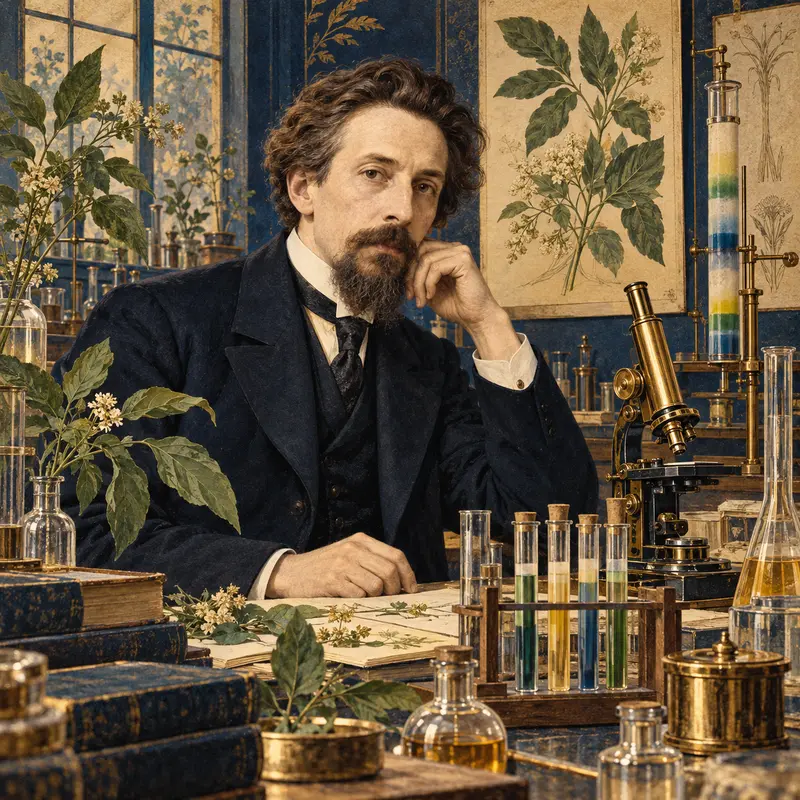
About the chemist
Mikhail Tsvet
1872-1919 · Russia
Invented chromatography