The discovery, explained · Chemist no. 308 of 350
Mikhail Tsvet and the Discovery of Chromatography: Writing with Colours
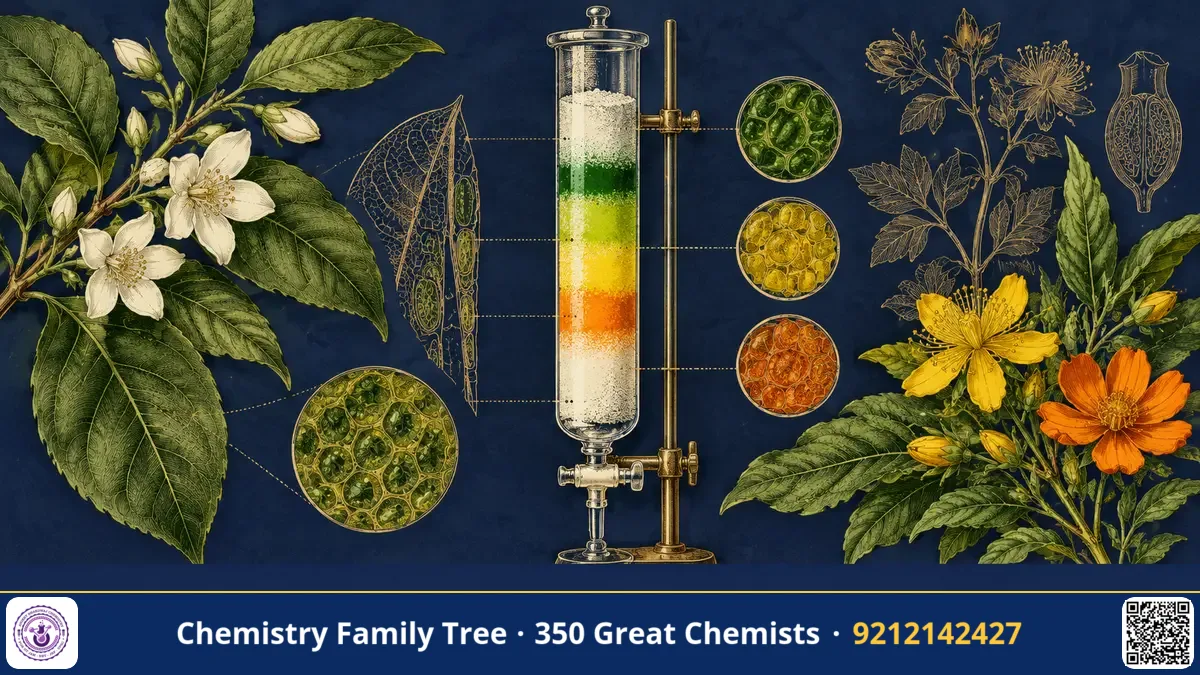
Chromatography is one of the most important laboratory techniques in the world. It is used to purify drugs, test food, check doping in sport, detect pollutants in water and analyse DNA. Every chemistry student learns paper, thin-layer and column chromatography, as well as GC and HPLC. All of these started with a simple experiment performed around 1900–1906 by Mikhail Semyonovich Tsvet (also spelled Tswett), a botanist working in Warsaw. He passed a green plant extract through a glass tube filled with powdered calcium carbonate and saw it separate into coloured bands. He called the method chromatography, from the Greek words chroma (colour) and graphein (to write).
The Scientific Problem Before the Discovery
In the late nineteenth century, chemists separated mixtures mostly by distillation, crystallisation or extraction with solvents. These worked well for volatile liquids or substances with very different solubilities, but they were of little use for delicate, closely related natural products. Plant pigments were an excellent example. It was known that green leaves contain chlorophyll, and that autumn leaves show yellow and orange pigments, but nobody knew how many pigments were present. Many scientists believed that chlorophyll was a single compound. Extracts were complex and chemical treatments often changed the pigments, so it was impossible to be sure what was really in the leaf.
Tsvet was interested in the physical state of chlorophyll in the living cell. He realised that he needed a gentle method which would separate the components of the extract without destroying them.
The Discovery: Step by Step
Tsvet started his experiments around 1900 and reported the method in 1903 at a meeting of the Warsaw Society of Naturalists. His detailed papers appeared in 1906, and a major monograph followed in 1910. His procedure can be summarised as follows:
- Prepare an extract. Green leaves were ground and extracted with a solvent such as petroleum ether or ethanol to dissolve the pigments.
- Pack a column. A narrow glass tube was filled with a fine powder as the adsorbent, such as calcium carbonate (CaCO₃). He tested many substances, such as inulin, sucrose and alumina, as well.
- Load the sample. A small volume of the extract was poured at the top of the column. The pigments stuck to the top layer of the adsorbent.
- Develop the column. Pure solvent (petroleum ether, possibly with a little alcohol or benzene) was added continuously. The solvent flowed down the column and carried the pigments with it at different speeds.
- Observe the bands. The single green band separated into distinct coloured zones: yellow-orange carotene travelled fastest, followed by yellow xanthophylls, then blue-green chlorophyll a and yellow-green chlorophyll b near the bottom.
- Collect the fractions. The column could be pushed out of the tube and cut into sections, or the pigments could be washed out (eluted) separately.
Tsvet called the coloured record on the column a chromatogram. He pointed out that the principle was not limited to coloured substances, and that the same technique could be used for colourless substances if suitable ways of detection existed. This prediction came true, since ultraviolet lamps, chemical spray reagents and electronic detectors are now used to "see" colourless compounds.
The Chemistry Behind It
Chromatography relies on the distribution of a solute between two phases:
- a stationary phase, which stays in place (in Tsvet's work, solid CaCO₃), and
- a mobile phase, which moves (the solvent).
Each component of a mixture is partly adsorbed on the stationary phase and partly dissolved in the mobile phase. A compound that sticks strongly to the stationary phase moves slowly. A compound that prefers the mobile phase moves quickly. Because different substances have different affinities, they separate. In the column of Tsvet, non-polar carotene (a hydrocarbon) has the weakest attraction to polar CaCO₃, so it runs fastest. Polar xanthophylls (with –OH groups) are held more strongly, and the chlorophylls, which have polar ester and carbonyl groups and magnesium, are held more strongly still.
The partition between phases is expressed by the distribution coefficient:
K = C(stationary) / C(mobile)

Rf = (distance moved by solute) / (distance moved by solvent front)       (0 ≤ Rf ≤ 1)

Retention factor k' = (tR − t0) / t0
Resolution Rs = 2(tR2 − tR1) / (w1 + w2)
| Type | Stationary phase | Mobile phase | Used for |
|---|---|---|---|
| Column (adsorption) | Silica, alumina | Liquid | Purification of organic compounds |
| Paper | Water held in cellulose | Liquid | Amino acids, sugars, inks |
| Thin layer (TLC) | Silica on glass or plastic | Liquid | Reaction monitoring, purity tests |
| Gas (GC) | Liquid on solid support or capillary wall | Inert gas (He, N₂) | Volatile compounds, petrol, flavours |
| HPLC | Packed small particles (C18) | Liquid under high pressure | Drugs, vitamins, proteins |
| Ion exchange | Charged resin | Buffer | Water softening, amino acids, proteins |
Applications Today
- Pharmaceuticals: HPLC is a standard method for assay and impurity profiling of tablets; India's large generic drug industry relies on it for quality control.
- Food safety and agriculture: Detecting pesticide residues in fruits, vegetables, tea and spices, and checking food colours and adulterants.
- Forensics and sports: GC–MS and LC–MS detect drugs, poisons and doping agents.
- Environmental analysis: Measuring pollutants such as benzene, PAHs and pesticides in air and water.
- Biochemistry: Size-exclusion, ion-exchange and affinity chromatography purify proteins and enzymes.
- Everyday school demonstration: Separating ink or leaf pigments on filter paper is a classic class activity.
Exam Corner: 5 Likely Points
- Tsvet (Tswett) discovered chromatography in 1903 and coined the name; he used a CaCO₃ column to separate plant pigments with petroleum ether.
- Rf = distance moved by solute / distance moved by solvent front; it is always between 0 and 1 and depends on the solvent system and adsorbent.
- In adsorption chromatography, polar compounds are held more strongly on polar adsorbents like silica and alumina; elution order follows increasing polarity in normal phase.
- Van Deemter equation: H = A + B/u + C·u, which relates plate height to flow velocity.
- Martin and Synge received the 1952 Nobel Prize in Chemistry for partition chromatography.
Common Misconceptions
- "Chromatography only works for coloured substances." The name is historical. Colourless substances are detected by UV, fluorescence, spray reagents, refractive index or mass spectrometry.
- "Rf can be greater than 1." Not for a solute; the solvent front always moves further than the spot.
- "The mobile phase must be a liquid." It can be a gas (GC) or a supercritical fluid (SFC).
Quick Revision Box
- Tsvet presented chromatography in 1903 and published the main papers in 1906 and a monograph in 1910.
- Stationary phase: CaCO₃ column; mobile phase: petroleum ether (with some alcohol).
- Elution order of plant pigments: carotene, then xanthophylls, then chlorophyll a, then chlorophyll b.
- Rf = d(solute)/d(solvent front).
- Separation depends on differences in distribution between the phases.
- Name from Greek chroma (colour) and graphein (write).
FAQ
Is Tsvet's surname connected to colour?
Yes. In Russian, tsvet means "colour". Many writers have noted the coincidence that the inventor of chromatography had a name meaning colour, but he named the method himself from Greek.
Why was chromatography ignored for years?
It was published mostly in Russian and German botanical journals, and some leading chemists doubted his results. The method was re-discovered and made popular in the 1930s, notably by Richard Kuhn and colleagues, and later by Martin and Synge.
What is the difference between adsorption and partition chromatography?
In adsorption chromatography, separation is based on adsorption on the surface of a solid. In partition chromatography, separation is based on the distribution between two liquid phases, one of which is held on a support.
What is the best way to remember the elution order of pigments?
Remember that the least polar compound, carotene, travels furthest, and that polarity increases as you go from carotene to xanthophyll and then to the chlorophylls.
Published by ABC Chemistry — IIT-JAM | CSIR-NET | GATE Chemistry Coaching. Visit abcchemistry.com
About the chemist
Mikhail Tsvet
1872-1919 · Russia
Invented chromatography