Biography · Chemist no. 221 of 350
Morten Meldal: The Danish Peptide Chemist Who Helped Make Click Chemistry Real
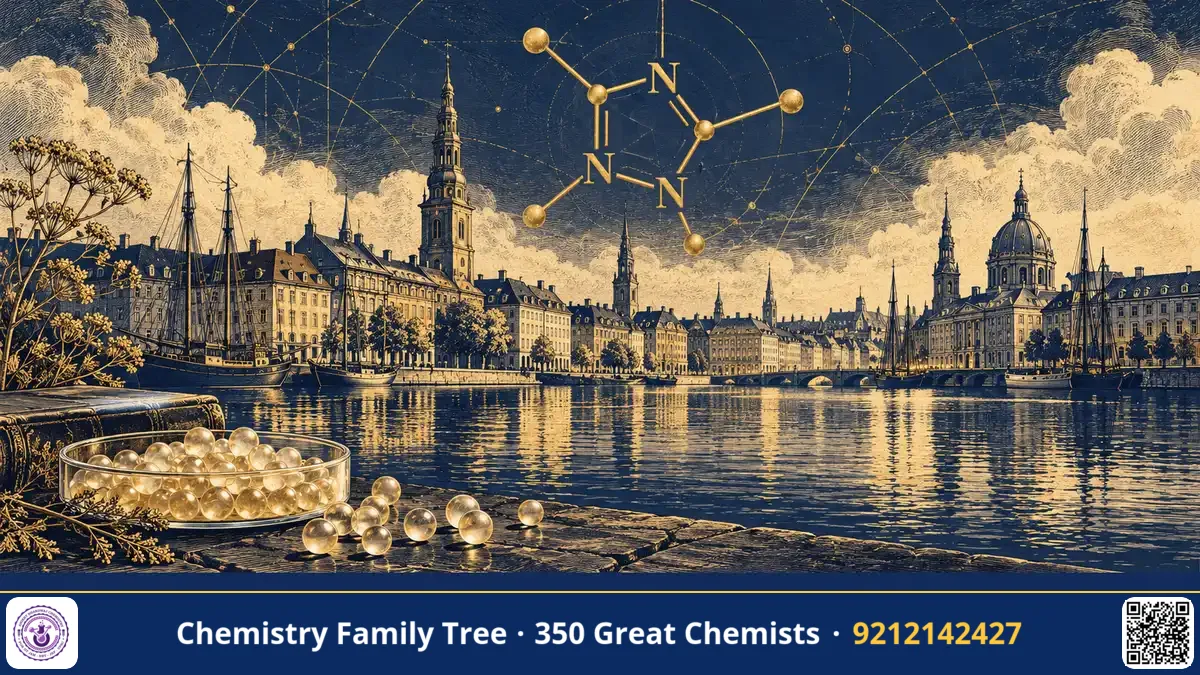
Morten Peter Meldal, born in 1954 in Denmark, is a chemist at the University of Copenhagen. He is best known for discovering, in 2002, that copper(I) catalyses the reaction between azides and terminal alkynes to give 1,4-triazoles, the reaction at the heart of "click chemistry". For this, he shared the 2022 Nobel Prize in Chemistry with Carolyn Bertozzi and K. Barry Sharpless. His legacy in one line: a patient peptide chemist found the reaction that chemists across the world use to join molecules together.
Early Life and Family
Meldal was born on 16 January 1954 in Denmark. Public information about his childhood and family is limited, and this post does not speculate. What is known is that he grew up in Denmark and chose chemistry for his university studies at a time when Danish chemistry had a strong tradition in physical organic chemistry and peptide science.
Education and Mentors
Meldal studied at the Technical University of Denmark (DTU) in Lyngby, where he received his master's degree and went on to a doctorate in organic chemistry, completed in 1986. His early research dealt with carbohydrate chemistry and glycopeptides, the synthesis of sugar-decorated peptides. He then worked at the Carlsberg Laboratory in Copenhagen, the research institute associated with the Carlsberg brewery that has a long history in biochemistry (the pH scale was invented there by S. P. L. Sorensen in 1909).
Career Timeline
| Year | Event |
|---|---|
| 1954 | Born in Denmark |
| 1986 | PhD, Technical University of Denmark |
| Late 1980s | Research at the Carlsberg Laboratory, Copenhagen |
| 1990s | Develops solid-phase methods, combinatorial libraries and fluorescence-quenched peptide substrates |
| 2002 | Publishes the copper(I)-catalysed azide-alkyne cycloaddition |
| 2011 | Joins the University of Copenhagen as professor of chemistry |
| 2022 | Nobel Prize in Chemistry (shared) |
Major Scientific Contributions
CuAAC (2002). He and co-workers reported that Cu(I) catalyses the reaction of azides with terminal alkynes on solid-phase peptides at room temperature to give 1,4-disubstituted triazoles quantitatively. Please read our discovery post for the mechanism and equations.
Combinatorial chemistry and libraries. In the 1990s Meldal developed approaches for "split-and-mix" synthesis of large peptide libraries on beads, and ways to identify active compounds. He also helped develop resins compatible with both organic and aqueous solvents, which allow enzymes to act on bead-bound peptides.
Fluorescence-quenched substrates. His group designed internally quenched fluorescent peptide substrates. When a protease cuts the peptide, the fluorescent group is separated from the quencher and light is emitted, enabling quick screening of protease specificity.
Glycopeptide synthesis. He worked on synthesising peptides carrying carbohydrate groups, which are important for studying glycoproteins and the immune system.
Later work. His group has extended triazole chemistry to new catalysts, and has founded companies that apply the ideas. Another interest has been materials made by click reactions, such as polymer and nanoparticle systems.
Awards, Honours and Nobel Prize
The Nobel Prize in Chemistry 2022 was awarded jointly to Carolyn R. Bertozzi, Morten Meldal and K. Barry Sharpless "for the development of click chemistry and bioorthogonal chemistry". Only the Nobel Prize is listed here, because other honours could not be verified with certainty.
Personality, Struggles and Lesser-Known Facts
- Independent discovery. The 2002 CuAAC reaction was found by Meldal's group and, independently, by the Sharpless group. Both papers appeared within a few months of each other. The Nobel committee recognised both contributions.
- A discovery that grew from a practical need. He was not looking for a famous reaction; he needed a better way to link groups on peptide resin beads.
- Carlsberg connection. The Carlsberg Laboratory has a distinguished past: the Kjeldahl method for nitrogen was also developed there by Johan Kjeldahl in 1883, a method Indian chemistry students meet in analytical courses.
- Brewery science. The Carlsberg Laboratory was founded by the brewery in 1875, which shows how industry funding can support basic science.
Legacy and Influence on Modern Chemistry
CuAAC is one of the most widely used reactions in all of chemistry. Typing "click chemistry" into any scientific database gives tens of thousands of papers, in fields from drug discovery to polymer science and surface chemistry. Because the reaction is simple, a student with minimal equipment can use it, which is why it appears in practical courses. It also paved the way for strain-promoted and other bioorthogonal reactions, which Bertozzi developed for live cells.
Meldal's story also shows the value of a deep specialisation. His deep knowledge of solid-phase chemistry made him capable of noticing an unusual outcome when many others would have regarded it as noise.
Lessons for Students
- Be an expert in something. Mastery of peptide chemistry prepared Meldal to recognise the importance of a surprising result.
- Observe carefully. A clean single product instead of a mixture is a clue worth pursuing.
- Simple is powerful. The best reactions are often those that anyone can run.
- Parallel discovery is normal. Science progresses when several groups work on related ideas; credit is shared.
- Learn the mechanism. Understanding the copper acetylide pathway explains regioselectivity.
Quick Facts Box
- Born: 16 January 1954, Denmark
- Died: Living
- Nationality: Danish
- Field: Organic chemistry, peptide and combinatorial chemistry
- Famous for: Copper-catalysed azide-alkyne cycloaddition (CuAAC), 2002
- Nobel: Chemistry 2022, shared with Bertozzi and Sharpless
FAQ
Where does Morten Meldal work?
He is a professor of chemistry at the University of Copenhagen, and earlier worked at the Carlsberg Laboratory.
What is the relation between Meldal and Sharpless?
Both independently discovered Cu(I) catalysis of the azide-alkyne reaction in 2002. Sharpless also coined the term click chemistry in 2001.
What is solid-phase synthesis?
It is building a molecule, such as a peptide, on an insoluble polymer bead so that excess reagents can be washed away by filtration. Bruce Merrifield won the 1984 Nobel Prize in Chemistry for it.
Is click chemistry in the Indian syllabus?
Cycloadditions and triazole formation are in advanced organic chemistry courses, and click chemistry is a frequent topic in research and general-awareness questions.
Published by ABC Chemistry — IIT-JAM | CSIR-NET | GATE Chemistry Coaching. Visit abcchemistry.com
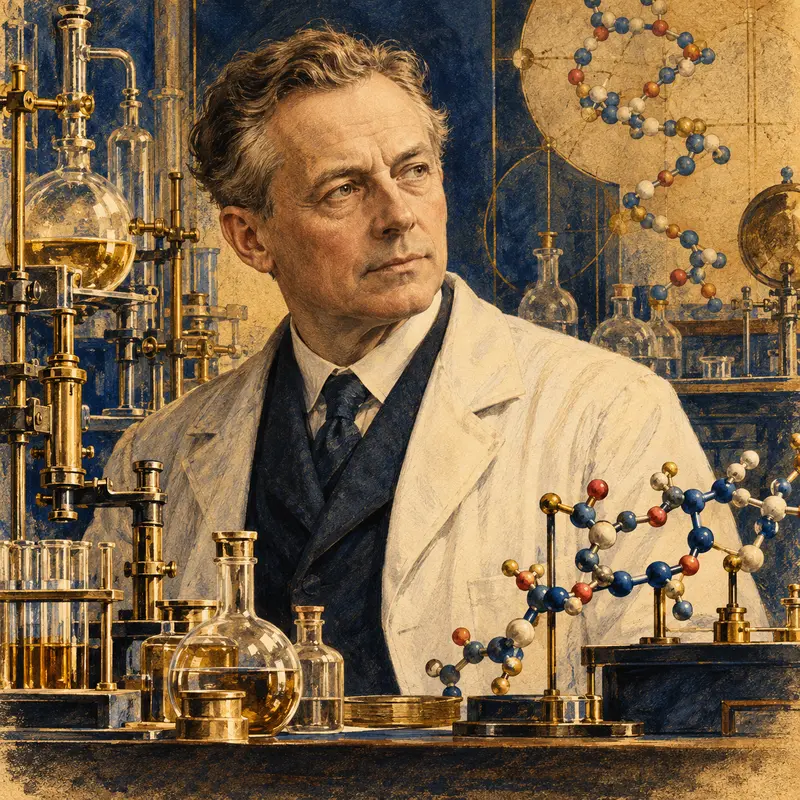
About the chemist
Morten Meldal
1954- · Denmark · Nobel Chemistry 2022
Copper-catalyzed azide-alkyne click reaction