The discovery, explained · Chemist no. 221 of 350
The Copper-Catalysed Click Reaction: How Morten Meldal Found the Perfect Way to Join Two Molecules
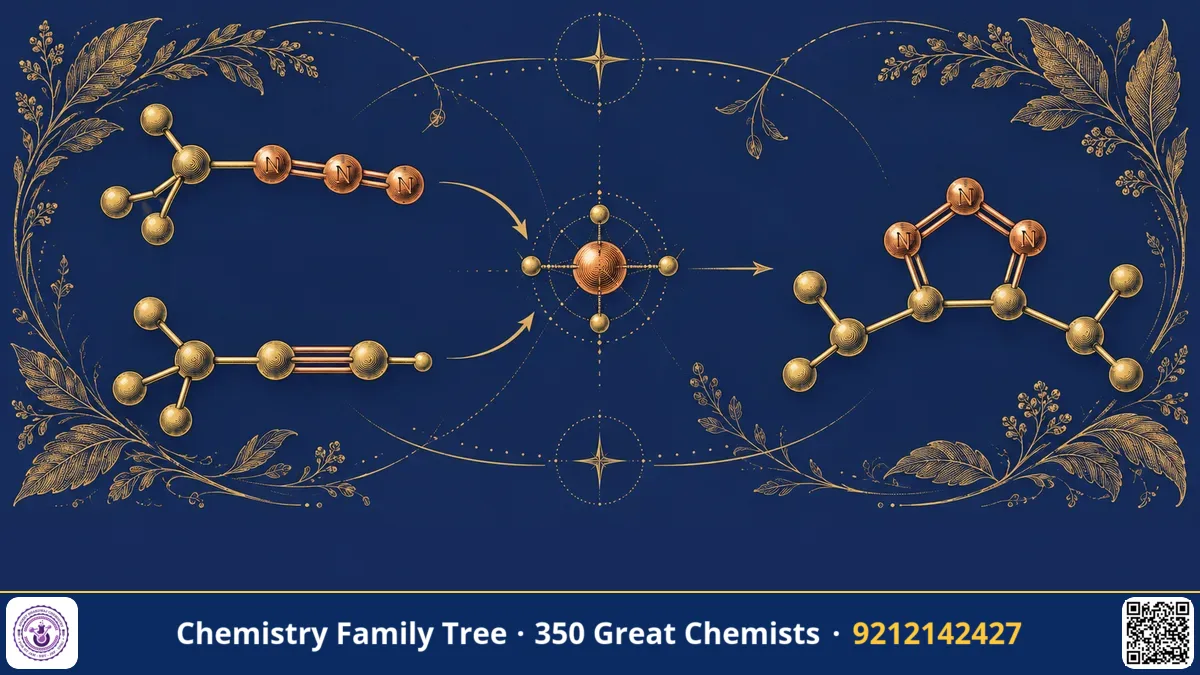
Imagine two molecules, each carrying a small functional group, that find each other in a complex mixture, join quickly, in high yield, at room temperature, in almost any solvent, and with no messy by-products. This is the dream of "click" chemistry. In 2002, the Danish chemist Morten Meldal, working at the Carlsberg Laboratory in Copenhagen, reported that copper(I) turns the slow reaction of an azide with a terminal alkyne into a fast, perfectly regioselective one that gives 1,4-disubstituted 1,2,3-triazoles. At almost the same time, K. Barry Sharpless and Valery Fokin independently reported the same reaction. In 2022, Meldal, Sharpless and Carolyn Bertozzi shared the Nobel Prize in Chemistry for click chemistry and bioorthogonal chemistry.
The reaction is now called the copper-catalysed azide-alkyne cycloaddition (CuAAC). This post explains the earlier problem, how Meldal found it, how the mechanism works, and what you need for exams.
The Scientific Problem Before the Discovery
Rolf Huisgen studied 1,3-dipolar cycloadditions in the 1960s. An organic azide (R-N3) and an alkyne (R'-C≡CH) react to form a 1,2,3-triazole. But the thermal reaction has two problems:
- It needs high temperature (often around 100 degrees C) and long reaction times, because the activation barrier is high.
- With a terminal alkyne it gives a roughly 1:1 mixture of 1,4- and 1,5-disubstituted triazoles, which are hard to separate.
So, despite the beautiful stability of the triazole ring (it resists hydrolysis, oxidation and reduction), the reaction was not useful for joining large, delicate molecules such as peptides. In 2001 Sharpless had introduced the idea of "click chemistry": reactions that are modular, wide in scope, high yielding, create only harmless by-products, are stereospecific, and use simple conditions and benign solvents. A reaction that clicks well was still needed.
The Discovery / Experiment
Meldal was an expert in solid-phase peptide synthesis and combinatorial libraries. In peptide synthesis, a peptide chain is built on insoluble resin beads. Each coupling must be nearly quantitative, so Meldal was looking for new efficient ways to link building blocks on the bead. His group was making peptidotriazoles, peptides in which a triazole ring is part of the structure, as potential enzyme inhibitors.
The experiment, described by Tornoe, Christensen and Meldal in the Journal of Organic Chemistry in 2002, went like this:
- A resin-bound peptide carried a terminal alkyne.
- An azide-containing amino acid derivative was added in an organic solvent with a base and a copper(I) source.
- Instead of a mixture of isomers and a slow reaction, they observed a rapid, clean reaction at room temperature giving a single product, the 1,4-disubstituted triazole.
- The yield was nearly quantitative, and the reaction worked across a wide range of peptide sequences.
R-N3 + HC≡C-R'  --Cu(I), rt-->  1,4-disubstituted 1,2,3-triazole
(azide)  (terminal alkyne)        (rate increase ~10^7 compared with thermal)
The rate acceleration is huge, of the order of ten million times compared with the uncatalysed reaction. Soon after, Sharpless and Fokin showed that the reaction also works in water with Cu(II) sulfate and sodium ascorbate, which generates Cu(I) in situ, making it a very simple practical procedure.
The Chemistry Behind It
The reaction is not a concerted pericyclic Huisgen cycloaddition once copper is present. It is a stepwise process with metal-bound intermediates:
- Copper acetylide formation. Cu(I) coordinates to the terminal alkyne, increasing its acidity, and a base removes the proton to give a copper(I) acetylide.
- Azide coordination. The azide binds to copper through its nitrogen atom; many studies suggest that two copper centres are involved in the key step.
- Ring formation. The terminal nitrogen of the azide attacks the acetylide carbon, forming a six-membered copper metallacycle.
- Ring contraction and protonation. The metallacycle contracts to a triazolyl-copper species, which is protonated to release the 1,4-triazole and regenerate the catalyst.
Because the C-C bond forms between the azide terminal nitrogen and the internal acetylide carbon in a defined way, only the 1,4-isomer is produced. Later, ruthenium catalysts (RuAAC) were found to give the 1,5-isomer, and work with internal alkynes.
| Condition | Product | Rate |
|---|---|---|
| Thermal (Huisgen) | Mixture of 1,4- and 1,5-triazoles | Slow, heat needed |
| Cu(I) (CuAAC) | 1,4-triazole only | Very fast at room temperature |
| Ru (RuAAC) | 1,5-triazole | Fast; works with internal alkynes |
The triazole formed is not just a linker. It is rigid, has a strong dipole, can accept hydrogen bonds and resembles an amide bond in size and polarity, so it can serve as an amide bioisostere in drug design.
Applications Today
- Drug discovery. Medicinal chemists use CuAAC to assemble libraries of candidates quickly by linking azide and alkyne fragments.
- Polymers and materials. Click reactions build dendrimers, block copolymers, hydrogels and functional surfaces.
- Bioconjugation. Labelling proteins, nucleic acids and glycans in lysates or on fixed cells; for live cells, copper-free versions developed by Bertozzi are often preferred.
- DNA chemistry. Click ligation is used to join DNA strands and to label oligonucleotides, as well as in DNA sequencing and diagnostic technology.
- Industry and education. The reaction is a favourite example of green and atom-economic chemistry taught in Indian university curricula.
Exam Corner
- CuAAC gives only 1,4-disubstituted 1,2,3-triazoles; RuAAC gives the 1,5-isomer.
- Huisgen 1,3-dipolar cycloaddition is a [3+2] thermal reaction with a mixture of regioisomers.
- Cu(II) + sodium ascorbate generates the active Cu(I) catalyst in situ.
- A click reaction should be modular, high yielding, stereospecific and use simple conditions.
- The 2022 Chemistry Nobel: Meldal, Sharpless and Bertozzi.
Common Misconceptions
- "Click chemistry is a single reaction." It is a set of criteria; CuAAC is the best-known example, but others (thiol-ene, SuFEx, etc.) also qualify.
- "CuAAC is a concerted cycloaddition." The copper-mediated pathway is stepwise.
- "Meldal and Sharpless worked together." They discovered the copper catalysis independently and at about the same time.
Quick Revision Box
- Year: 2002; Carlsberg Laboratory, Copenhagen.
- Substrates: organic azide + terminal alkyne.
- Catalyst: Cu(I) (or Cu(II) with a reducing agent such as sodium ascorbate).
- Product: 1,4-disubstituted 1,2,3-triazole, single regioisomer.
- Rate acceleration: roughly 10^7 over the thermal reaction.
- Nobel Prize in Chemistry 2022.
FAQ
What is a triazole?
It is a five-membered aromatic ring containing three nitrogen atoms and two carbon atoms. The 1,2,3-triazole is the one made in the azide-alkyne reaction.
Why did Meldal discover it on a solid support?
His group was making peptide libraries on resin beads, and a high-yielding reaction was essential for such work. The solid phase made the new reactivity easy to notice.
Is the reaction safe?
Small organic azides can be explosive and must be handled carefully, but at normal laboratory scales with proper precautions the reaction is widely used.
Why does the catalyst give only one isomer?
The copper acetylide mechanism joins the azide's terminal nitrogen to the alkyne's internal carbon through a metallacycle, which fixes the 1,4-substitution pattern.
Published by ABC Chemistry — IIT-JAM | CSIR-NET | GATE Chemistry Coaching. Visit abcchemistry.com
About the chemist
Morten Meldal
1954- · Denmark · Nobel Chemistry 2022
Copper-catalyzed azide-alkyne click reaction