The discovery, explained · Chemist no. 33 of 350
Molecular Orbital Theory: Robert Mulliken's Way of Seeing Chemical Bonds
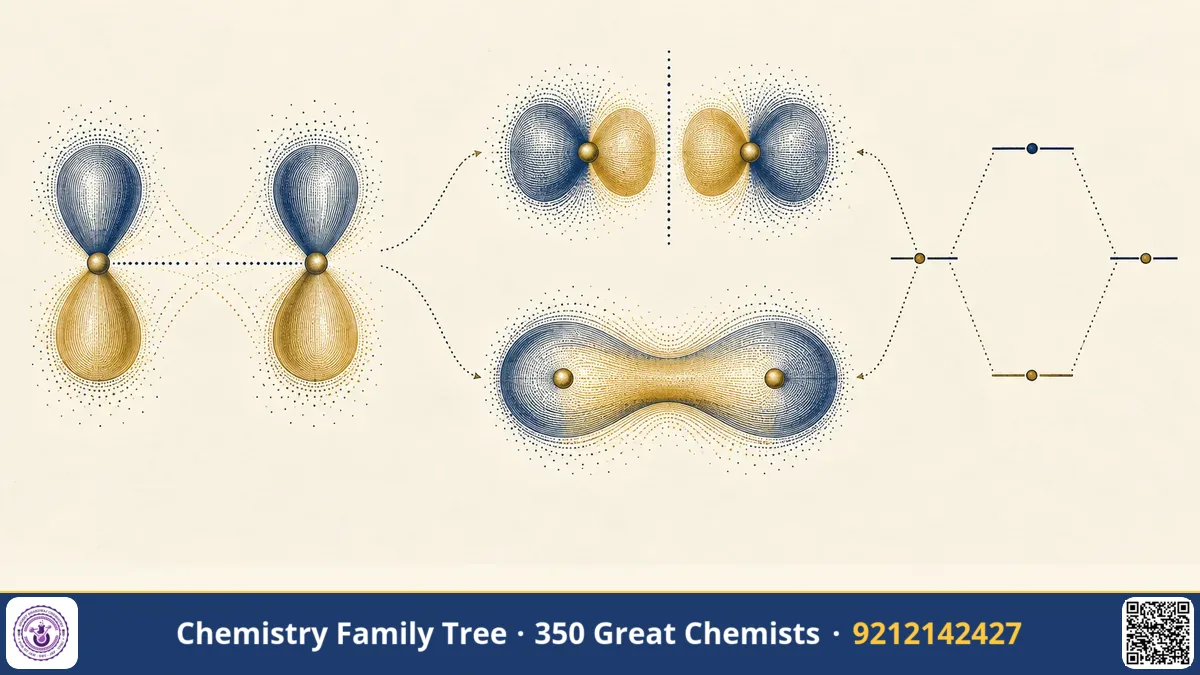
Why is oxygen attracted to a magnet? Why does a nitrogen molecule have such a strong triple bond? Why is the helium molecule He₂ not found? These questions are difficult to answer with simple Lewis dot structures. In the late 1920s and 1930s the American chemist Robert S. Mulliken, working with the German physicist Friedrich Hund and later with others, developed molecular orbital (MO) theory, which treats electrons in a molecule as spread over the entire molecule in orbitals, just as electrons in atoms occupy atomic orbitals. Mulliken received the 1966 Nobel Prize in Chemistry for his fundamental work concerning chemical bonds and the electronic structure of molecules by the molecular orbital method. This post explains the theory in the way you need it for exams.
The Scientific Problem Before the Discovery
G. N. Lewis (1916) described a bond as a shared pair of electrons, and Heitler and London (1927) gave a quantum-mechanical treatment of the hydrogen molecule that led to valence bond theory (VBT). These ideas were successful and simple, but they left problems unsolved.
- Oxygen has an even number of electrons, so a Lewis structure O=O with all electrons paired would predict that oxygen is diamagnetic. Experiments show that liquid oxygen is attracted to a magnetic field: it is paramagnetic.
- Valence bond theory had difficulty explaining odd-electron bonds such as the one-electron bond in H₂⁺.
- Electronic spectra of molecules, with their characteristic absorption bands, needed a picture in which electrons occupy defined energy levels in the whole molecule.
- Delocalised systems such as benzene needed resonance structures in VBT, which many students find artificial.
The Discovery: Step by Step
Mulliken began by studying the band spectra of diatomic molecules in the 1920s. He realised that the spectral lines could be understood if each electron in a molecule has its own orbital, with its own energy, extending over the whole molecule. Working in Europe in 1925-1927 with Hund and others, he classified molecular electronic states and developed the language of molecular orbitals. In 1932 he introduced the word orbital for such one-electron wave functions. Meanwhile, John Lennard-Jones (1929) proposed building molecular orbitals as combinations of atomic orbitals, the idea now called LCAO.
The LCAO idea
When two atomic orbitals φ_A and φ_B overlap, they combine in two ways:
ψ(bonding) = φ_A + φ_B        (waves in phase; lower energy)
ψ(antibonding) = φ_A - φ_B    (waves out of phase; higher energy, with a node between nuclei)
The bonding orbital concentrates electron density between the nuclei and stabilises the molecule. The antibonding orbital (marked with an asterisk, for example σ*) has a node between the nuclei and destabilises the molecule.
Rules for forming molecular orbitals
- The number of molecular orbitals equals the number of atomic orbitals combined.
- Atomic orbitals combine effectively only if their energies are similar and they have the same symmetry about the bond axis.
- The overlap must be good. Greater overlap means a larger splitting.
- Electrons fill the orbitals following the Aufbau principle, the Pauli exclusion principle and Hund's rule.
Bond order
Bond order = (Nb - Na) / 2
Here Nb is the number of electrons in bonding orbitals and Na is the number in antibonding orbitals. Bond order zero means the molecule does not form.
Order of energy levels
For homonuclear diatomics of the second period, the energy sequence is:
Li₂ to N₂:   σ1s < σ*1s < σ2s < σ*2s < π2p(x,y) < σ2p(z) < π*2p(x,y) < σ*2p(z)
O₂ and F₂:   σ1s < σ*1s < σ2s < σ*2s < σ2p(z) < π2p(x,y) < π*2p(x,y) < σ*2p(z)
The switch in the order of σ2p and π2p for lighter molecules (up to N₂) is due to s-p mixing.
The Chemistry Behind It
Oxygen is paramagnetic
O₂ has 16 electrons. After filling up to π2p, the last two electrons go into the two degenerate π* orbitals, one in each, with parallel spins (Hund's rule). So O₂ has two unpaired electrons and is paramagnetic. Bond order = (10 - 6)/2 = 2, which matches an O=O double bond. This was a major success of MO theory over simple Lewis theory.
Nitrogen and bond order
N₂ has 14 electrons: 10 bonding and 4 antibonding, so bond order = 3, with all electrons paired (diamagnetic). The very strong triple bond explains why N₂ is so unreactive.
Ions and trends
| Species | Bond order | Magnetism |
|---|---|---|
| H₂ | 1 | Diamagnetic |
| He₂ | 0 | Does not exist |
| B₂ | 1 | Paramagnetic |
| C₂ | 2 | Diamagnetic |
| N₂ | 3 | Diamagnetic |
| O₂ | 2 | Paramagnetic |
| O₂⁺ | 2.5 | Paramagnetic |
| O₂⁻ | 1.5 | Paramagnetic |
| F₂ | 1 | Diamagnetic |
Removing an electron from O₂ takes it out of an antibonding orbital, so O₂⁺ has a higher bond order (2.5) and a shorter bond. Adding an electron to O₂ increases antibonding population and lowers the bond order.
Mulliken electronegativity
Mulliken also proposed a scale of electronegativity as the average of the ionisation energy and the electron affinity of an atom:
χ(Mulliken) = (IE + EA) / 2
This is a definition based on measurable atomic properties, in contrast to the thermochemical scale of Pauling. He also introduced Mulliken population analysis, a method for dividing electron density between atoms in a molecule, and the Mulliken symbols (A, B, E, T) used to label orbital symmetry in group theory.
Applications Today
- Computational chemistry: software such as Gaussian, ORCA and GAMESS builds molecular orbitals as combinations of basis functions, an extension of LCAO.
- Spectroscopy: UV-visible absorption corresponds to HOMO-LUMO transitions; colour of dyes and pigments can be understood from orbital energy gaps.
- Inorganic chemistry: crystal field theory and ligand field theory (octahedral complexes, magnetic moments) rely on MO ideas.
- Materials: band theory of semiconductors is MO theory extended to large numbers of atoms.
- Organic reactivity: frontier orbital theory and the Woodward-Hoffmann rules use molecular orbitals to predict reactions.
- India context: Liquid oxygen's paramagnetism is demonstrated in many school and college laboratories, and MO diagrams appear in every Indian undergraduate syllabus.
Exam Corner
- Bond order = (Nb - Na)/2; higher bond order means shorter bond length and greater bond energy.
- O₂ is paramagnetic with two unpaired electrons in π*2p; N₂ is diamagnetic with bond order 3.
- For B₂, C₂ and N₂, the π2p orbitals lie below σ2p because of s-p mixing; B₂ is paramagnetic.
- Mulliken electronegativity is the average of ionisation energy and electron affinity.
- Mulliken was awarded the 1966 Nobel Prize in Chemistry.
Common Misconceptions
- "Antibonding orbitals are empty." They may hold electrons, as in O₂, but this weakens the bond.
- "MO theory and VB theory are rivals and one is wrong." They are two approximate approaches; each is better for some questions.
- "Bond order must be a whole number." It can be a fraction, such as 2.5 in O₂⁺ or 1.5 in O₂⁻.
Quick Revision Box
- MO theory: electrons occupy orbitals spread over the whole molecule.
- LCAO: bonding = φA + φB; antibonding = φA - φB.
- Bond order = (Nb - Na)/2.
- O₂: bond order 2, paramagnetic. N₂: bond order 3, diamagnetic.
- Mulliken electronegativity = (IE + EA)/2.
- Nobel Prize in Chemistry 1966.
FAQ
Who coined the word orbital?
Mulliken introduced the term in 1932 for one-electron wave functions in atoms and molecules.
Why does He₂ not exist?
Both the bonding σ1s and antibonding σ*1s orbitals would be filled, so bond order is zero and there is no net stabilisation.
What is the HOMO-LUMO gap?
It is the energy difference between the highest occupied and the lowest unoccupied molecular orbital, which controls colour and reactivity.
Did Mulliken work alone?
No. Friedrich Hund, John Lennard-Jones, Erich Hückel and others also contributed to molecular orbital theory.
Published by ABC Chemistry — IIT-JAM | CSIR-NET | GATE Chemistry Coaching. Visit abcchemistry.com
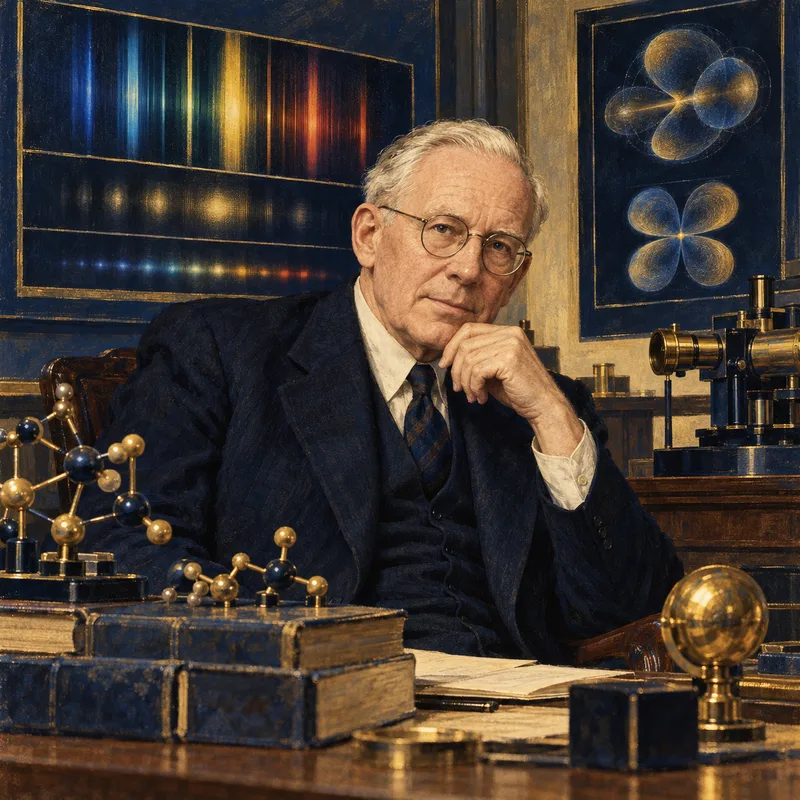
About the chemist
Robert S. Mulliken
1896-1986 · United States · Nobel Chemistry 1966
Molecular orbital theory