Biography · Chemist no. 33 of 350
Robert S. Mulliken: The Architect of Molecular Orbitals
Introduction
Robert Sanderson Mulliken (1896-1986) was an American physical chemist who taught the world to see molecules as collections of electrons moving in orbitals that spread over the whole molecule. His molecular orbital theory explains why oxygen is paramagnetic, why nitrogen is so stable, and why molecules absorb light of particular colours. He received the Nobel Prize in Chemistry in 1966, and spent most of his career at the University of Chicago. His legacy in one line: he gave chemistry the molecular orbital, the idea at the heart of every modern calculation of chemical bonding.
Early Life and Family
Mulliken was born on 7 June 1896 in Newburyport, Massachusetts. His father, Samuel Parsons Mulliken, was a professor of organic chemistry at the Massachusetts Institute of Technology and the author of a well-known work on the identification of organic compounds. Growing up in a family of scientists and academics, he was exposed to chemistry from an early age, and he grew up in the New England academic world around Boston.
Education and Mentors
Mulliken studied chemistry at MIT and graduated with a bachelor's degree in 1917. He then began graduate study at the University of Chicago, but the First World War interrupted it, and he worked for the Chemical Warfare Service, taking part in research on poison gases. After the war, he returned to Chicago, where his supervisor was William Draper Harkins. His doctoral work on the separation of isotopes of mercury by evaporation earned his PhD in 1921. This gave him an early interest in isotopes, and in the 1920s his research shifted to molecular spectra. He worked as a postdoctoral researcher at Harvard, then spent time in Europe in 1925-1927, where he met leading quantum theorists in Göttingen, Zürich and elsewhere, including Friedrich Hund, Max Born and Erwin Schrödinger.
Career Timeline
| Year | Event |
|---|---|
| 1896 | Born in Newburyport, Massachusetts (7 June) |
| 1917 | Graduates from MIT in chemistry |
| 1918 | Works on chemical warfare research during the First World War |
| 1921 | PhD at the University of Chicago, studying isotope separation |
| 1925-27 | Works in Europe with leading quantum physicists, including Hund |
| 1926 | Joins New York University as an assistant professor |
| 1928 | Returns to the University of Chicago as professor of physics |
| 1932 | Introduces the term orbital for one-electron wave functions |
| 1934 | Proposes the electronegativity scale based on ionisation energy and electron affinity |
| 1942-45 | Works at the University of Chicago on the Manhattan Project (information division) |
| 1966 | Wins the Nobel Prize in Chemistry |
| 1960s-80s | Continues research at Chicago and later Florida State University |
| 1986 | Dies in Arlington, Virginia (31 October) |
Major Scientific Contributions
- Molecular orbital theory: the description of electrons in molecules as occupying orbitals of the whole molecule, built as linear combinations of atomic orbitals.
- Classification of molecular states: a systematic notation for the electronic states of diatomic molecules, using symbols such as σ, π, δ and the labels Σ, Π, Δ.
- Electronegativity scale (1934): χ = (IE + EA)/2.
- Population analysis (1955): a way to estimate the charges on atoms in a molecule from its wave function.
- Charge-transfer complexes: his work on donor-acceptor complexes helped to explain the colour and bonding in compounds such as iodine in different solvents.
- Isotope effects in band spectra: early work that connected spectral lines to isotopic mass.
The details of the theory, with MO diagrams for O₂ and N₂, are in our companion post on molecular orbital theory.
Awards, Honours and Nobel Prize
- Nobel Prize in Chemistry, 1966: awarded to Mulliken alone for his fundamental work concerning chemical bonds and the electronic structure of molecules by the molecular orbital method.
- Member of the United States National Academy of Sciences, elected in the 1930s.
- Priestley Medal of the American Chemical Society, awarded late in his career.
- Honorary degrees and memberships in many foreign academies.
Personality, Struggles and Lesser-Known Facts
- A family of chemists. His father taught organic chemistry at MIT, and Robert chose to apply physics to chemistry, reflecting a bridge between two disciplines.
- Years in wartime research. In the First World War he worked on gas research; in the Second World War he took part in the Chicago group that dealt with scientific information for the atomic bomb project, though his main work remained spectroscopy.
- The bridge between physics and chemistry. Mulliken held a professorship in both physics and chemistry at Chicago. He believed that chemists should use quantum theory freely.
- Modest about the prize. He often described MO theory as the combined work of many people, including Hund, Lennard-Jones, Hückel and Slater, not only his own.
- Family. He married Mary Helen von Noé in 1929, and they had two daughters.
Legacy and Influence on Modern Chemistry
Molecular orbital theory is now the main language of theoretical chemistry. Gaussian-type programs compute molecular orbitals for thousands of molecules every day. The HOMO and LUMO ideas guide organic chemists in understanding reactions, inorganic chemists in understanding coordination compounds, and materials scientists in developing semiconductors, solar cells and light-emitting diodes. The Mulliken symbols are used in group theory and spectroscopy in every syllabus. His electronegativity concept remains a standard alternative to the Pauling scale. Students at IIT, IISc and central universities in India meet his ideas in their first course in inorganic chemistry.
Lessons for Students
- Learn physics as a chemist. The most powerful chemical ideas often come from the border of two subjects.
- Spectra hold clues. Careful measurements can reveal hidden structure.
- Share credit. Great theories grow from many people's contributions.
- Be persistent. It took decades for MO theory to become popular.
- Travel and talk. His time in Europe linked him to the quantum revolution.
Quick Facts Box
- Born: 7 June 1896, Newburyport, Massachusetts, USA
- Died: 31 October 1986, Arlington, Virginia, USA
- Nationality: American
- Field: Physical and theoretical chemistry
- Famous for: Molecular orbital theory, Mulliken electronegativity
- Nobel Prize: Chemistry, 1966
FAQ
Why did Mulliken win the Nobel Prize?
For his fundamental work on chemical bonds and the electronic structure of molecules using the molecular orbital method.
Where did Mulliken work for most of his career?
At the University of Chicago, where he was professor of physics and chemistry for many years.
What is Mulliken electronegativity?
It is the average of the first ionisation energy and the electron affinity of an atom.
Who worked with Mulliken on early MO theory?
Friedrich Hund was a close collaborator, and the two names are linked as Hund-Mulliken theory.
Published by ABC Chemistry — IIT-JAM | CSIR-NET | GATE Chemistry Coaching. Visit abcchemistry.com
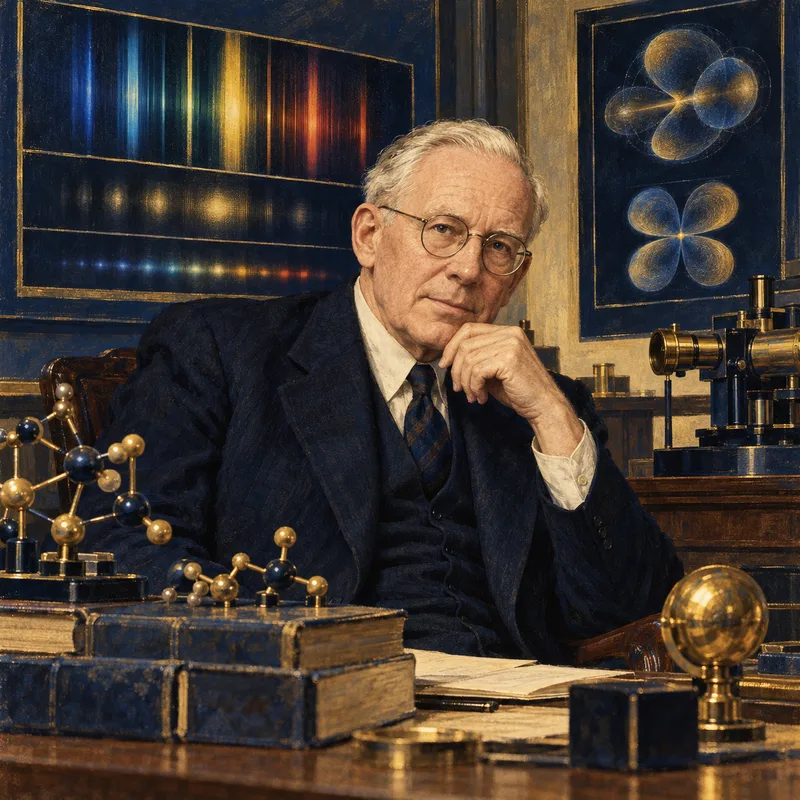
About the chemist
Robert S. Mulliken
1896-1986 · United States · Nobel Chemistry 1966
Molecular orbital theory