Biography · Chemist no. 333 of 350
Nagarjuna the Alchemist: Separating Legend from History
Introduction
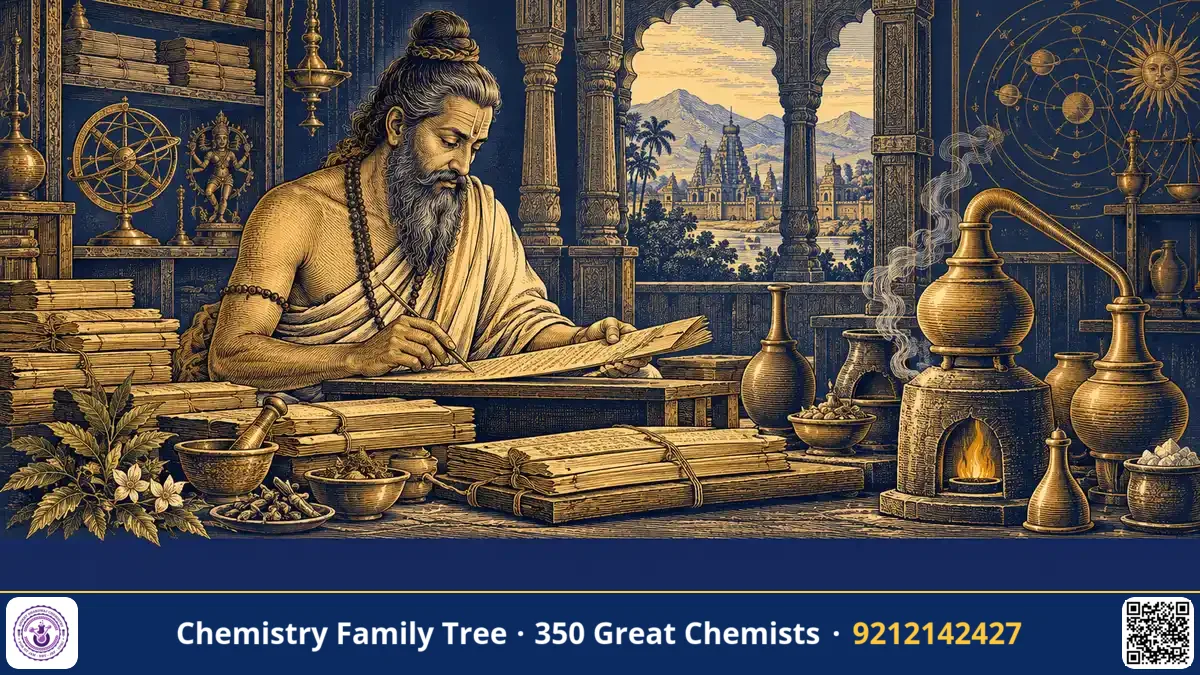
Nagarjuna is one of the most famous names in the history of Indian chemistry, and also one of the most difficult to pin down. Texts of Rasashastra, the Indian tradition of mercury-based alchemy and medicine, present him as a great master (siddha). Stories say he made gold, lived for centuries and gave his own head to a prince. Historians, however, can say much less. This post is written differently from the other biographies: it clearly divides what is documented from what is legend, because for Nagarjuna the alchemist, there are almost no secure personal dates, no certain birthplace and no verified portrait.
Early Life and Family
What is documented. Al-Biruni, the Persian scholar who travelled in India and wrote his account (Kitab al-Hind) in the early 11th century, mentions an alchemist called Nagarjuna, from Daihak near Somnath in Gujarat, who was an expert in the art of alchemy and who, according to Al-Biruni, lived about a century before his own time. This is one of the few outside records.
What is legend. Later stories give him a miraculous birth, a life of several centuries, and associations with the Satavahana kings and with the Nagarjunakonda region of Andhra Pradesh. These accounts mix him with the Buddhist philosopher Nagarjuna (c. 2nd century CE), the founder of the Madhyamaka school. Most historians now think that the philosopher and the alchemist were separate people.
Education and Mentors
Nothing reliable is known about his formal education. Rasashastra works place him within a lineage of teachers, and refer to him as a student or follower of earlier masters in a tradition that was transmitted orally and in manuscripts. These lineages belong to the way such texts present themselves, and cannot be verified. The works show that their authors knew mining, metallurgy, medicine and the techniques of heating and distillation, but where and from whom the person called Nagarjuna learned them is not recorded.
Career Timeline
| Period | Event |
|---|---|
| c. 2nd century CE | Buddhist philosopher Nagarjuna (a different person according to most historians) |
| Early medieval period | Rasashastra develops; texts attributed to Nagarjuna such as the Rasaratnakara take shape |
| Before about 1000 CE | Alchemist Nagarjuna of Daihak, near Somnath, as reported by Al-Biruni |
| 11th to 14th centuries | Later texts such as Rasarnava and Rasendra Mangala expand the tradition |
| Modern era | Scholars such as P. C. Ray draw attention to Indian alchemy in A History of Hindu Chemistry |
The table deliberately gives periods and not precise years, because exact dates cannot be given with confidence.
Major Scientific Contributions
The texts attached to his name describe:
- Purification and treatment of mercury in a series of processes (samskaras).
- Extraction of mercury from cinnabar and preparation of sulphides of mercury (HgS), as in HgS + O₂ → Hg + SO₂.
- Classification of minerals and metals, and preparation of calcined metal powders (bhasmas).
- Descriptions of apparatus such as furnaces, crucibles and distillation devices.
See the companion discovery post for the chemistry. It is important to be careful. The attribution of these contributions to one individual is a tradition. They are better described as the accumulated work of a school of practitioners to which his name was attached.
Awards, Honours and Nobel Prize
There are no awards in the modern sense, and no Nobel Prize, since he belongs to a different age. His honour is the continuing place of his name in Indian scientific memory. The Nagarjuna name is also attached to institutions and to the Nagarjuna Sagar dam in Andhra Pradesh and Telangana, though that name comes from the Buddhist philosopher's association with the region and not from the alchemist.
Personality, Struggles and Lesser-Known Facts
- Legend: gift of his head. A widely told story says that he offered his own head to the son of a king who wished to be king, and died. It is a legend and not a historical fact, and it is generally told about the Buddhist Nagarjuna.
- Legend: gold-making. The tradition says he could transmute metals to gold. There is no evidence for this. Such stories were common to alchemy everywhere.
- Documented: foreign interest. Al-Biruni was interested in the Indian alchemical tradition and recorded what he heard, which tells us the name had fame by the early 11th century.
- Documented: text tradition. Many manuscripts of Rasashastra exist in Indian libraries, and several works carry his name, which shows the authority attached to it.
- Modern scholarship. P. C. Ray used the Sanskrit alchemical texts, including those linked to Nagarjuna, as source material for his history, which introduced the subject to the modern scientific community.
Legacy and Influence on Modern Chemistry
Rasashastra did not lead directly to modern chemistry in the way that European alchemy did, but it left a rich tradition of laboratory skills: distillation, sublimation, calcination, the use of closed vessels and careful preparation of inorganic compounds. These practices are part of the long history of chemistry as a practical art. The documented zinc distillation at Zawar and the production of wootz steel show that Indian craftsmen reached a high level of materials technology. Today, mercury-containing traditional medicines are a subject of study and regulation because of toxicity, and the tradition is also examined by historians of science to understand how knowledge was passed on.
Lessons for Students
- Distinguish evidence from legend. This is the first rule of science and of history.
- Respect traditional knowledge, but test it with modern methods and safety standards.
- Remember that chemistry grew out of crafts such as mining, dyeing and metallurgy.
- Never handle mercury casually. Its vapour is toxic.
Quick Facts Box
- Born: Unknown; early medieval India (before about 1000 CE)
- Died: Unknown
- Nationality: Indian
- Field: Rasashastra (alchemy, mercury chemistry, medicine)
- Famous for: Attributed author of the Rasaratnakara; mercury processing
- Nobel: Not applicable
FAQ
Is Nagarjuna the alchemist the same as Nagarjuna the Buddhist philosopher?
Tradition often merges them, but most historians believe they were two different people living centuries apart.
What does Al-Biruni say about Nagarjuna?
He mentions an alchemist named Nagarjuna from Daihak near Somnath in Gujarat, who lived some time before his own day.
Did he really discover how to make gold?
No credible evidence supports this. It belongs to legend.
Why do chemistry students study him?
Because he represents the early Indian tradition of chemistry, including the extraction and treatment of mercury, which may be asked in history-of-chemistry questions.
Published by ABC Chemistry — IIT-JAM | CSIR-NET | GATE Chemistry Coaching. Visit abcchemistry.com
About the chemist
Nagarjuna (Indian alchemist)
c. 10th century · India
Rasa Shastra; mercury alchemy