The discovery, explained · Chemist no. 333 of 350
Nagarjuna and the Rasaratnakara: Indian Alchemy, Mercury and the Roots of Chemistry
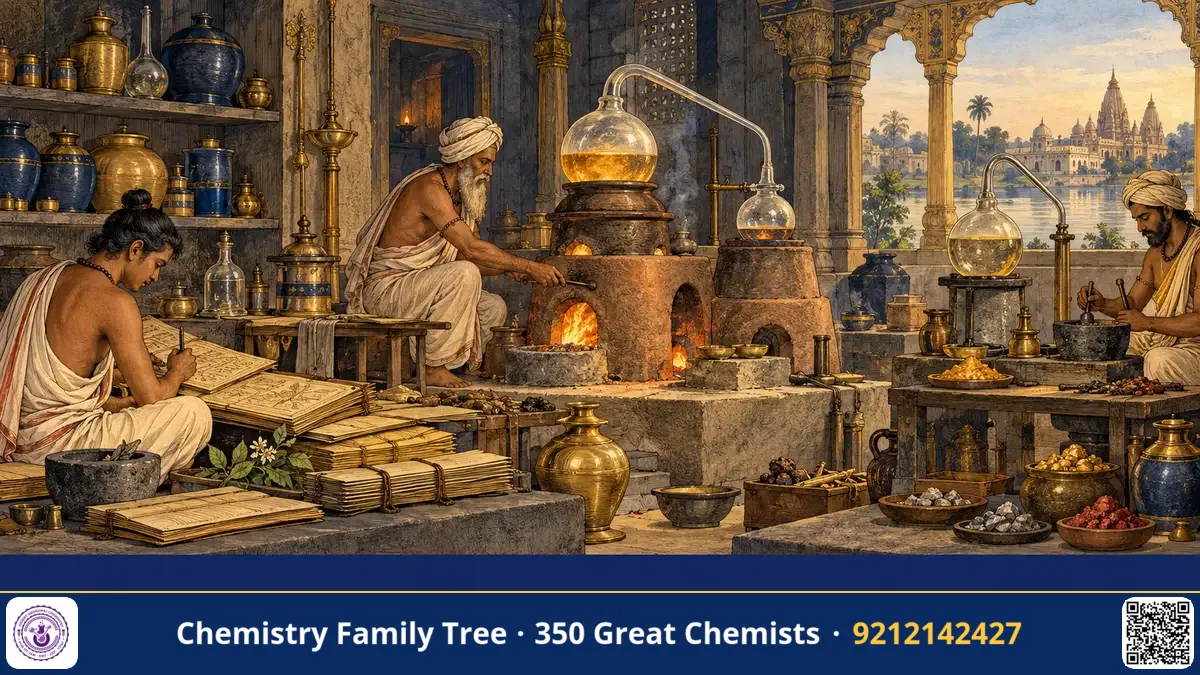
Long before the periodic table, Indian practitioners of Rasashastra, the "science of mercury" (rasa means mercury), developed methods to purify, transform and use mercury and other minerals. The name most closely linked with this tradition is Nagarjuna, an alchemist to whom the text Rasaratnakara (the "Mine of Mercurial Jewels") is traditionally attributed. This post separates what we can say with reasonable historical confidence from what belongs to legend, and then looks at the real chemistry behind mercury processing that you may meet in exams on the history and development of chemistry.
The Scientific Problem Before the Discovery
Ancient and medieval India had mining, metallurgy, dyeing, glassmaking and medicine. Texts such as the Arthashastra (a work on statecraft) mention metals, alloys and mineral processing, and the medical Charaka and Sushruta Samhitas use some metals and minerals. But the tradition of Rasashastra, in which mercury is the central substance, emerges later, in the early medieval period. Its practitioners wanted two things. One was a medicine that could keep the body free of disease, and the other, in the alchemical sense, was to transmute base metals into gold. Mercury, a liquid metal that dissolves other metals into amalgams, seemed the key. The practical problem was that raw mercury and its ores are poisonous. They had to be purified and converted into forms that could be handled.
Legend Versus Documented History
| Claim | Status |
|---|---|
| A person named Nagarjuna is the great alchemist of India | Strong tradition; Rasashastra texts name him as a master (siddha) |
| Nagarjuna wrote the Rasaratnakara | Attributed by tradition; scholars generally think the surviving text is a later composition (early medieval) associated with his name |
| He is the same person as Nagarjuna the Buddhist Madhyamaka philosopher | Tradition links them, but historians treat the philosopher (c. 2nd century CE) and the alchemist as different people, with the alchemist later |
| Al-Biruni (early 11th century) mentions an alchemist Nagarjuna from Daihak, near Somnath in Gujarat | Documented in Al-Biruni's account of India; it places an alchemist of this name some time before 1000 CE |
| He turned lead into gold, lived hundreds of years, or died by beheading when he gave up his head to a prince | Legend; no scientific or historical evidence |
The honest statement is this: a historical alchemist of the name Nagarjuna probably lived in the early medieval period, but the details of his life are not secure, and the texts that carry his name were revised and extended over time. We can still study what those texts say about chemical practice.
The Discovery: Step by Step
Texts of this tradition, including the Rasaratnakara and later works such as the Rasarnava and Rasendra Mangala, describe a systematic programme of mercury treatment known as the samskaras (processes), traditionally eighteen in number. The broad scheme is:
- Step 1: Purification. Mercury is ground with substances such as garlic, rock salt, brick powder and sour liquids to remove impurities.
- Step 2: Heating and steaming. Mercury is heated in pots by indirect steam (swedana) to modify and cleanse it.
- Step 3: Extraction from cinnabar. Mercury is obtained from its ore (hingula, cinnabar HgS) by heating and distillation.
- Step 4: Combination with sulphur. Mercury is rubbed with sulphur to make a black or red sulphide (kajjali), then heated further to give cinnabar (rasa sindura).
- Step 5: Calcination (marana). Metals are heated with herbal and mineral substances to turn them into fine powders or oxides called bhasmas.
Cinnabar roasting:   HgS + O₂ → Hg(g) + SO₂
Condensation:        Hg(g) → Hg(l)  (cooled in a receiver)
Kajjali:             Hg + S → HgS (black, metacinnabar), grinding at room temperature
Heating further:     HgS (black) → HgS (red, cinnabar) by sublimation
The apparatus is described in these texts as well: crucibles (musha), furnaces (kosthi), distillation set-ups such as the patana yantra (an upward or downward distillation apparatus), the dola yantra (a suspended-pot vessel for boiling a substance in liquid) and the sthali yantra. These show a developed laboratory practice, with control of heat, closed vessels and condensation.
The Chemistry Behind It
Mercury and its ore. Cinnabar is mercury(II) sulphide. It is roasted in air and mercury vapour distils because the boiling point of mercury is low (356.7 °C). Reaction: HgS + O₂ → Hg + SO₂. This is the classic example of a metal obtained by roasting its sulphide without a reducing agent, because the mercury oxide that would form decomposes on heating: 2HgO → 2Hg + O₂. The sulphur dioxide formed is a hazard, as is mercury vapour.
Amalgams. Mercury dissolves many metals, including gold and silver, forming amalgams. This property is the basis for amalgamation in gold extraction. Heating the amalgam drives off mercury, leaving the gold, which could have looked like a transformation to a person unaware of what was happening.
Calcination. Heating metals in air gives oxides, for example 2Cu + O₂ → 2CuO. The bhasmas are in practice metal oxides, sulphides or other compounds in very fine particles. Modern studies have examined some of them, finding nano- to micron-sized particles, but the safety and effectiveness of mercury-containing preparations is a serious subject of concern.
Distillation of zinc. Indian metallurgists also developed the downward distillation of zinc from its ore at places like Zawar in Rajasthan. Zinc boils at about 907 °C, and extracting it needs a closed vessel, because the vapour re-oxidises in air. The archaeological evidence for this at Zawar is documented, though it belongs to the later medieval period, and it shows the competence of the Indian craft tradition.
Applications Today
- History of science. Rasashastra is studied as a historical tradition that shows how chemistry developed from practical arts.
- Metallurgy. The documented zinc distillation and wootz steel production show the strength of Indian materials technology.
- Ayurvedic preparations. Mercury-based drugs (Rasa aushadhi) continue to be sold in India. Regulators and researchers have raised concerns about heavy-metal toxicity, so modern analysis and safety are important.
- Mercury today. Mercury is used in thermometers (now being phased out), lamps and chlor-alkali cells, and is controlled by the Minamata Convention.
- Cultural heritage. Interest in traditional knowledge has led to documentation projects in India.
Exam Corner
- Cinnabar is HgS; mercury is extracted by roasting in air: HgS + O₂ → Hg + SO₂.
- Rasa means mercury; Rasashastra is the Indian alchemical-medical tradition.
- The Rasaratnakara is traditionally attributed to Nagarjuna; Al-Biruni mentions an alchemist of that name.
- Zinc distillation at Zawar, Rajasthan, is a documented example of early Indian chemical technology.
- Mercury is the only common metal liquid at room temperature; it forms amalgams.
Common Misconceptions
- "Nagarjuna the alchemist and Nagarjuna the Buddhist philosopher are certainly the same." Historians treat them as different persons, even though legends connect them.
- "Alchemists in India made gold." There is no evidence of real transmutation. Apparent gold-like alloys or amalgam effects explain such stories.
- "Alchemy is just superstition." It mixed myth with real laboratory work. Distillation, sublimation, calcination and the use of closed vessels were genuine advances.
Quick Revision Box
- Rasashastra: Indian science of mercury and minerals.
- Rasaratnakara: text traditionally attributed to Nagarjuna.
- Al-Biruni mentions Nagarjuna of Daihak, near Somnath.
- HgS + O₂ → Hg + SO₂.
- Apparatus: patana yantra, dola yantra, musha.
- Gold-making and long-life stories are legend.
FAQ
Who was Nagarjuna the alchemist?
He is a figure of the Rasashastra tradition, credited with advances in mercury chemistry. His exact dates and life are uncertain, and legends surround him.
Did Nagarjuna write the Rasaratnakara?
Tradition says so, but scholars think the surviving texts are later works that carry his name.
What does the text actually describe?
It describes processing of mercury, preparation of metal compounds, apparatus and heating methods. It also contains ritual and mythical material.
Is this topic useful for exams?
Yes, for questions on the history of chemistry in India and on extraction of mercury from cinnabar.
Published by ABC Chemistry — IIT-JAM | CSIR-NET | GATE Chemistry Coaching. Visit abcchemistry.com
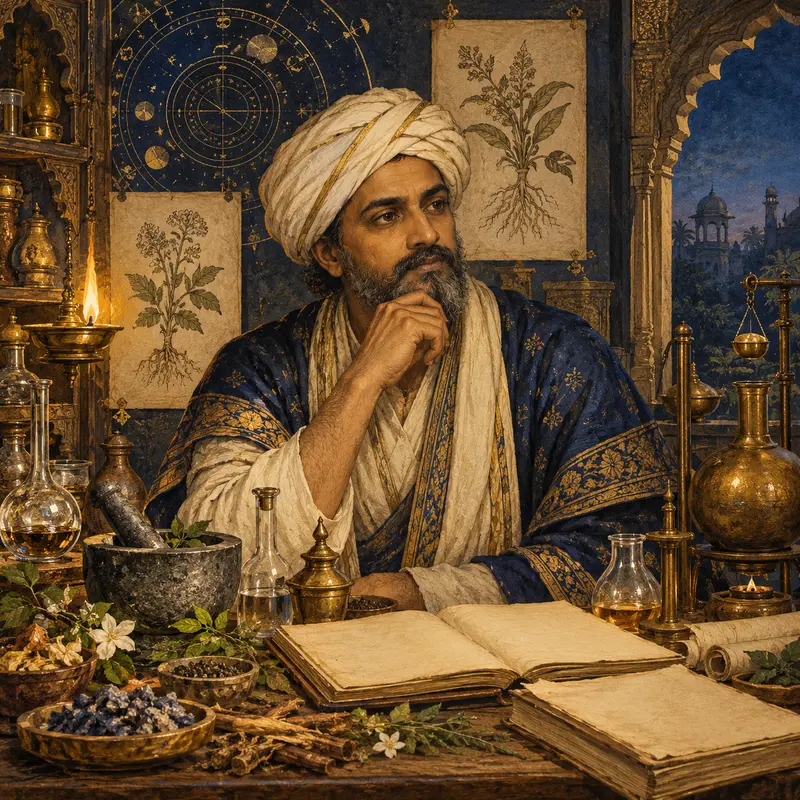
About the chemist
Nagarjuna (Indian alchemist)
c. 10th century · India
Rasa Shastra; mercury alchemy