Biography · Chemist no. 338 of 350
Nicolas Leblanc: The Inventor Who Gave France Soda and Lost Everything
Introduction
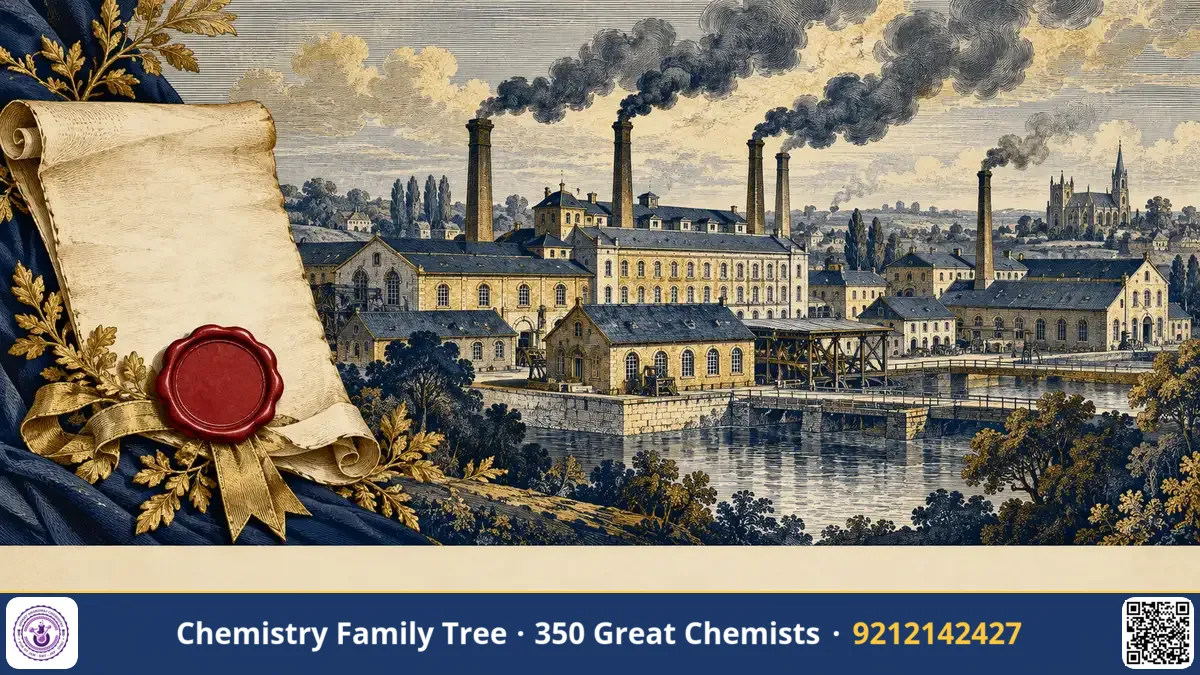
Nicolas Leblanc (1742–1806) was a French physician and chemist who invented the first industrial process for making soda ash from common salt. His process supplied the glass, soap and textile industries of Europe for about a century. He was not rewarded for it. The French Revolution took his factory, his patent and his fortune, and he died by suicide in 1806. His legacy in one line: a brilliant invention and a cautionary tale about how societies treat their inventors.
Early Life and Family
Leblanc was born on 6 December 1742 in Ivoy-le-Pré, in the Berry region of central France. His father was an ironmaster, and the family worked in the iron industry, which gave the boy early contact with furnaces and metals. His father died when he was a child, and Nicolas was placed under the guardianship of a physician, Dr Bien, in Bourges, who took an interest in his education. This led him to study medicine.
Education and Mentors
He studied medicine and surgery in Paris, and also followed lectures in chemistry. Among the leading French chemists of the time were Guillaume-François Rouelle and Pierre-Joseph Macquer, and the Parisian scientific milieu was strongly influenced by the new chemistry of Lavoisier. Leblanc qualified as a surgeon, and in 1780 or thereabouts he became a physician to Louis Philippe Joseph, Duke of Orléans, a wealthy prince who also had a keen interest in science and who became a patron of Leblanc's chemical work. Details of his training with particular teachers are not clearly documented.
Career Timeline
| Year | Event |
|---|---|
| 1742 | Born in Ivoy-le-Pré, France |
| 1775 | French Académie des Sciences announces a prize for a method of making soda from salt |
| c. 1780 | Becomes surgeon to the Duke of Orléans |
| 1789 to 1790 | Develops the process with financial support from the Duke and associates |
| 1791 | Receives a patent (monopoly) and builds the works at Saint-Denis near Paris |
| 1793 | The Revolutionary government confiscates the patent and factory, after the Duke is guillotined |
| 1801 | Napoleon's government returns the factory, but it is derelict and he lacks capital |
| 1806 | Dies at Saint-Denis on 16 January |
Major Scientific Contributions
Soda from salt. Leblanc converted sodium chloride to sodium sulphate with sulphuric acid and then heated this with chalk and charcoal to form black ash, from which sodium carbonate was extracted. The reactions are given in the companion discovery post.
Foundation of heavy chemical industry. The process demanded sulphuric acid in large amounts, which stimulated lead chamber acid manufacture. The hydrogen chloride by-product led to chlorine and bleaching powder production, and the whole complex of chemicals associated with soda became the basis of industrial chemistry in Britain and France.
Crystallography. Leblanc also wrote on crystal forms, and published a study on the crystallisation of salts. This work is much less known than the soda process.
Awards, Honours and Nobel Prize
Leblanc never received the Académie's prize. The prize had been offered in 1775 but was not awarded, because the Revolution disrupted the Académie. Later, he received limited recognition: Napoleon's government gave back his factory, and he was afforded a small amount of compensation. The Nobel Prize did not exist in his time. His real posthumous honour is his place among the founders of the chemical industry.
Personality, Struggles and Lesser-Known Facts
- Patron's fate. His main supporter, the Duke of Orléans, took the name Philippe Égalité during the Revolution and voted for the death of his cousin Louis XVI. He was himself guillotined in November 1793. With his death, Leblanc lost his financial backer.
- Forced to share secrets. In 1793, the Committee of Public Safety required inventors to hand over their process details for the national good, and Leblanc's patent was made public. The nationalised factory was used for the production of saltpetre for gunpowder in war.
- Struggle for compensation. After 1795 he petitioned repeatedly for the return of his works and for compensation. The factory was returned to him in 1801 but in poor condition, and he could not find money to restart it.
- Others made fortunes. The process was copied in Britain after 1814 and in France, where manufacturers such as James Muspratt made large profits.
- Tragic end. In 1806 he died by suicide at Saint-Denis after years of poverty and despair. This is a sad fact, and is mentioned here with respect.
- Later recognition. After his death, historians and chemists recognised him as the true inventor of the soda process, whose work had made the fortunes of others.
Legacy and Influence on Modern Chemistry
The Leblanc process was the first in which a major chemical product was made on an industrial scale from cheap raw materials. It created the modern chemical industry and, at the same time, the problem of industrial waste, which led to the first air-pollution legislation (Alkali Act, UK, 1863) and a rethinking of by-product use. It was superseded by Solvay's process, but its influence on process design is lasting: by-product utilisation, integration of plants and attention to environmental cost. In modern green chemistry, the concept of atom economy implicitly criticises a process like Leblanc's, which wasted two-thirds of its feedstock as by-products.
Lessons for Students
- A good invention needs protection and capital as well as chemistry. Be aware of legal and financial realities.
- Think about by-products. A process that creates large waste may not survive.
- Do not tie your future to a single patron.
- Seek help in hard times. Mental health matters, and no failure should lead to despair.
Quick Facts Box
- Born: 6 December 1742, Ivoy-le-Pré, France
- Died: 16 January 1806, Saint-Denis, France
- Nationality: French
- Field: Industrial chemistry; medicine
- Famous for: Leblanc process for soda ash
- Nobel: None (prize established 1901)
FAQ
Who funded Leblanc's work?
The Duke of Orléans and a few associates financed his research and the Saint-Denis factory.
Why did he lose his patent?
The Revolutionary government abolished private monopolies and seized his factory in 1793.
Was the Leblanc process used long?
Yes, for about a century in Europe, until the Solvay process replaced it.
Why do students learn about Leblanc?
The process illustrates redox and metathesis reactions, industrial by-products and the origin of environmental regulation, and it is a common comparison with the Solvay process.
Published by ABC Chemistry — IIT-JAM | CSIR-NET | GATE Chemistry Coaching. Visit abcchemistry.com
About the chemist
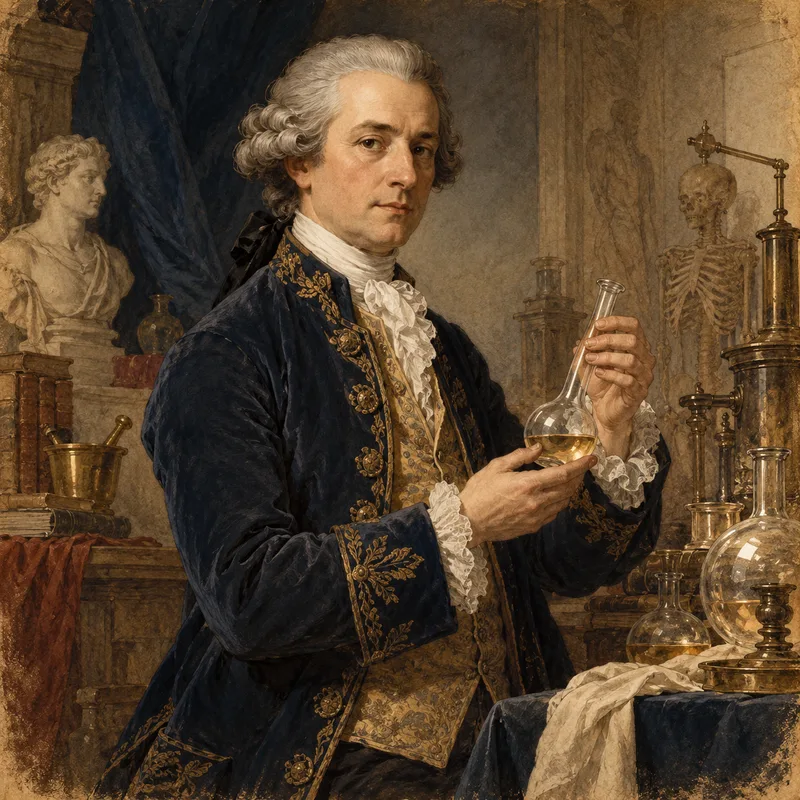
Nicolas Leblanc
1742-1806 · France
Leblanc process for soda ash