The discovery, explained · Chemist no. 338 of 350
The Leblanc Process: The First Industrial Route from Salt to Soda
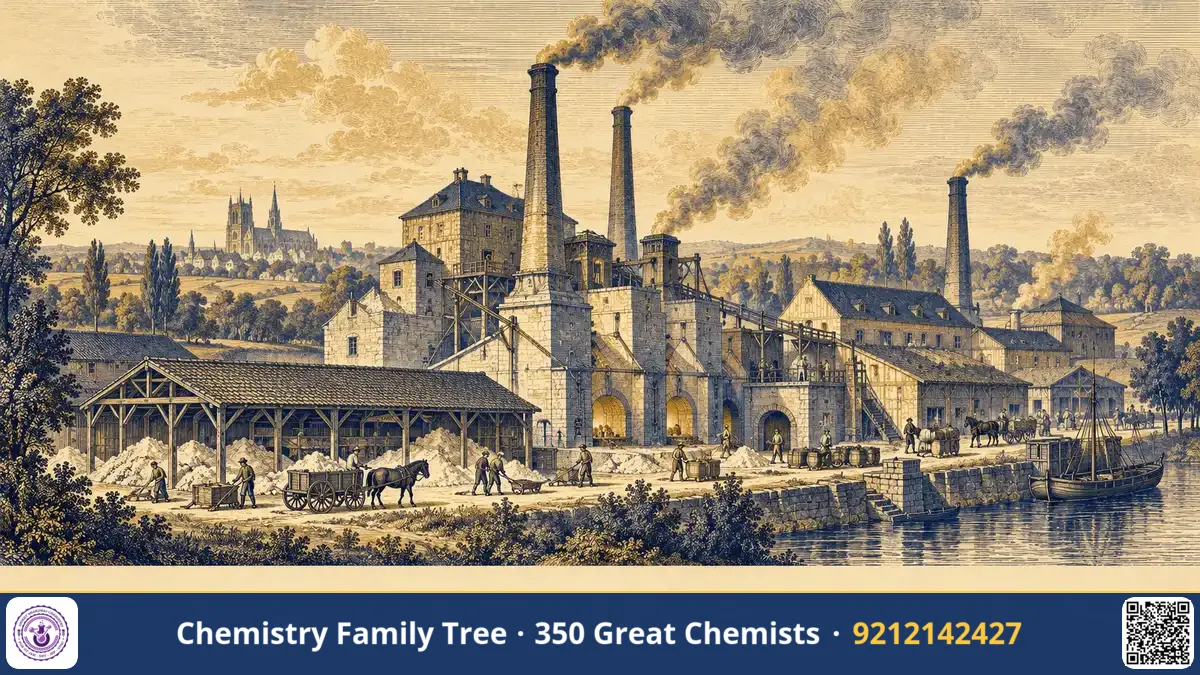
In 1775, the French Académie des Sciences offered a prize for a practical way of making soda (sodium carbonate) from common salt. A surgeon named Nicolas Leblanc solved the problem a few years later, in about 1789 to 1791. The Leblanc process was one of the first large-scale chemical manufacturing processes. It fed the glass, soap and textile industries of Europe throughout the nineteenth century, and it led to the creation of an entire heavy chemical industry, including sulphuric acid, hydrochloric acid and bleaching powder. It also produced the first major industrial pollution problem and the first environmental laws in chemistry. Leblanc's own story ended tragically, as the biography post describes.
The Scientific Problem Before the Discovery
Soda ash was needed for glass, soap and bleaching. Until the late eighteenth century, it came from the ashes of sea plants such as kelp and barilla, from Spain, or from natural deposits. Supplies were limited, the quality varied, and in wartime imports from Spain and elsewhere were interrupted. France, in particular, wanted a domestic source. Chemists knew that common salt (NaCl) contains sodium, and in 1736 Henri-Louis Duhamel de Monceau had shown that the base in common salt and soda is the same. But nobody had a cheap way to convert NaCl to Na₂CO₃. The prize of the Académie in 1775 therefore invited chemists to find one.
The Discovery: Step by Step
- Step 1: Salt cake. Sodium chloride is heated with concentrated sulphuric acid to give sodium sulphate (called salt cake) and hydrogen chloride gas.
- Step 2: Black ash. The salt cake is ground and mixed with crushed limestone (or chalk) and coal or charcoal. This mixture is heated strongly in a reverberatory furnace at about 1000 °C. The product is a dark mass called black ash.
- Step 3: Lixiviation. Black ash is leached with water. Sodium carbonate dissolves, while the insoluble calcium sulphide and other residues remain.
- Step 4: Crystallisation. The solution is evaporated, giving crude soda ash, or crystallised as washing soda.
Leblanc built a factory at Saint-Denis near Paris in 1791, financed by the Duke of Orléans, with a patent granted that year. The works were not able to operate for long: the Revolution confiscated the patent and factory in 1793.
The Chemistry Behind It
Step 1:  2NaCl + H₂SO₄ → Na₂SO₄ + 2HCl↑                      (salt cake, ~ 800 °C)
Step 2a: Na₂SO₄ + 2C → Na₂S + 2CO₂                           (carbon reduces sulphate to sulphide)
Step 2b: Na₂S + CaCO₃ → Na₂CO₃ + CaS                         (double decomposition)
Overall: Na₂SO₄ + CaCO₃ + 2C → Na₂CO₃ + CaS + 2CO₂
The reduction of the sulphate (step 2a) is a high-temperature redox reaction: sulphur goes from +6 in Na₂SO₄ to –2 in Na₂S, while carbon is oxidised from 0 to +4. The second step is a metathesis in a melt. Calcium sulphide is very poorly soluble in water, and Na₂CO₃ is soluble, so leaching separates them. In practice some Na₂CO₃ is lost, and the product contains impurities such as NaOH and Na₂S.
| Material | Formula | Role |
|---|---|---|
| Salt cake | Na₂SO₄ | Intermediate |
| Black ash | Na₂CO₃ + CaS + C etc. | Crude product mix |
| Alkali waste | CaS | Foul-smelling waste, gives H₂S with damp CO₂ |
| Hydrogen chloride | HCl | By-product that corroded and polluted |
By-products and links to other industries. The large volumes of HCl were at first vented into the air, destroying vegetation around the works. Later, HCl was absorbed in water to give hydrochloric acid. It was also oxidised to chlorine, for making bleaching powder (Charles Tennant, 1799): Ca(OH)₂ + Cl₂ → CaOCl₂ + H₂O. The Weldon and Deacon processes produced chlorine from HCl: 4HCl + O₂ → 2Cl₂ + 2H₂O (Deacon, over a CuCl₂ catalyst). Sulphur could be recovered from the calcium sulphide waste by the Chance-Claus process.
Applications Today
- Historic importance. The Leblanc process created the modern heavy chemical industry in Britain and France, and workers and towns grew around its factories, such as at St Helens and Widnes in England.
- Environmental law. The pollution it caused led to the UK Alkali Act of 1863, an early law on air pollution, and the appointment of alkali inspectors.
- Replaced by Solvay. By about 1900, the ammonia-soda process, cheaper and cleaner, replaced it in most places. The last Leblanc plants closed in the early twentieth century.
- Chemical principles. It is still a standard example of redox in solid-state reactions, metathesis, and of the relationship between by-products and process design.
- Soda ash today. Used in glass, detergents and chemicals; in India, produced by the Solvay method at plants in Gujarat.
Exam Corner
- Leblanc steps: NaCl + H₂SO₄ gives Na₂SO₄ (salt cake); salt cake + limestone + coal gives black ash.
- Black ash contains Na₂CO₃ and CaS; water leaches the sodium carbonate.
- HCl by-product led to the Alkali Act of 1863 in Britain.
- Solvay process replaced Leblanc; Solvay recycles NH₃ and avoids HCl and CaS waste.
- Deacon process: 4HCl + O₂ → 2Cl₂ + 2H₂O with CuCl₂ catalyst at about 400 °C.
Common Misconceptions
- "The Leblanc process uses ammonia." No, that is the Solvay process.
- "Black ash is pure sodium carbonate." It is a crude mixture with calcium sulphide and carbon.
- "Leblanc grew rich from his discovery." The opposite is true. He died in poverty.
Quick Revision Box
- Académie prize 1775; process developed about 1789 to 1791.
- Salt cake: Na₂SO₄ from NaCl and H₂SO₄.
- Black ash: salt cake + CaCO₃ + C heated.
- Overall: Na₂SO₄ + CaCO₃ + 2C → Na₂CO₃ + CaS + 2CO₂.
- By-products: HCl and CaS.
- Alkali Act 1863 (UK) was a result of its pollution.
FAQ
Why was the Leblanc process so polluting?
It released HCl gas and left piles of calcium sulphide waste, which produced hydrogen sulphide gas on weathering.
Why did the Solvay process replace it?
The Solvay process was cheaper, continuous, gave purer soda and avoided those wastes.
What is a reverberatory furnace?
A furnace in which the charge is heated by flames and hot gases deflected from a low roof, without direct contact with the fuel.
Did the Leblanc process help the chlor-alkali industry?
Indirectly, yes. HCl from the process was a source of chlorine for bleaching powder, before electrolytic chlorine production took over.
Published by ABC Chemistry — IIT-JAM | CSIR-NET | GATE Chemistry Coaching. Visit abcchemistry.com
About the chemist
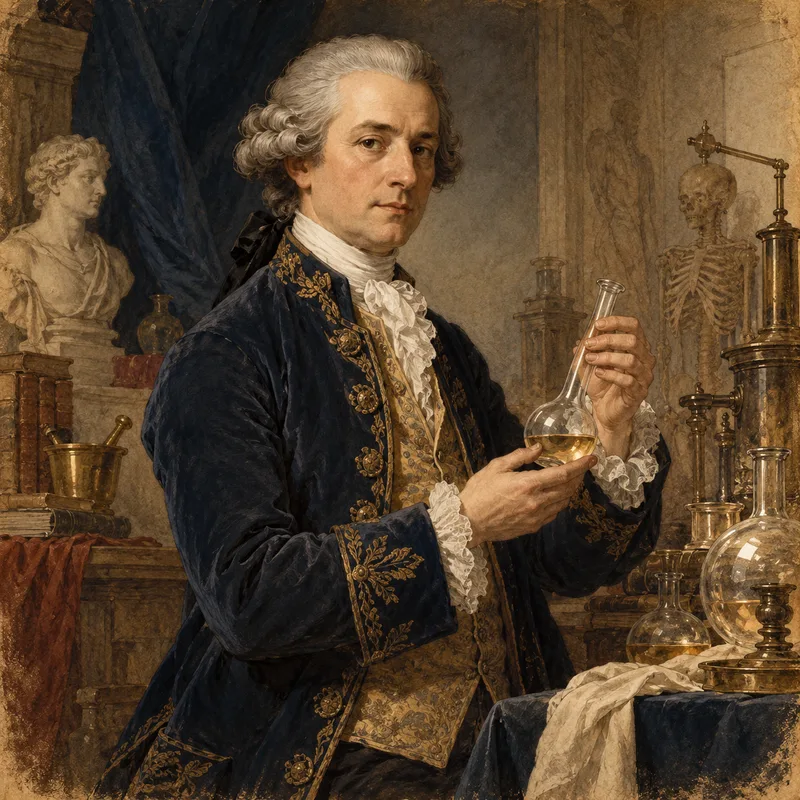
Nicolas Leblanc
1742-1806 · France
Leblanc process for soda ash