The discovery, explained · Chemist no. 31 of 350
The Bohr Model of the Atom: Quantised Orbits and the Hydrogen Spectrum
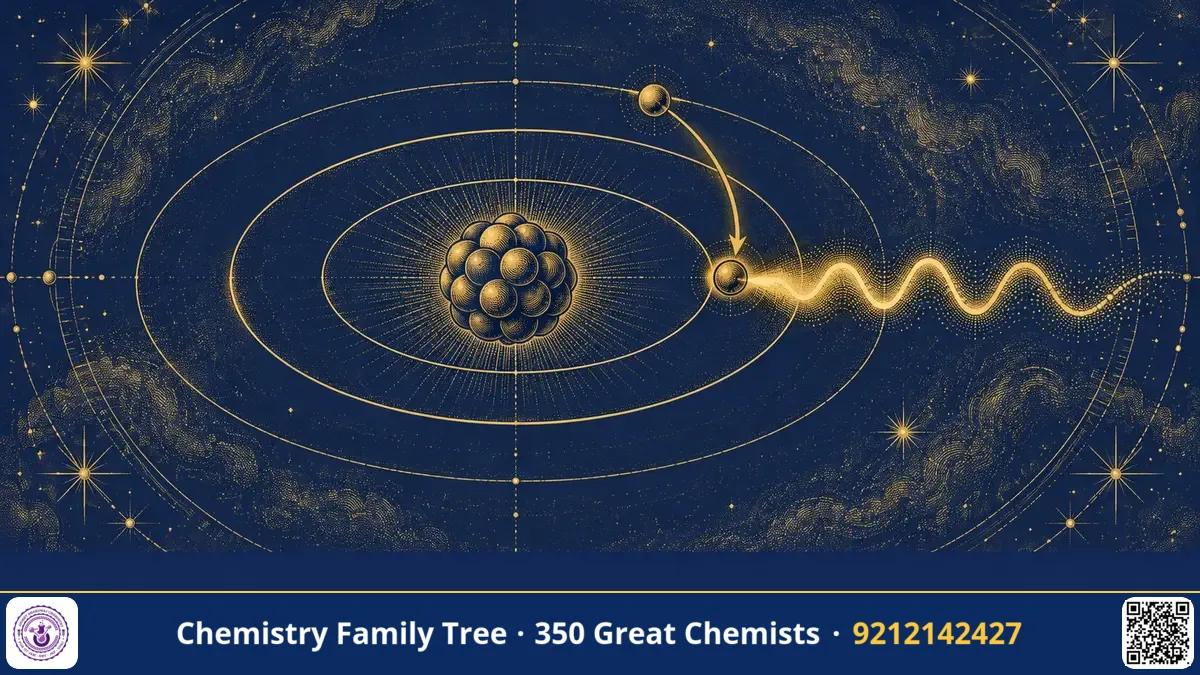
In 1913, a 27-year-old Danish physicist published a three-part paper that explained a puzzle that had stood for almost thirty years: why does hydrogen glow with only a few sharp lines of colour? Niels Bohr combined Rutherford's nuclear atom with Planck's quantum idea and proposed that electrons move only in certain allowed circular orbits, each with a fixed energy. When an electron jumps between orbits, it absorbs or emits a photon with exactly the right energy. This simple model predicted the hydrogen spectrum with remarkable accuracy and became the starting point for modern quantum chemistry. Bohr received the Nobel Prize in Physics in 1922 for his work on the structure of atoms and the radiation from them. Though he is a physicist by title, every chemistry syllabus treats the Bohr model as the first step towards understanding electronic configurations and the periodic table.
The Scientific Problem Before the Discovery
Ernest Rutherford's gold-foil experiment of 1909-1911 showed that an atom has a tiny, dense, positively charged nucleus with electrons outside. But this picture had a serious problem. According to classical electromagnetism, an electron moving in a circle is accelerating, and an accelerating charge must radiate energy. The electron should lose energy continuously, spiral into the nucleus in a fraction of a second, and the atom would collapse. Also, it would emit light of continuously changing colour. Real atoms are stable, and they emit light only at sharp, specific wavelengths.
Spectroscopists had already collected the data. Balmer in 1885 found a formula for the visible lines of hydrogen, and Rydberg generalised it:
1/λ = R (1/n₁² - 1/n₂²) R = 1.097 × 10⁷ m⁻¹
Here n₁ and n₂ are whole numbers with n₂ greater than n₁. The formula worked beautifully, but nobody knew why whole numbers appeared. Classical physics gave no explanation.
The Discovery: Step by Step
Bohr had worked with J. J. Thomson at Cambridge and with Rutherford at Manchester in 1911-1912. Around February 1913 he saw how the Balmer formula could be explained, and he built his model on four postulates.
- Stationary orbits. An electron in a hydrogen-like atom moves in certain circular orbits around the nucleus without radiating energy. These are stationary states.
- Quantised angular momentum. Only orbits in which the angular momentum is a whole-number multiple of h/2π are allowed:
mvr = nh / 2π (n = 1, 2, 3, ...)
- Energy changes by photons. Energy is emitted or absorbed only when the electron jumps from one allowed orbit to another:
ΔE = E₂ - E₁ = hν
- Balance of forces. The electrostatic attraction between the nucleus and the electron provides the centripetal force.
Deriving the results
Equating the Coulomb force to the centripetal force and combining with the quantisation condition gives the radius and energy of the nth orbit for a species with nuclear charge Z:
rₙ = 0.529 × n² / Z   Å
Eₙ = -13.6 × Z² / n²   eV   (= -2.18 × 10⁻¹⁸ Z²/n² J per atom)
vₙ = 2.18 × 10⁶ × Z / n   m/s
For hydrogen, the first orbit has radius 0.529 Å, called the Bohr radius (a₀), and energy -13.6 eV, the ionisation energy of hydrogen. The negative sign means the electron is bound to the nucleus. Energy levels get closer together as n increases and approach zero at n = infinity, where the electron is free.
Explaining the spectrum
When an electron jumps from n₂ to n₁, the photon energy is
ΔE = 13.6 Z² (1/n₁² - 1/n₂²) eV
Dividing by hc gives exactly the Rydberg formula, and Bohr's theory even gave a value of the Rydberg constant that matched experiment. This was his triumph. The named series are:
| Series | Transition to | Region |
|---|---|---|
| Lyman | n = 1 | Ultraviolet |
| Balmer | n = 2 | Visible |
| Paschen | n = 3 | Infrared |
| Brackett | n = 4 | Infrared |
| Pfund | n = 5 | Far infrared |
The Chemistry Behind It
Atomic spectra as fingerprints
Each element has its own set of energy levels, so its emission or absorption spectrum is unique. This is the basis of flame tests, atomic absorption spectroscopy and astronomical analysis of stars.
Ionisation energy
The ionisation energy of a hydrogen-like species is the energy needed to take the electron from n = 1 to infinity, which is 13.6 Z² eV. For He⁺ (Z = 2) it is 54.4 eV, and for Li²⁺ (Z = 3) it is 122.4 eV. This is useful in numerical problems.
Limitations of the model
- It works well only for hydrogen and hydrogen-like one-electron species (H, He⁺, Li²⁺).
- It cannot explain spectra of multi-electron atoms.
- It does not explain fine structure, the Zeeman effect (splitting in a magnetic field) or the Stark effect (splitting in an electric field), though Sommerfeld's extension partly helped.
- It violates Heisenberg's uncertainty principle by assigning definite position and momentum to the electron, and it does not account for the wave nature of the electron.
- It cannot explain chemical bonding or the shapes of molecules.
These problems were later solved by de Broglie's matter waves, Heisenberg's uncertainty principle and Schrödinger's wave mechanics, and the orbit was replaced by the orbital.
Correspondence principle
Bohr later stated that for large quantum numbers, quantum predictions should agree with classical physics. This guided the development of quantum mechanics.
Applications Today
- Spectroscopy: atomic emission and absorption spectra are used in chemical analysis in laboratories, steel plants and environmental monitoring.
- Astronomy: the hydrogen lines identify hydrogen in stars and galaxies, and their shifts measure the speed of cosmic objects.
- Lasers and lighting: quantised energy levels explain how lasers, LEDs and sodium or neon lamps produce coloured light.
- Quantum chemistry teaching: the idea of discrete energy levels leads naturally to orbitals and electron configurations.
- India context: Raman spectroscopy, studied by C. V. Raman, and many spectroscopic techniques used in Indian universities rely on quantised levels.
Exam Corner
- Radius: rₙ = 0.529 n²/Z Å. Energy: Eₙ = -13.6 Z²/n² eV. Velocity is proportional to Z/n.
- Angular momentum of the nth orbit = nh/2π. Number of spectral lines from level n to ground state = n(n - 1)/2.
- Balmer series: transitions to n = 2 (visible). Lyman: to n = 1 (UV). Paschen: to n = 3 (IR).
- The model fails for multi-electron atoms and conflicts with the uncertainty principle.
- Bohr won the 1922 Nobel Prize in Physics. The element bohrium (Z = 107) is named after him.
Common Misconceptions
- "Electrons really orbit like planets." The orbit is an early model. Today we use probability clouds (orbitals).
- "Energy of the electron is positive." Bound energy levels are negative, with zero at infinite separation.
- "Bohr's model works for helium atoms." It works for He⁺, not for neutral He with two electrons.
Quick Revision Box
- 1913: Bohr proposes quantised circular orbits.
- mvr = nh/2π; ΔE = hν.
- Eₙ = -13.6 Z²/n² eV; rₙ = 0.529 n²/Z Å.
- Explains the Rydberg formula and spectral series of hydrogen.
- Limitations: multi-electron atoms, uncertainty principle, fine structure.
- Nobel Prize in Physics, 1922.
FAQ
Why are energies of Bohr orbits negative?
The zero of energy is defined as the electron at rest infinitely far from the nucleus. Energy must be supplied to remove a bound electron, so bound states have negative energy.
What happens when an electron jumps to a lower orbit?
It emits a photon whose energy equals the difference between the two orbit energies.
Is Bohr's model still taught?
Yes. It remains useful for hydrogen-like ions and for understanding spectra, even though quantum mechanics gives the complete picture.
Who extended the Bohr model?
Arnold Sommerfeld introduced elliptical orbits and extra quantum numbers, which helped explain fine structure.
Published by ABC Chemistry — IIT-JAM | CSIR-NET | GATE Chemistry Coaching. Visit abcchemistry.com
About the chemist
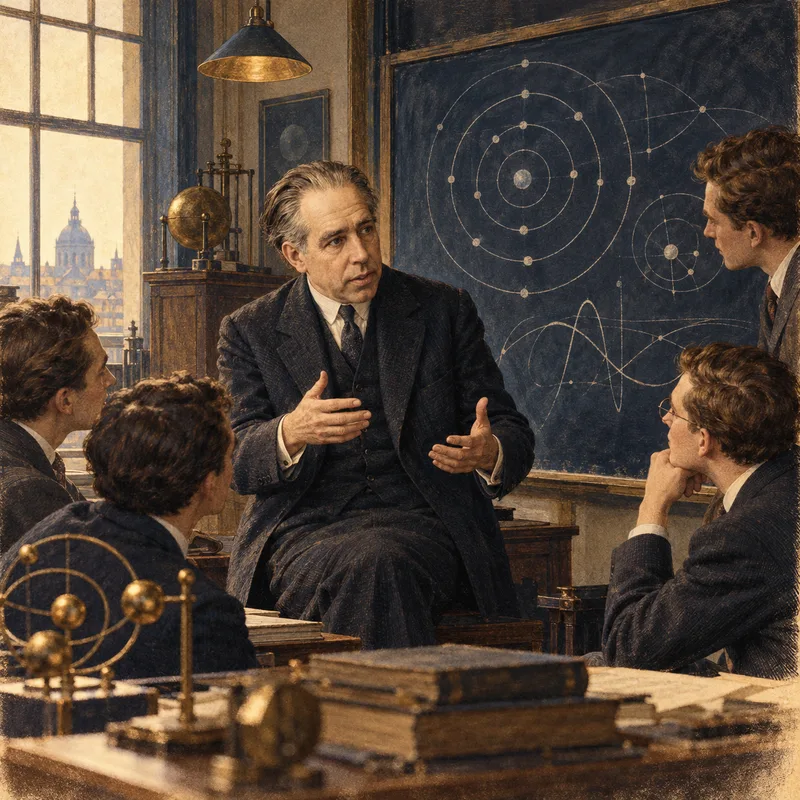
Niels Bohr
1885-1962 · Denmark · Nobel Physics 1922
Bohr model of the atom