Biography · Chemist no. 31 of 350
Niels Bohr: Father of the Quantum Atom
Introduction
Niels Henrik David Bohr (1885-1962) was a Danish physicist whose atomic model of 1913 introduced quantum ideas into the structure of the atom and shaped how chemists think about electrons. He founded the Institute for Theoretical Physics in Copenhagen, which became the meeting place of the world's leading physicists, and he received the Nobel Prize in Physics in 1922. His legacy in one line: he taught the world that the atom is governed by quantum rules, and he built the community that worked out what those rules mean.
Early Life and Family
Bohr was born on 7 October 1885 in Copenhagen, Denmark. His father, Christian Bohr, was a respected professor of physiology at the University of Copenhagen who studied respiration and the behaviour of haemoglobin. His mother, Ellen Adler Bohr, came from a prominent and wealthy Jewish banking family. The household was full of intellectual discussion, with university colleagues often visiting. Niels had a younger brother, Harald, who became a distinguished mathematician and who also played football for Denmark at the 1908 Olympic Games, where the team won the silver medal. Niels was also a keen footballer, though less famous for it than his brother.
Education and Mentors
Bohr studied physics at the University of Copenhagen. As a student he won a gold medal from the Royal Danish Academy of Sciences for a paper on the surface tension of liquids, based on experiments carried out in his father's laboratory. He received his master's degree in 1909 and his doctorate in 1911, with a thesis on the electron theory of metals. In 1911 he moved to Cambridge to work with J. J. Thomson, but found the arrangement less satisfactory than he had hoped. In early 1912 he moved to Manchester and joined Ernest Rutherford, who had just proposed the nuclear atom. This was the beginning of the great collaboration that led to the Bohr model.
Career Timeline
| Year | Event |
|---|---|
| 1885 | Born in Copenhagen (7 October) |
| 1911 | Doctorate from the University of Copenhagen; goes to Cambridge |
| 1912 | Works with Rutherford at Manchester; marries Margrethe Nørlund |
| 1913 | Publishes the Bohr model of the atom in three parts |
| 1916 | Appointed professor of theoretical physics at Copenhagen |
| 1921 | Opens the Institute for Theoretical Physics in Copenhagen |
| 1922 | Awarded the Nobel Prize in Physics; explains the periodic table by electron shells |
| 1927 | Presents the principle of complementarity |
| 1939 | With John Wheeler, explains nuclear fission using the liquid-drop model |
| 1943 | Escapes German-occupied Denmark to Sweden and then travels to Britain and the United States |
| 1957 | Receives the first Atoms for Peace Award |
| 1962 | Dies in Copenhagen (18 November) |
Major Scientific Contributions
- Bohr model (1913): quantised angular momentum and stationary orbits, with Eₙ = -13.6/n² eV for hydrogen. It explained the Balmer and Rydberg formulas.
- Explanation of the periodic table (1920-22): he proposed that elements are arranged in shells and that chemical properties come from the outermost electrons, an early version of the electron configuration idea. This linked atomic structure to periodicity.
- Correspondence principle: quantum predictions must match classical physics for large quantum numbers.
- Complementarity: wave and particle descriptions are complementary aspects of quantum objects.
- Nuclear physics: the compound nucleus and liquid-drop ideas, and the 1939 work with Wheeler showing that uranium-235 is the isotope that undergoes fission with slow neutrons.
The physics and chemistry of the model are explained in our companion post on the Bohr atom.
Awards, Honours and Nobel Prize
- Nobel Prize in Physics, 1922: for his services in the investigation of the structure of atoms and of the radiation emanating from them.
- Atoms for Peace Award, 1957.
- Element 107, bohrium (Bh), was named in his honour. His son Aage Bohr also won the Nobel Prize in Physics in 1975.
- Foreign member of many academies, including the Royal Society of London.
Personality, Struggles and Lesser-Known Facts
- Thinking aloud. Bohr was famous for working out ideas in long conversations. He often struggled to put his thoughts on paper and relied on colleagues and assistants to write drafts with him.
- Great debates with Einstein. Over many years Bohr and Albert Einstein debated the meaning of quantum mechanics, notably at the Solvay conferences. Their disagreement was friendly and deeply respectful.
- Danish Jewish heritage and wartime escape. In September 1943, after being warned that he was in danger, Bohr escaped from Denmark by boat to Sweden. He then went to Britain and the United States, where he pressed leaders to consider the postwar control of nuclear weapons.
- Support for refugees. In the 1930s his institute helped scientists who left Germany after the Nazi rise to power.
- Hafnium. The element hafnium (Z = 72) was discovered in 1923 at his institute by Dirk Coster and George de Hevesy, following Bohr's theoretical prediction that it would be a transition metal similar to zirconium, not a rare earth.
Legacy and Influence on Modern Chemistry
The idea that electrons occupy quantised energy levels is the foundation of modern chemistry. Electron configurations, the periodic table, atomic spectra, lasers and spectroscopy all rest on this idea. The "Copenhagen school" trained or hosted Heisenberg, Pauli, Dirac, Hund and many others, and Bohr's institute (today the Niels Bohr Institute) is still a leading centre of research. His work on the atom bridged classical physics and the new quantum theory, and his ideas on openness in science influenced international scientific cooperation after the war.
Lessons for Students
- Combine ideas. Bohr joined Rutherford's atom with Planck's quantum, and a new theory appeared.
- Ask questions freely. Bohr was known for encouraging young people to challenge him.
- Models are tools. The Bohr model was incomplete but opened the way to better ones.
- Build a community. Great science is often a team effort.
- Think about responsibility. Bohr spoke about the peaceful use of atomic energy.
Quick Facts Box
- Born: 7 October 1885, Copenhagen, Denmark
- Died: 18 November 1962, Copenhagen, Denmark
- Nationality: Danish
- Field: Atomic and quantum physics
- Famous for: Bohr atomic model, complementarity, Copenhagen school
- Nobel Prize: Physics, 1922
FAQ
Did Niels Bohr win a Nobel Prize in Chemistry?
No. He won the Nobel Prize in Physics in 1922, though his work is central to chemistry.
Who was Bohr's teacher?
He worked with J. J. Thomson at Cambridge and mainly with Ernest Rutherford at Manchester, where the Bohr model took shape.
Which element is named after Bohr?
Bohrium, atomic number 107.
What is the Niels Bohr Institute?
It is the research institute at the University of Copenhagen that grew from the Institute for Theoretical Physics he founded in 1921.
Published by ABC Chemistry — IIT-JAM | CSIR-NET | GATE Chemistry Coaching. Visit abcchemistry.com
About the chemist
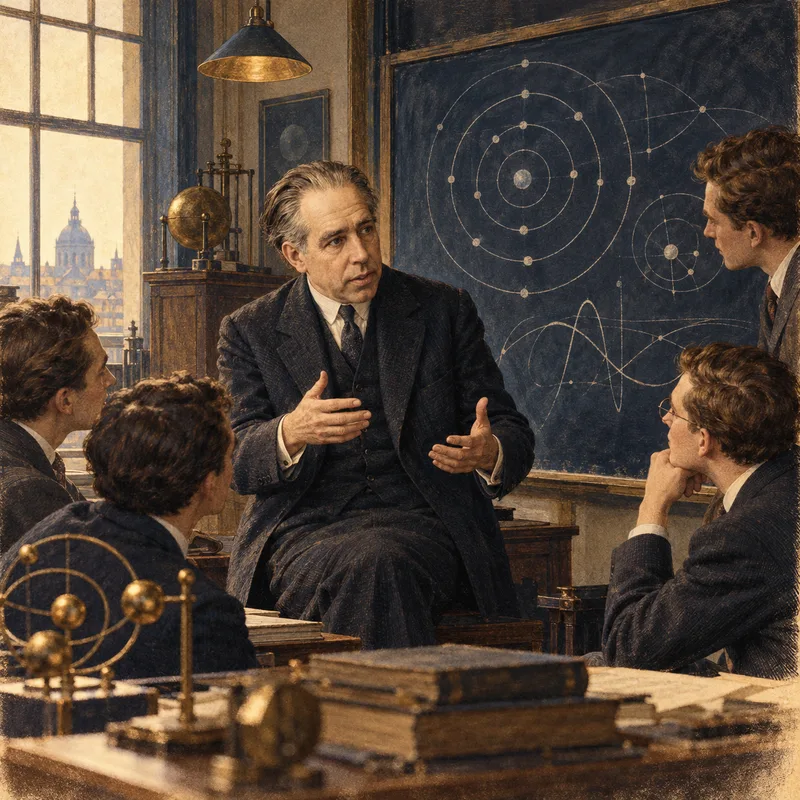
Niels Bohr
1885-1962 · Denmark · Nobel Physics 1922
Bohr model of the atom