Biography · Chemist no. 132 of 350
Nikolay Nikolaevich Semenov (1896-1986): The Russian Chemist Who Explained Explosions
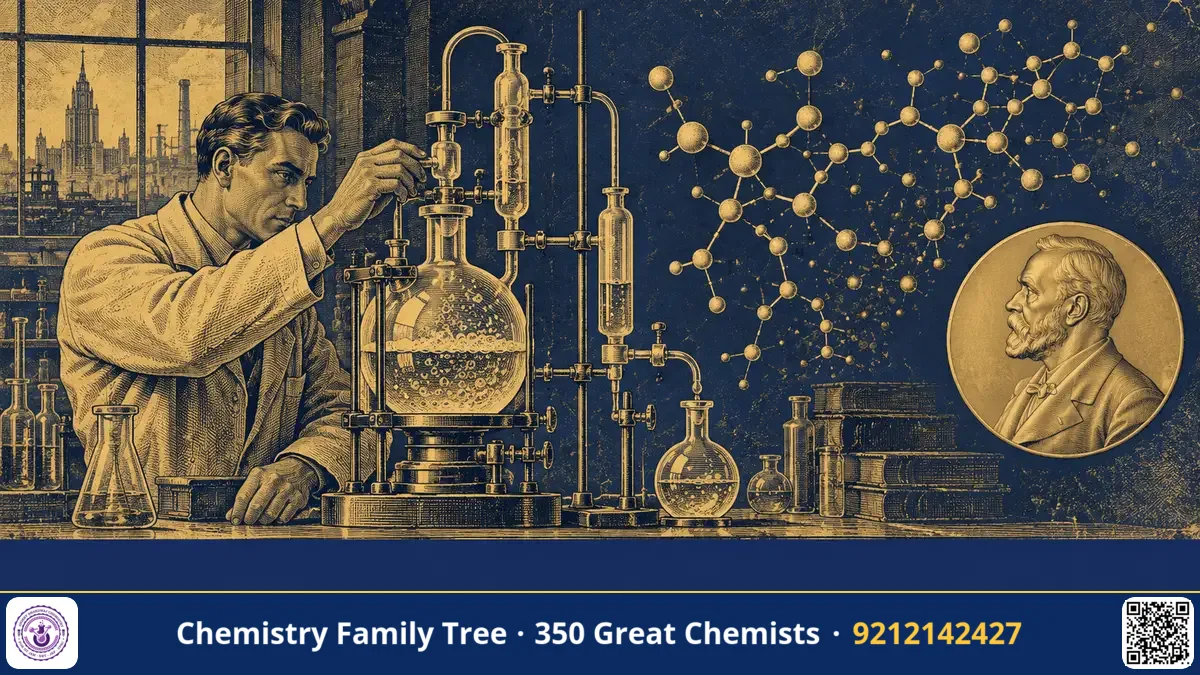
Nikolay Semenov was a Russian (Soviet) physical chemist who created the modern theory of chain reactions and thermal explosions, and founded the Institute of Chemical Physics in the Soviet Union. In 1956 he shared the Nobel Prize in Chemistry with Sir Cyril Hinshelwood and became the first Soviet scientist to win the Chemistry Nobel. His one-line legacy: he showed that reactions can accelerate by multiplying reactive radicals, and he gave chemists the mathematics to predict when that leads to an explosion.
Early Life and Family
Semenov was born on 15 April 1896 (3 April in the old Russian calendar) in Saratov, on the Volga river, in the Russian Empire. His family belonged to the educated provincial middle class. He grew up in Samara, where he went to school. Even as a young man he had a strong interest in physics and mathematics, and he left for the capital to study these subjects.
Education and Mentors
Semenov studied physics at Petrograd University, graduating in 1917, during the year of the Russian revolutions. His great mentor was Abram Ioffe, the founder of Soviet physics, who invited him to the Physico-Technical Institute in Petrograd (later Leningrad) in 1920. Ioffe's school emphasised physical thinking about problems of materials and molecules. Semenov's early work was on the physics of electrical breakdown in gases and the collisions of electrons with atoms, before his interest turned to chemical kinetics. His friendship with colleagues such as Yuli Khariton and Pyotr Kapitsa from the same milieu also formed the community in which his ideas developed.
Career Timeline
| Year | Event |
|---|---|
| 1896 | Born in Saratov, Russia |
| 1917 | Graduates from Petrograd University |
| 1920 | Joins the Physico-Technical Institute under Abram Ioffe |
| 1920s | Studies explosion limits in phosphorus vapour oxidation with colleagues |
| 1931 | Founds the Institute of Chemical Physics in Leningrad |
| 1932 | Elected member of the Academy of Sciences of the USSR |
| 1934 | Publishes Chemical Kinetics and Chain Reactions |
| 1944 | Becomes a professor at Moscow State University |
| 1956 | Shares the Nobel Prize in Chemistry with Cyril Hinshelwood |
| 1986 | Dies in Moscow |
Major Scientific Contributions
Branched chain reactions. Semenov proposed that in some reactions one radical can generate two or more radicals, so that the reaction accelerates. If branching rate f exceeds termination rate g, the number of active centres grows as n = (n₀/φ)(e^(φt) − 1) with φ = f − g, and an explosion results. This explained the strange explosion limits of hydrogen-oxygen mixtures and of phosphorus vapour.
Thermal explosion theory. He showed that an explosion can also come from heat accumulation: when heat released by an exothermic reaction cannot be removed fast enough, the temperature rises, the Arrhenius rate rises, and the reaction runs away. The critical condition is described by what is now called the Semenov theory of thermal explosion, and it is used in chemical engineering and safety.
Degenerate branching. For slower oxidation processes, such as hydrocarbon oxidation, he described chains that branch through unstable intermediate products, giving long induction periods followed by sudden acceleration.
Institute of Chemical Physics. The institute he founded became a centre for combustion science, polymer chemistry and later for studies of biological systems. It now carries his name.
The mathematical and mechanistic detail is explained in the companion discovery article.
Awards, Honours and Nobel Prize
Semenov and Hinshelwood shared the 1956 Nobel Prize in Chemistry "for their researches into the mechanism of chemical reactions". In the Soviet Union he received the Stalin Prize, the Lenin Prize, and the title Hero of Socialist Labour (more than once), and many orders. He was also elected to foreign academies and societies, including the Royal Society as a foreign member.
Personality, Struggles and Lesser-Known Facts
- He began his career as a physicist and moved into chemistry. His Nobel Prize is in Chemistry, even though his methods were closely tied to physics.
- Working in a young state during revolution and civil war, he, like many Soviet scientists, built laboratories in difficult conditions with limited equipment.
- Although Semenov and Hinshelwood worked at opposite ends of Europe and in different political systems, their independent research on chain reactions met in the Nobel recognition of 1956.
- He remained a leader of Soviet science for decades, supporting the training of physical chemists and the use of chemical physics in industry and defence-related research.
- He lived to be ninety, working in science almost to the end of his life.
Legacy and Influence on Modern Chemistry
Semenov's theory underlies our understanding of combustion, explosions, flames, polymerisation and many oxidation processes. Chemical engineers use his thermal explosion criteria to design reactors and to store reactive materials safely. Atmospheric scientists use radical chain concepts to model the troposphere. In India, the concepts of chain reactions, explosion limits and Semenov-type thermal runaway appear in syllabi for B.Sc., IIT-JAM, CSIR-NET and GATE chemistry and chemical engineering. The Semenov Institute of Chemical Physics, in Moscow, remains active in research.
Lessons for Students
- Cross the boundaries between subjects. A physicist who looked at chemistry gave the field new mathematics.
- Explain strange experimental facts, such as explosion limits, by a simple, testable model.
- Build institutions as well as theories; students and colleagues carry ideas forward.
- Safety is chemistry. Understanding how reactions run away saves lives.
Quick Facts Box
- Born: 15 April 1896 (3 April O.S.), Saratov, Russian Empire
- Died: 25 September 1986, Moscow, USSR
- Nationality: Russian / Soviet
- Field: Physical chemistry and chemical physics
- Famous for: Theory of branched chain reactions and thermal explosion
- Nobel Prize: Chemistry, 1956 (shared with Cyril Hinshelwood)
FAQ
Why is Semenov called the father of chemical physics in the USSR?
Because he founded the Institute of Chemical Physics and applied physical methods to chemical reactions.
What is the Semenov theory of thermal explosion?
It states that explosion occurs when the rate of heat generation by reaction exceeds the rate of heat loss to the surroundings so that temperature runs away.
Was his Nobel Prize in Physics?
No. It was in Chemistry, in 1956.
Who was his teacher?
Abram Ioffe, the founder of the Physico-Technical Institute in Leningrad.
Published by ABC Chemistry — IIT-JAM | CSIR-NET | GATE Chemistry Coaching. Visit abcchemistry.com
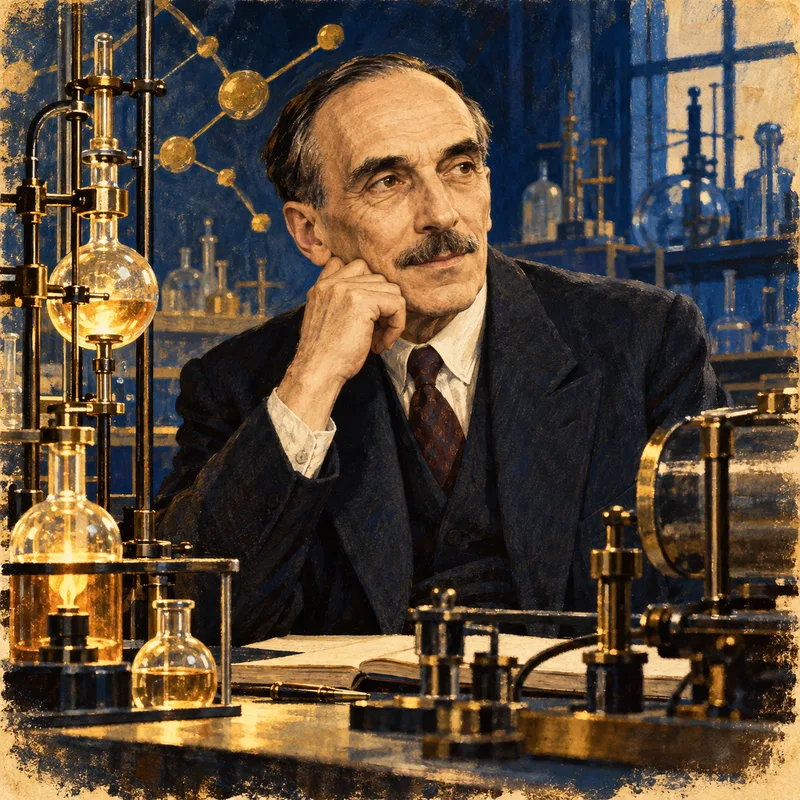
About the chemist
Nikolay Semenov
1896-1986 · Soviet Union · Nobel Chemistry 1956
Chain reactions and combustion