The discovery, explained · Chemist no. 132 of 350
Nikolay Semenov and Branched Chain Reactions: The Chemistry of Explosions
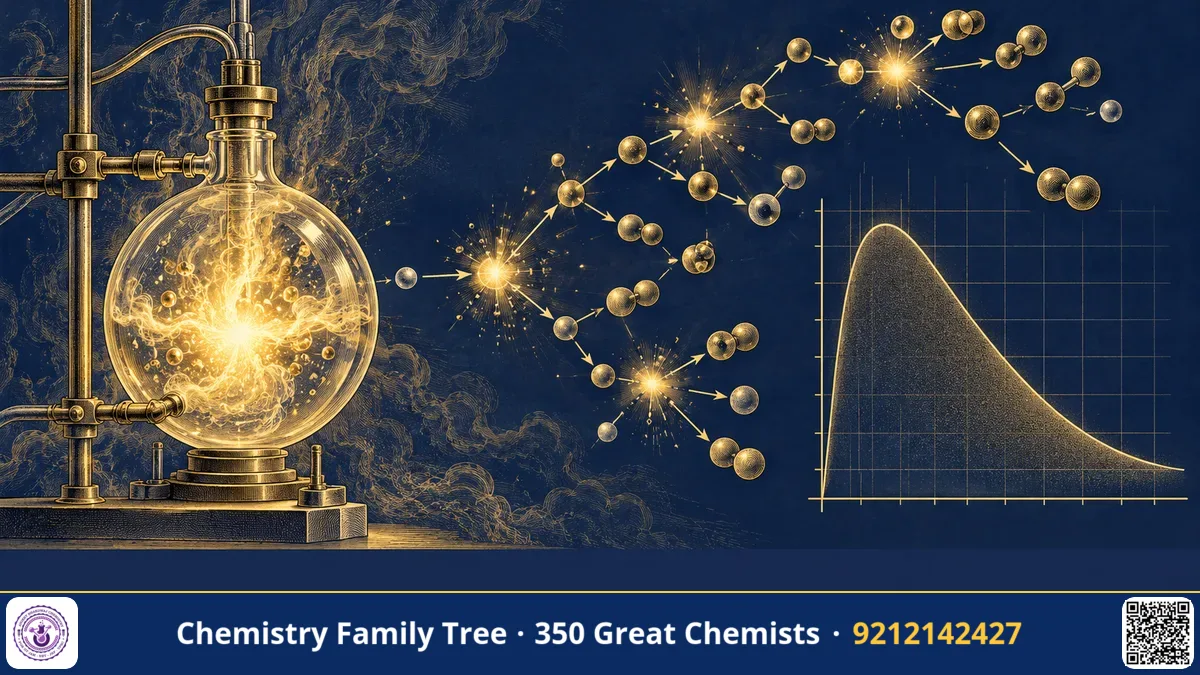
A spark in a mixture of hydrogen and oxygen: sometimes the mixture burns quietly, sometimes it explodes violently, and sometimes nothing happens at all, depending only on pressure and temperature. In the 1920s and 1930s the Russian physical chemist Nikolay Nikolaevich Semenov explained this puzzle. He showed that many fast reactions proceed by chain reactions in which reactive radicals multiply, and that when the radical number grows faster than it is destroyed, the reaction rate accelerates to an explosion. He also developed the theory of thermal explosion. In 1956 he shared the Nobel Prize in Chemistry with Cyril Hinshelwood, and he became the first Soviet scientist to win a Nobel Prize in Chemistry. This article explains the ideas for JAM, NET and GATE.
The Scientific Problem Before the Discovery
Chain reactions were already known in photochemistry. Max Bodenstein had shown in 1913 that the photochemical reaction of hydrogen and chlorine yields many molecules of HCl for each photon absorbed, and Walther Nernst suggested a chain of reactions. But the thermal reaction of hydrogen and oxygen was baffling. Experiments in a glass vessel showed that at low pressure the mixture did not react at all, then exploded when the pressure crossed a limit, and exploded no more above a second limit, at least at suitable temperatures. Also, phosphorus vapour glowed in oxygen at low pressure but not at higher pressure, a strange result in which reaction stops when pressure rises. Ordinary kinetics, where rate increases with concentration, could not explain such behaviour.
The Discovery: Step by Step
- Experiments in Leningrad. Semenov and his coworkers, notably Yuli Khariton and others at the Physico-Technical Institute, studied the oxidation of phosphorus vapour and found explosion limits. They also noted that the reaction was sensitive to the size and surface of the vessel and to inert gases.
- The idea of branching. A chain carrier (an atom or radical) could produce two or more new carriers in one step. Then the number of carriers could multiply exponentially.
- Balance of branching and termination. Carriers are destroyed at the walls of the vessel (surface termination) and in the gas by collisions (gas-phase termination). If the rate of branching is greater than termination, explosion occurs.
- Theory. Semenov developed the mathematical theory of branched chain reactions and, in 1934, published the monograph Chemical Kinetics and Chain Reactions. Hinshelwood had arrived at similar conclusions at Oxford, and the two schools influenced each other.
The Chemistry Behind It
For a chain reaction we count the number of active centres n (radicals). Let n₀ be the rate of initiation, f the rate constant for chain branching and g that for termination. Then:
dn/dt = n₀ + (f − g) n
Let φ = f − g. If φ < 0, the radical concentration reaches a steady state n = n₀ / |φ| and the reaction is slow and smooth. If φ > 0, n grows exponentially, n = (n₀/φ)(e^(φt) − 1), and the rate runs away. The condition f = g defines the explosion limit.
For hydrogen and oxygen, the main steps are:
Initiation:     H₂ → 2H•  (or wall reaction)
Propagation:    •OH + H₂ → H₂O + H•
Branching:      H• + O₂ → •OH + O:
                O: + H₂ → •OH + H•
Termination 1:  H•, •OH diffuse to the wall and are destroyed
Termination 2:  H• + O₂ + M → HO₂• + M   (three-body)
In one branching cycle, one H• gives three new radicals (two •OH and one H•), so radicals multiply. The overall result is 2H₂ + O₂ → 2H₂O.
Explosion limits. At low pressure, radicals diffuse to the wall quickly, so termination at the wall wins, and no explosion occurs. As pressure rises, wall termination slows down, branching wins, and you reach the first (lower) limit. At higher pressure, the three-body termination step H• + O₂ + M → HO₂• needs a third body M and increases with pressure faster than branching; this sets the second (upper) limit. At still higher pressure, HO₂• reactions regenerate radicals, and a third limit arises, which is a thermal explosion. The curve of pressure against temperature that shows these limits is often called the explosion peninsula.
Thermal explosion. Semenov also gave the theory of thermal explosion: if heat produced by an exothermic reaction exceeds heat lost to the surroundings, temperature climbs, the rate increases (Arrhenius law), and the run-away continues. The critical condition is that the heat-generation curve touches the heat-loss line.
Applications Today
- Industrial safety. Understanding explosion limits guides the safe handling of hydrogen, solvents, gas mixtures and dust in chemical plants, including in Indian fertiliser and petrochemical industries.
- Combustion engines. Knock in petrol engines is a chain-branching phenomenon; fuel additives that remove radicals act as anti-knock agents.
- Polymer chemistry. Free-radical polymerisation of ethylene, styrene and vinyl chloride is a chain reaction, and thermal run-away must be controlled.
- Atmospheric chemistry. Radical chain cycles involving OH, HO₂ and Cl govern the lifetime of pollutants and ozone chemistry.
- Nuclear science. Semenov's ideas about chain branching were also applied to nuclear chain reactions in the Soviet Union.
Exam Corner
- Chain reaction steps: initiation, propagation, branching, termination.
- Explosion occurs when the rate of branching exceeds that of termination (f > g).
- H₂ + O₂ shows first, second and third explosion limits; the second depends on three-body termination H• + O₂ + M.
- H₂ + Cl₂ is a non-branching chain; quantum yield is very high.
- Semenov and Hinshelwood: 1956 Nobel Prize in Chemistry.
Common Misconceptions
- "Higher pressure always means explosion." Not for H₂ + O₂ at some temperatures, where the mixture can pass from explosive to non-explosive as pressure rises beyond the second limit.
- "All chain reactions explode." Only branching chains do; non-branching chains give a steady rate.
- "Semenov won the Nobel Prize in Physics." No. His prize was in Chemistry.
Quick Revision Box
- Rate of change of radicals: dn/dt = n₀ + (f − g) n.
- f > g gives exponential growth and explosion; f < g gives steady state.
- Branching: H• + O₂ → •OH + O:; O: + H₂ → •OH + H•.
- Lower limit: wall termination; upper limit: gas-phase three-body termination.
- Thermal explosion occurs when heat generation exceeds heat loss.
- Nobel Prize in Chemistry 1956 with Hinshelwood.
FAQ
What is chain branching?
A step in which one radical produces more than one new radical, so the radical concentration multiplies.
What is the difference between chain and thermal explosion?
A chain explosion arises from multiplication of radicals; a thermal explosion arises from heat build-up that raises the rate through the Arrhenius law.
Why is there an upper explosion limit?
Because at higher pressure three-body collisions convert reactive H• into the less reactive HO₂•, which terminates the chains.
Who shared the Nobel Prize with Semenov?
Sir Cyril Hinshelwood of Oxford.
Published by ABC Chemistry — IIT-JAM | CSIR-NET | GATE Chemistry Coaching. Visit abcchemistry.com
About the chemist
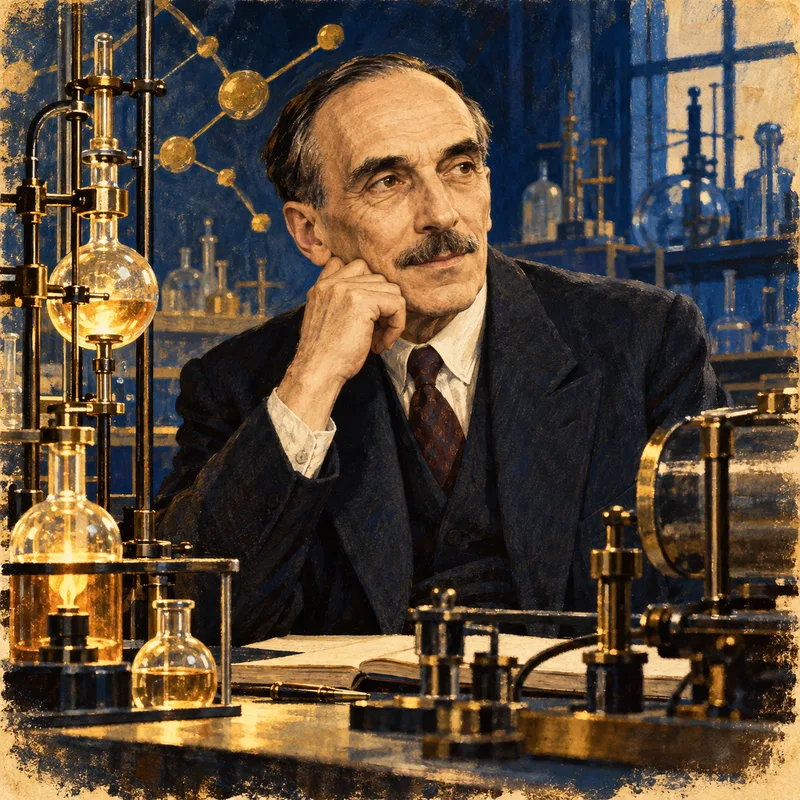
Nikolay Semenov
1896-1986 · Soviet Union · Nobel Chemistry 1956
Chain reactions and combustion