Biography · Chemist no. 260 of 350
Nikolay Nikolaevich Zinin (1812-1880): The Patriarch of Russian Organic Chemistry
Introduction
Nikolay Nikolaevich Zinin was a Russian organic chemist and teacher who discovered that nitrobenzene can be reduced to aniline, a reaction that supplied the dye and drug industries with their key building block. He was also first president of the Russian Chemical Society, and the teacher of Butlerov. His legacy in one line: he gave organic chemistry the nitro-to-amine reduction and trained the generation that built Russian chemistry.
Early Life and Family
Zinin was born on 25 August 1812 (Old Style; 6 September New Style) in Shusha, in the Caucasus region (in present-day Azerbaijan). His parents died while he was young, and he was raised by an uncle in Saratov. He grew up in provincial surroundings, far from major scientific centres. His education began in Saratov, where he showed ability in mathematics. This background of hardship made him very independent, and he developed a deep belief in the value of education.
Education and Mentors
He studied at Kazan University, graduating in 1833 with a degree in mathematics, and he was first interested in physics and mathematics before turning to chemistry. He became a teacher at Kazan, first for physics and mathematics, then chemistry. He was then sent to Europe (1836-1841), where he studied in Berlin with Eilhard Mitscherlich and worked with Justus von Liebig in Giessen, and in Paris with Jules Pelouze and others. Liebig's laboratory training had a lasting effect on his teaching style.
Career Timeline
| Year | Event |
|---|---|
| 1812 | Born in Shusha, Caucasus |
| 1833 | Graduated from Kazan University |
| 1836-41 | Studied in Berlin, Giessen and Paris |
| 1830s | Worked in Liebig's laboratory in Giessen on benzoin chemistry |
| 1841 | Professor of chemistry at Kazan University |
| 1842 | Reduced nitrobenzene to aniline |
| 1847 | Moved to St Petersburg, Medical-Surgical Academy |
| 1865 | Elected full member of the St Petersburg Academy of Sciences |
| 1868 | Became first president of the Russian Chemical Society |
| 1880 | Died in St Petersburg, 18 February |
Major Scientific Contributions
- Aniline from nitrobenzene (1842): The Zinin reduction. See our discovery blog for the detailed reaction and its selectivity.
- Benzoin and related compounds: He worked on the chemistry of benzaldehyde derivatives. He studied benzoin, which he prepared by benzoin condensation. The benzoin condensation is linked with the names of Liebig, Wöhler and Zinin.
- Naphthylamine and azo compounds: He prepared naphthylamine and azoxybenzene and azobenzene by reduction, which later served dye chemistry.
- Benzidine: He studied hydrazobenzene and produced benzidine on treatment with acids, which is the benzidine rearrangement (the mechanism became clear later).
- Teaching laboratory: He built one of Russia's first good teaching laboratories for organic chemistry at the Medical-Surgical Academy, where Borodin was among those who trained.
Awards, Honours and Nobel Prize
Zinin was elected a full member of the St Petersburg Academy of Sciences, and was the first president of the Russian Chemical Society, founded in 1868 (a task carried out together with Mendeleev, Butlerov and others). He did not receive a Nobel Prize because the prizes started after his death in 1880.
Personality, Struggles and Lesser-Known Facts
- The full industrial impact of his aniline discovery came only after Perkin used aniline for mauveine in 1856.
- Alexander Borodin, who is also famous as a composer, was his student and later successor at the Medical-Surgical Academy.
- He is often called the founder of the Russian school of organic chemistry, because students such as Butlerov and Borodin carried his methods forward.
- He started as a mathematics graduate and moved to chemistry, a path that shows how flexible a good scientific education can be.
- He left Kazan for St Petersburg because of better opportunities for science and the need for strong chemistry teaching for medical students.
Legacy and Influence on Modern Chemistry
Every time a chemist reduces a nitro group, the line of discovery goes back to Zinin. Aniline from his reaction made possible azo dyes, sulfa drugs, paracetamol precursors, polyurethanes and rubber chemicals. In India, the large textile dye and pharma industries use this chemistry daily. His Russian school produced organic structural theory (Butlerov), the Markovnikov and Zaitsev rules, and leaders of science. The Zinin reduction with sulfides is still used for selective reduction in synthesis. In exams (JAM, NET, GATE), the ideas of nitro-group reduction in different media, the benzidine rearrangement and azo dyes are standard topics.
Why Zinin Matters for Exam Preparation
For students of JAM, NET and GATE, Zinin's life connects several topics that are often tested separately. First, nitro-group reductions: remember that the product depends on the medium. In acidic medium (Sn/HCl or Fe/HCl) the product is aniline; in neutral medium (Zn/NH₄Cl) it is phenylhydroxylamine; and in alkaline medium bimolecular products such as azoxybenzene, azobenzene and hydrazobenzene appear. Second, the Zinin-type reduction with sulfides is the standard answer when a question asks for selective reduction of one nitro group in a dinitro compound, for example m-dinitrobenzene to m-nitroaniline. Third, aniline chemistry that follows from his work, including diazotisation at 0-5 °C, coupling to give azo dyes, and the carbylamine test, is a high-frequency topic in organic chemistry papers.
Lessons for Students
- Build from the basics. A simple reduction led to a whole industry.
- Teaching multiplies discovery. His students were as significant as his own papers.
- Training abroad helps. He brought German laboratory methods to Russia.
- Humble beginnings are not a barrier. An orphan from the Caucasus became the head of a national society.
- Share your lab. Open laboratories grow scientists.
Quick Facts Box
- Born: 6 September 1812 (N.S.), Shusha, Caucasus
- Died: 18 February 1880, St Petersburg
- Nationality: Russian
- Field: Organic chemistry
- Famous for: Zinin reduction; nitrobenzene to aniline (1842)
- Nobel Prize: None (died before 1901)
FAQ
Where did Zinin make his discovery?
At Kazan University in 1842.
Who were Zinin's famous students?
Alexander Butlerov and Alexander Borodin were among his students.
What was Zinin's role in the Russian Chemical Society?
He was its first president, from its founding in 1868.
Why is the Zinin reduction useful?
It allows selective reduction of one nitro group in a polynitro compound using sulfide reagents.
Published by ABC Chemistry — IIT-JAM | CSIR-NET | GATE Chemistry Coaching. Visit abcchemistry.com
About the chemist
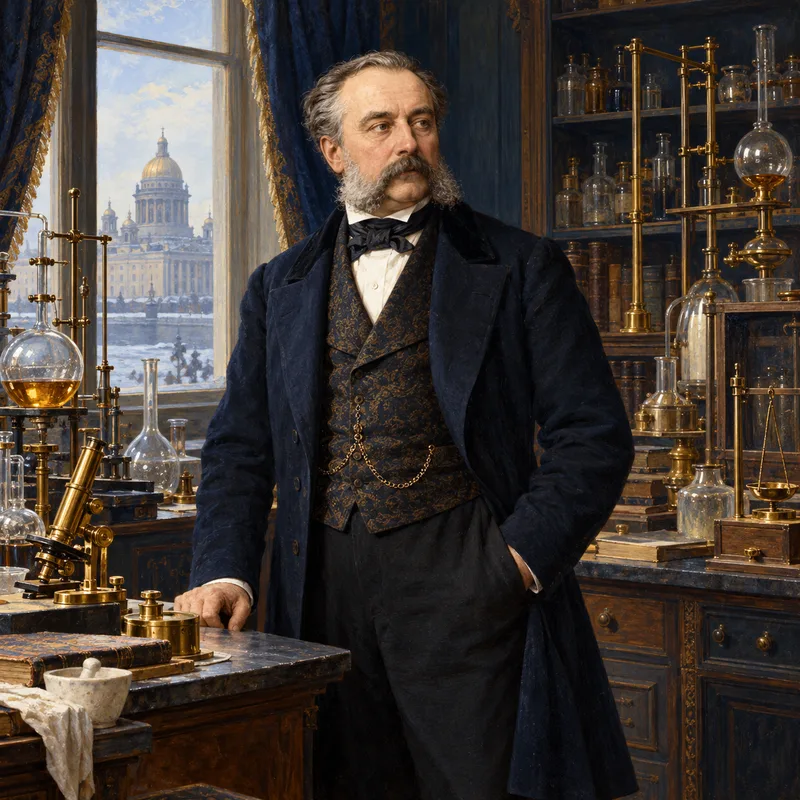
Nikolay Zinin
1812-1880 · Russia
Zinin reduction; aniline from nitrobenzene