The discovery, explained · Chemist no. 260 of 350
The Zinin Reduction: How Nitrobenzene Became Aniline
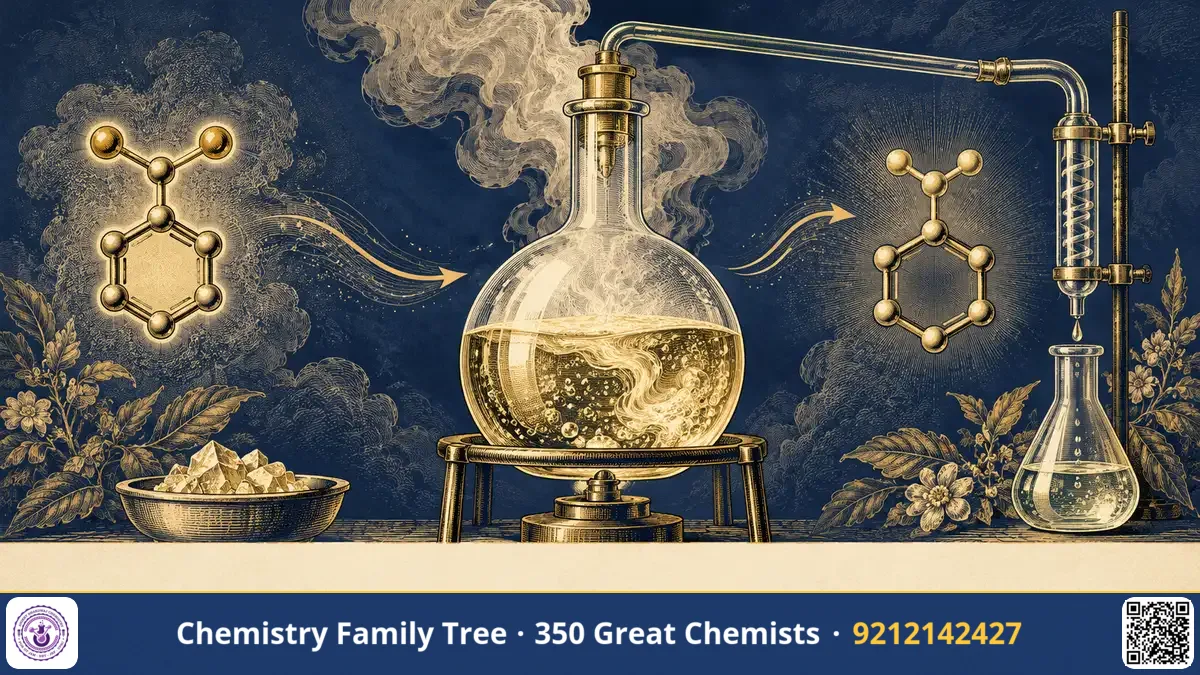
Aniline is the starting material for dyes, medicines, rubber chemicals and polyurethane precursors. Today it is made on a huge scale from nitrobenzene. The first laboratory reduction of an aromatic nitro compound to an amine was done in 1842 by the Russian chemist Nikolay Nikolaevich Zinin at Kazan University, who used ammonium sulfide. This reaction, now called the Zinin reduction, opened the door to aromatic amines and thus to the synthetic dye industry and to modern pharmaceutical chemistry. In this post we explain the discovery, the chemistry, the later Béchamp variation and the exam points.
The Scientific Problem Before the Discovery
Aniline had been seen before in other forms. Otto Unverdorben (1826) isolated it from the distillation of indigo, Runge (1834) found a substance in coal tar that gave a blue colour with bleaching powder, and Fritzsche (1840) obtained it by treating indigo with potash and named it "aniline" after the Spanish word for indigo, añil. All of these were regarded as different substances until later. Nobody could make aniline cheaply, and its link with benzene was not understood.
Eilhard Mitscherlich had prepared nitrobenzene in 1834 by nitrating benzene, using fuming nitric acid:
C6H6 + HNO3 --(H2SO4)--> C6H5NO2 + H2O
The problem was how to turn the nitro group (–NO₂) into the amino group (–NH₂). This was not simple, since strong reduction could destroy the molecule.
The Discovery: Zinin's Experiment
In 1842 Zinin was a young professor at Kazan. He took nitrobenzene (then called "nitrobenzid") and treated it with an alcoholic solution of ammonium sulfide. He obtained a basic oil, which he named "benzidam". It was later shown to be identical to the aniline of Fritzsche and the "krystallin" of Runge. This showed that all these substances were the same, and that aniline is related directly to benzene.
Steps of the experiment:
- Prepare nitrobenzene by nitration of benzene.
- Dissolve it in alcohol and saturate with ammonia, then pass hydrogen sulfide (forming ammonium sulfide).
- Heat the mixture; sulfur separates out.
- Isolate the basic product by treating with acid and then base, followed by distillation.
C6H5NO2 + 3 H2S → C6H5NH2 + 2 H2O + 3 S
This simplified equation shows the essential change: the nitro group is reduced to an amino group, and sulfide is oxidised to sulfur. In practice ammonium sulfide or polysulfides are present, but this is the equation to write in exams.
Zinin also reduced dinitrobenzene with the same reagent and found that only one nitro group was reduced, giving m-nitroaniline. This selective reduction is now called the Zinin reaction and is used for converting one nitro group of a dinitro compound selectively.
m-C6H4(NO2)2 + 3 H2S → m-O2N–C6H4–NH2 + 2 H2O + 3 S
Later, in 1854, Antoine Béchamp showed that iron and hydrochloric acid could do this reduction cheaply, which made aniline a bulk chemical:
4 C6H5NO2 + 9 Fe + 4 H2O → 4 C6H5NH2 + 3 Fe3O4 (Béchamp, with a little HCl)
Perkin then used this aniline to make mauveine in 1856, so Zinin's step is directly behind the first synthetic dye.
The Chemistry Behind It
The reduction of a nitro group to an amine is a six-electron process which goes through intermediates:
Ar–NO2 → Ar–N=O → Ar–NHOH → Ar–NH2
(nitro)  (nitroso) (hydroxylamine) (amine)
- Acidic medium (Sn/HCl, Fe/HCl): The reduction runs fully to aniline.
- Neutral medium (Zn/NH₄Cl): The reduction stops at N-phenylhydroxylamine.
- Alkaline medium (Zn/NaOH): Bimolecular products form, such as azoxybenzene, azobenzene and hydrazobenzene. Hydrazobenzene in acid undergoes the benzidine rearrangement, another reaction of importance for JAM and NET.
- Zinin conditions (Na₂S, (NH₄)₂S, NaSH): Mild, and selective for one nitro group in polynitro arenes. In dinitro compounds, the group which is more hindered or ortho to hydroxyl or amino is reduced preferentially.
- Catalytic hydrogenation: The modern industrial route uses H₂ over nickel or Pd/C: C₆H₅NO₂ + 3 H₂ → C₆H₅NH₂ + 2 H₂O.
Applications Today
- Dyes and pigments: Aniline is diazotised to make azo dyes, which are widely used in the textile industry of India.
- MDI and polyurethanes: The largest use of aniline today is making methylene diphenyl diisocyanate (MDI) for polyurethane foams and insulation.
- Pharmaceuticals: Paracetamol (acetaminophen) is made from p-aminophenol, itself made by reducing p-nitrophenol. Sulfa drugs also derive from aniline. India is among the world's major paracetamol producers.
- Rubber chemicals: Aniline derivatives are accelerators and antioxidants in tyres.
- Selective reductions in synthesis: The Zinin conditions are used in the preparation of intermediates where one nitro group must be preserved.
Exam Corner
- Zinin reduction: nitroarene + sulfide (Na₂S, (NH₄)₂S) gives arylamine; selective for one nitro group of a dinitroarene.
- Product from m-dinitrobenzene: m-nitroaniline.
- Sn/HCl or Fe/HCl: aniline. Zn/NH₄Cl: phenylhydroxylamine. Zn/NaOH: azobenzene or hydrazobenzene.
- Hydrazobenzene with acid gives benzidine (benzidine rearrangement).
- Aniline gives carbylamine test (with CHCl₃/KOH) and the diazonium salt at 0-5 °C.
Common Misconceptions
- "Zinin invented aniline." It was already known from indigo; Zinin showed it could be made from nitrobenzene and that it was the same substance.
- "All nitro reductions give aniline." The product depends on medium.
- "Zinin reduction uses tin." It uses sulfides, not metals.
Quick Revision Box
- 1842: Zinin reduced nitrobenzene to "benzidam" (aniline) at Kazan.
- Reagent: ammonium sulfide / H₂S; sulfur formed.
- Selective: dinitrobenzene gives m-nitroaniline.
- Béchamp (1854): Fe/HCl for industrial aniline.
- Pathway: nitro, nitroso, hydroxylamine, amine.
- Aniline led to mauveine and the dye industry.
FAQ
What is the Zinin reduction?
It is the reduction of aromatic nitro compounds to amines using sulfide reagents such as ammonium sulfide, often selective for one nitro group.
Why is aniline important?
It is the raw material for azo dyes, drugs, polyurethane precursors and rubber chemicals.
What did Zinin call aniline?
He called it "benzidam"; later it was found identical with aniline.
How is aniline made industrially today?
By catalytic hydrogenation of nitrobenzene with hydrogen over a metal catalyst.
Published by ABC Chemistry — IIT-JAM | CSIR-NET | GATE Chemistry Coaching. Visit abcchemistry.com
About the chemist
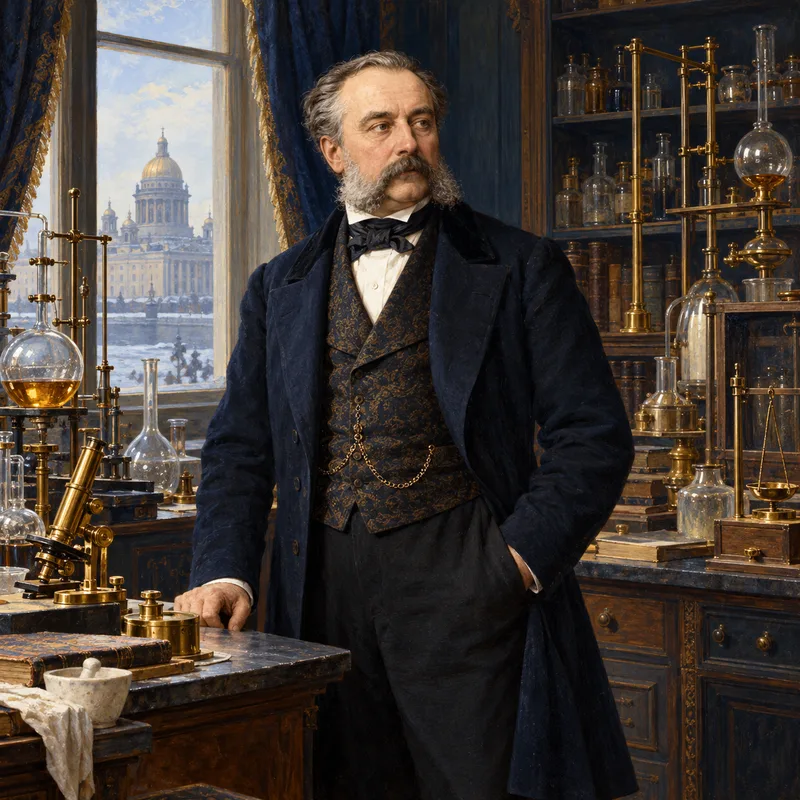
Nikolay Zinin
1812-1880 · Russia
Zinin reduction; aniline from nitrobenzene