Biography · Chemist no. 114 of 350
Sir Norman Haworth: The Chemist Who Gave Sugars Their Rings
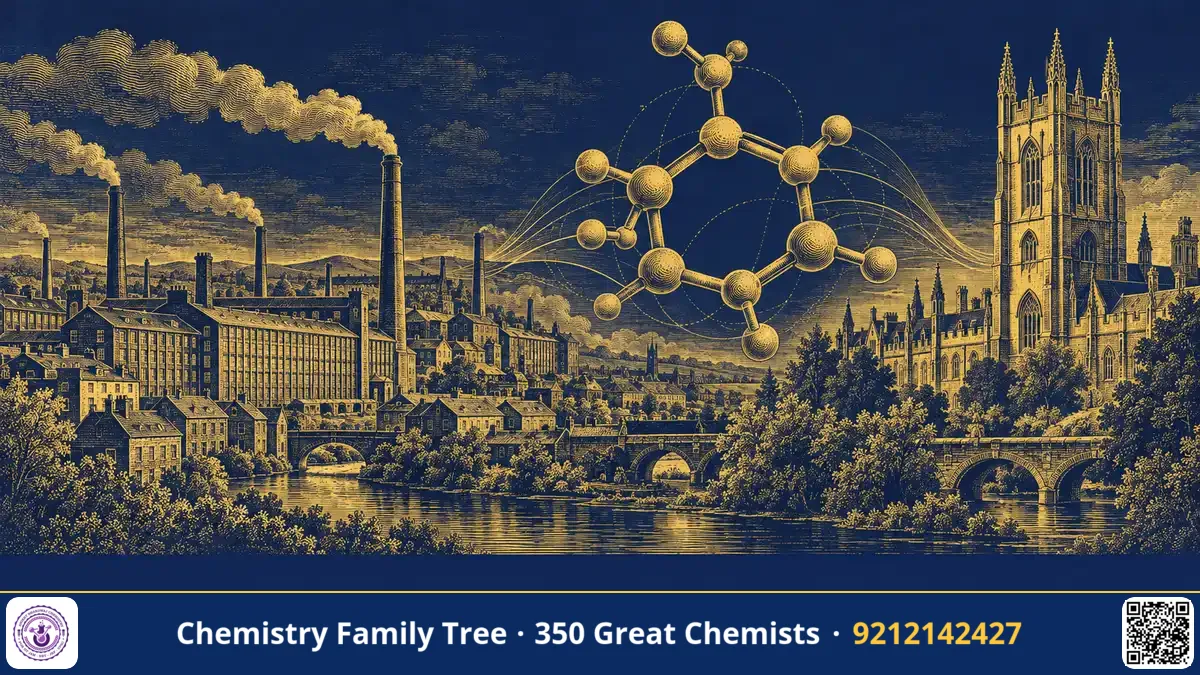
Sir Walter Norman Haworth (1883-1950) was a British organic chemist who showed that sugars such as glucose exist as six-membered rings, who worked out the structure of vitamin C, and who gave students the Haworth projection that is still drawn in every biochemistry class. He shared the 1937 Nobel Prize in Chemistry with the Swiss chemist Paul Karrer. His legacy is simple to state: when you draw glucose as a hexagon with up and down groups, you are using his idea.
Early Life & Family
Walter Norman Haworth was born on 19 March 1883 in Chorley, Lancashire, in the north-west of England, a town of the cotton industry. His father, Thomas Haworth, worked in a linoleum factory, and the family was of modest means. Haworth was known by his middle name, Norman, throughout his life. As a boy he left school at the age of 14 to work in the same factory as his father, where he was involved in the manufacture of linoleum. This gave him some early contact with practical chemistry, since linoleum is made from linseed oil oxidised into a rubbery film and mixed with cork and resin.
His interest in chemistry became stronger, and he returned to study. This change of direction, from a factory job to a university career, is one of the most inspiring parts of his story, and it came from his own persistence. In later life he married and had a family, and he remained devoted to his home and to his students.
Education & Mentors
Haworth entered the University of Manchester in 1903 to study chemistry. There he worked under William Henry Perkin Jr, one of the leading organic chemists in Britain, and took his degree and then a doctorate in research. Perkin's laboratory taught him careful experimental technique and the habit of proving a structure through synthesis.
He then went to Germany and worked at the University of Göttingen with Otto Wallach, a future Nobel laureate (1910) famous for his work on terpenes and essential oils. Haworth received his PhD in 1910 under Wallach. Returning to Manchester he gained a D.Sc. degree. The mixture of English practical training and German rigour shaped his later work. Wallach's terpene research also taught him how complex natural products can be solved by degradation, a method he later used on sugars.
Career Timeline
| Year | Event |
|---|---|
| 1883 | Born in Chorley, Lancashire |
| 1903 | Enters the University of Manchester |
| 1910 | PhD at Göttingen under Otto Wallach |
| 1912 | Lecturer at the University of St Andrews, where he begins carbohydrate research in the Purdie-Irvine school |
| 1920 | Professor of Organic Chemistry at Armstrong College, Newcastle (University of Durham) |
| 1925 | Becomes Mason Professor of Chemistry at the University of Birmingham |
| 1928 | Elected Fellow of the Royal Society |
| 1933 | With Edmund Hirst, completes the synthesis of ascorbic acid |
| 1937 | Awarded the Nobel Prize in Chemistry (shared with Paul Karrer) |
| 1939-45 | Contributes to wartime research in Birmingham, including work related to atomic energy |
| 1947 | Knighted |
| 1948 | Retires from the Birmingham chair |
| 1950 | Dies at Barnt Green, near Birmingham |
Major Scientific Contributions
Haworth's central contribution was to show that the common sugars exist as cyclic hemiacetals, and to establish the ring size by methylation. He named the six-membered form pyranose and the five-membered form furanose. Using the same methods he worked out the linkages in maltose, cellobiose, lactose and sucrose, and the nature of starch, glycogen, inulin and cellulose. He showed that cellulose is a chain of glucose units joined by β-1,4 links.
His second great area was vitamin C. Working with Szent-Györgyi's material he established that ascorbic acid is a lactone with an enediol group, and with Edmund Hirst he synthesised it in 1933. This was among the first vitamins made in the laboratory. For more on the reasoning, see our companion post on the discovery of the Haworth projection and the structure of sugars.
He also wrote an influential book, The Constitution of the Sugars (1929), which summarised the field for a generation of chemists.
Awards, Honours & Nobel Prize
The Nobel Prize in Chemistry for 1937 was divided between Haworth, "for his investigations on carbohydrates and vitamin C", and Paul Karrer, "for his investigations on carotenoids, flavins and vitamins A and B₂". The Nobel Prize in Physiology or Medicine that year went separately to Albert Szent-Györgyi for his work on biological combustion and vitamin C. Haworth was elected a Fellow of the Royal Society in 1928 and received its Davy Medal, and he later received the Royal Medal. He was knighted in 1947. He also held honorary degrees and foreign memberships of several academies.
Personality, Struggles & Lesser-Known Facts
- A late start. He left school at 14 and worked in a linoleum factory before entering university. Few Nobel winners began so far from a laboratory.
- A practical teacher. At Birmingham he built a large research school in which many young chemists, including Edmund Hirst and Maurice Stacey, trained. Stacey later became a leader in carbohydrate and polysaccharide work.
- Naming vitamin C. The name "ascorbic acid" came from the joint proposal of Haworth and Szent-Györgyi, linking the vitamin with its power to prevent scurvy.
- Wartime service. During the Second World War he took part in research related to atomic energy at Birmingham, with colleagues from the university.
- Public service. He served as Dean of Science at Birmingham and was active in the Chemical Society, serving as its President from 1944 to 1946.
Legacy & Influence on Modern Chemistry
Haworth's work became the foundation of carbohydrate chemistry. His school proved that polysaccharides are polymers of simple sugars joined by glycosidic links, an idea that supported the larger polymer science of Staudinger. Today glycobiology, which studies sugars on cell surfaces, vaccines made from sugar chains, and the sugar backbone of DNA and RNA, all rest on this ring-based understanding. Industrial vitamin C, which is made from glucose, remains one of the largest vitamin products by tonnage. The Haworth projection is taught from Class 12 to postgraduate level in India and across the world.
Lessons for Students
- It is never too late to turn towards your real interest. Haworth began with a factory job.
- Break a hard problem into small chemical tests. Methylation, hydrolysis and oxidation together solved the ring-size puzzle.
- A good drawing is a scientific tool. The Haworth projection made difficult stereochemistry readable.
- Build a team. Haworth's students and collaborators carried the work far beyond what one person could do.
Quick Facts Box
- Born: 19 March 1883, Chorley, Lancashire, England
- Died: 19 March 1950, Barnt Green, near Birmingham
- Nationality: British
- Field: Organic chemistry, carbohydrate chemistry
- Famous for: Ring structure of sugars, Haworth projection, structure and synthesis of vitamin C
- Nobel: Chemistry, 1937 (shared with Paul Karrer)
FAQ
Which Nobel Prize did Haworth win?
He won the Nobel Prize in Chemistry in 1937, shared with Paul Karrer, for his work on carbohydrates and vitamin C.
Where did Haworth work most of his career?
He spent his last and most productive period at the University of Birmingham, where he was professor of chemistry from 1925 to 1948.
Is the Haworth projection the actual shape of sugar?
No. It is a simplified flat drawing. The real six-membered ring adopts a chair conformation.
Who worked with Haworth on vitamin C?
Edmund Hirst was his main collaborator in the synthesis, and Albert Szent-Györgyi provided the original isolated compound and shared in naming it.
Published by ABC Chemistry — IIT-JAM | CSIR-NET | GATE Chemistry Coaching. Visit abcchemistry.com
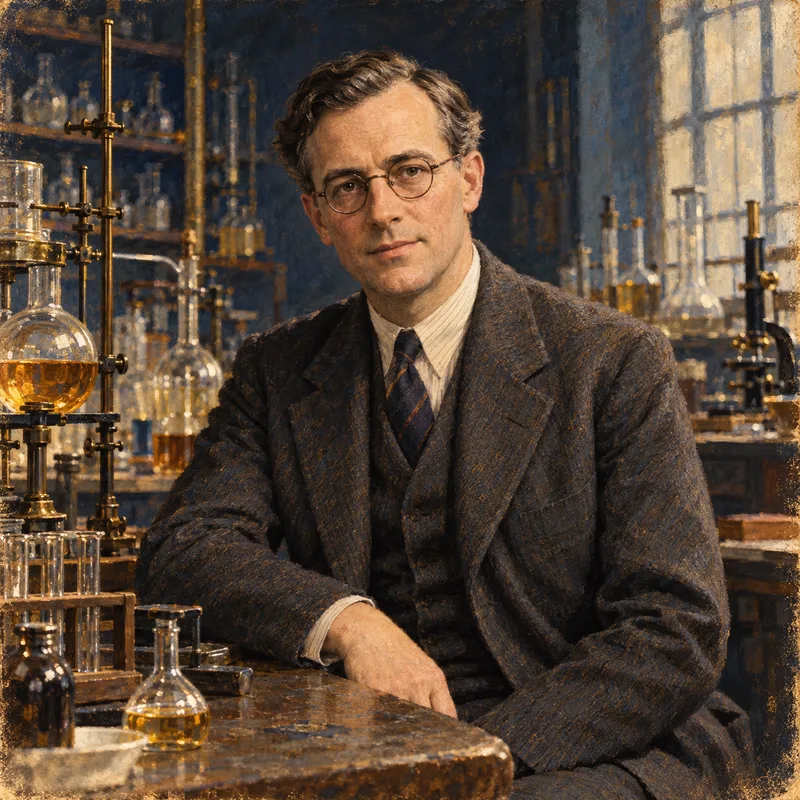
About the chemist
Norman Haworth
1883-1950 · United Kingdom · Nobel Chemistry 1937
Carbohydrate structure, synthesis of vitamin C