The discovery, explained · Chemist no. 114 of 350
Norman Haworth and the Ring Structure of Sugars: From Haworth Projection to Vitamin C
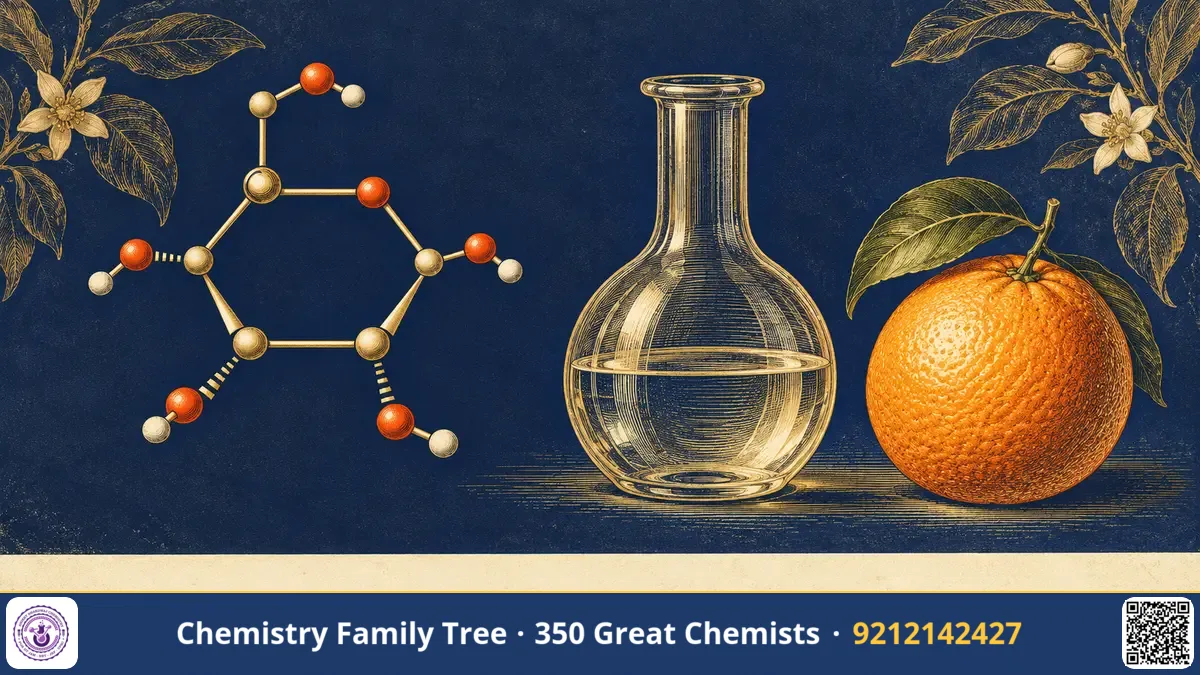
Every student of organic chemistry has drawn a flat hexagon with a bold front edge and written H and OH above and below it. That drawing is the Haworth projection, named after Sir Walter Norman Haworth. But the drawing is only the visible part of his work. Haworth proved that common sugars such as glucose and fructose exist mainly as rings and not as open chains. He also worked out the structure of ascorbic acid (vitamin C) and was part of the first laboratory synthesis of this vitamin. For this work he shared the 1937 Nobel Prize in Chemistry with Paul Karrer. In this post we follow his reasoning step by step, so that you can use it in your JAM, NET and GATE answers.
The Scientific Problem Before the Discovery
By the 1890s Emil Fischer had shown that glucose is a pentahydroxy aldehyde, HOCH₂–(CHOH)₄–CHO. This open-chain structure explained many reactions, such as the formation of an oxime, a cyanohydrin and an osazone. But it could not explain several puzzling facts.
- Mutarotation. A freshly made solution of glucose has specific rotation +112°, another form has +19°, and both slowly change to +52.7°. An open chain with one fixed structure cannot do this.
- Missing aldehyde behaviour. Glucose does not give the Schiff test and does not add sodium bisulphite easily, though a free aldehyde should.
- Two methyl glucosides. Treating glucose with methanol and HCl gives two different methyl glucosides, which cannot be explained by a free CHO group.
Chemists such as Tollens and later Emil Fischer had suggested a cyclic hemiacetal form, but nobody knew the ring size. Was it a five-membered ring or a six-membered ring? Without an answer, the structure of disaccharides, starch and cellulose could not be solved either.
The Discovery: How Haworth Fixed the Ring Size
Haworth worked first at Durham (then Armstrong College), then at St Andrews with Thomas Purdie and James Irvine's school of sugar chemistry, and later at Birmingham. His method was based on methylation followed by degradation. The logic is simple and appears often in exam questions.
- Methylate all free OH groups. Haworth used dimethyl sulfate with sodium hydroxide, which converts each free –OH to –OCH₃. The ring oxygen does not change. This is now called the Haworth methylation.
- Hydrolyse the glycosidic link. Dilute acid cleaves the methyl acetal (the C-1 OMe) to give a free hemiacetal OH at C-1, while other OMe ethers stay unchanged.
- Oxidise strongly. Nitric acid breaks the chain at the place where a free OH is present. The fragments are identified as methoxy-acids.
- Read the answer. The position of the free OH, which was the ring-closing oxygen, tells you which carbon carries the ring oxygen.
For methyl glucoside, the result was 2,3,4,6-tetra-O-methylglucose. The OH at C-5 was not methylated because it was tied up in the ring. So the ring closes between C-1 and C-5, giving a six-membered ring containing five carbons and one oxygen. Haworth called this ring type a pyranose, because it resembles pyran. The five-membered ring form, resembling furan, he called a furanose. These names are still used today.
The Haworth projection
To draw these rings clearly Haworth showed the ring as a flat hexagon seen almost edge-on, with the ring oxygen at the back right and the bold lines at the front. Groups that are on the right in the Fischer projection point down in the Haworth drawing, and groups on the left point up. For D-sugars the CH₂OH group at C-5 points up. The anomeric carbon C-1 gives two forms: in α-D-glucopyranose the OH at C-1 is down (trans to CH₂OH), and in β-D-glucopyranose it is up (cis to CH₂OH).
open chain D-glucose  ⇌  α-D-glucopyranose (36%)  +  β-D-glucopyranose (64%)
HOCH₂(CHOH)₄CHO       C-1 OH on C-5 oxygen ring closure
The Chemistry Behind It
Ring closure is an intramolecular nucleophilic addition. The OH group on C-5 attacks the carbonyl carbon of the aldehyde at C-1, and a cyclic hemiacetal forms. The old carbonyl carbon becomes a new stereocentre, called the anomeric carbon, and the two diastereomers are called anomers. Because the two anomers interconvert through the open-chain form in water, the optical rotation of a fresh solution drifts to an equilibrium value. That is mutarotation, and the Haworth ring picture explains it fully.
The real six-membered ring is not flat but adopts a chair conformation. In β-D-glucopyranose all the bulky substituents (all OH groups and CH₂OH) are equatorial. This is why glucose is the most stable and the most abundant aldohexose in nature. Haworth's flat drawing is a convenient bookkeeping tool, while the chair form shows the true shape.
The same methylation method was applied to disaccharides and polysaccharides. Haworth and his co-workers showed that maltose and cellobiose are made of two glucose units joined by a 1→4 link. They also showed that cellulose is a long chain of β-1,4 linked glucose units. For starch and glycogen, end-group assay with methylation told the average chain length, because each chain end gives one molecule of 2,3,4,6-tetramethylglucose. This was one of the first quantitative uses of end-group analysis in polymer chemistry.
Vitamin C
In the early 1930s Albert Szent-Györgyi isolated a reducing acid from adrenal glands and plants, which he called hexuronic acid. Haworth's group worked out its structure. Ascorbic acid, C₆H₈O₆, is a five-membered lactone (a γ-lactone) with an enediol group, C(OH)=C(OH), next to the C=O. This enediol is a strong reducing agent and is easily oxidised to dehydroascorbic acid. Haworth and Szent-Györgyi proposed the name ascorbic acid because the vitamin prevents scurvy (anti-scorbutic). In 1933 Haworth and Edmund Hirst at Birmingham made the vitamin from D-xylose in a synthesis, and almost at the same time Tadeus Reichstein in Zürich developed a practical route from D-glucose through sorbitol and L-sorbose. The Reichstein process is still the basis of industrial vitamin C manufacture.
Applications Today
- Biochemistry. Every textbook diagram of glucose, ribose, deoxyribose, fructose and sucrose uses the Haworth style. Nucleotides in DNA and RNA are drawn with furanose rings.
- Food and medicine. Vitamin C is made in thousands of tonnes per year for tablets, juices and as the antioxidant E300 in food. India is a large consumer and producer.
- Polymer and textile industry. Understanding cellulose as a β-1,4 polymer guides the making of rayon, cellulose acetate and nitrocellulose, and the pulp and paper industry.
- Analysis. Methylation analysis is still used to find linkage positions in complex polysaccharides, using GC-MS of partially methylated alditol acetates.
Exam Corner
- Glucose has pyranose (six-membered, C-1 to C-5) ring; fructose usually has furanose ring in combined form (sucrose) and pyranose in free form.
- In the Haworth projection of a D-sugar, groups on the right in Fischer projection go down; α-anomer has the anomeric OH trans to the terminal CH₂OH.
- Mutarotation: α (+112°) and β (+18.7°) forms reach equilibrium rotation of +52.7°, about 36% α and 64% β.
- Methylation with (CH₃)₂SO₄/NaOH, then hydrolysis, then oxidation, was used to find ring size; 2,3,4,6-tetra-O-methylglucose indicates a 1,5 ring.
- Vitamin C is a γ-lactone with enediol; it is an antioxidant and its deficiency causes scurvy. Industrial route: Reichstein process.
Common Misconceptions
- "The Haworth projection shows the real shape." It does not. The real ring is a chair; the Haworth ring is a flat simplification.
- "Glucose contains a free aldehyde group." In solution only a tiny fraction, well below 1%, is in open form. This is why it gives a weak response to some aldehyde tests.
- "Vitamin C is a carboxylic acid." The acidity (pKa about 4.2) comes from the enol OH at C-3 in the lactone, not from a COOH group.
Quick Revision Box
- Haworth: Nobel Prize in Chemistry, 1937, shared with Paul Karrer.
- Pyranose = six-membered ring, furanose = five-membered ring (names by Haworth).
- Haworth methylation uses dimethyl sulfate and alkali.
- Anomers differ only at C-1 (anomeric carbon).
- Ascorbic acid, C₆H₈O₆: lactone plus enediol, reducing agent.
- Cellulose is β-1,4 glucan; starch amylose is α-1,4 glucan.
FAQ
Why are the rings called pyranose and furanose?
Haworth compared the sugar rings with the heterocycles pyran (six-membered, one oxygen) and furan (five-membered, one oxygen), and added the ending -ose for sugars.
What is the difference between a Fischer and a Haworth projection?
A Fischer projection shows the open chain as a vertical line with horizontal substituents. A Haworth projection shows the ring form as a flat hexagon or pentagon with substituents above or below the plane.
Did Haworth discover vitamin C?
No. Szent-Györgyi isolated it, and Haworth established the structure and, with Hirst, synthesised it. The 1937 Nobel Prize in Physiology or Medicine went to Szent-Györgyi, and Haworth got the Chemistry prize.
Why does glucose show mutarotation but not methyl glucoside?
Methyl glucoside is a full acetal and cannot open to the free aldehyde in neutral water, so the anomers do not interconvert. Glucose is a hemiacetal and can open and close freely.
Published by ABC Chemistry — IIT-JAM | CSIR-NET | GATE Chemistry Coaching. Visit abcchemistry.com
About the chemist
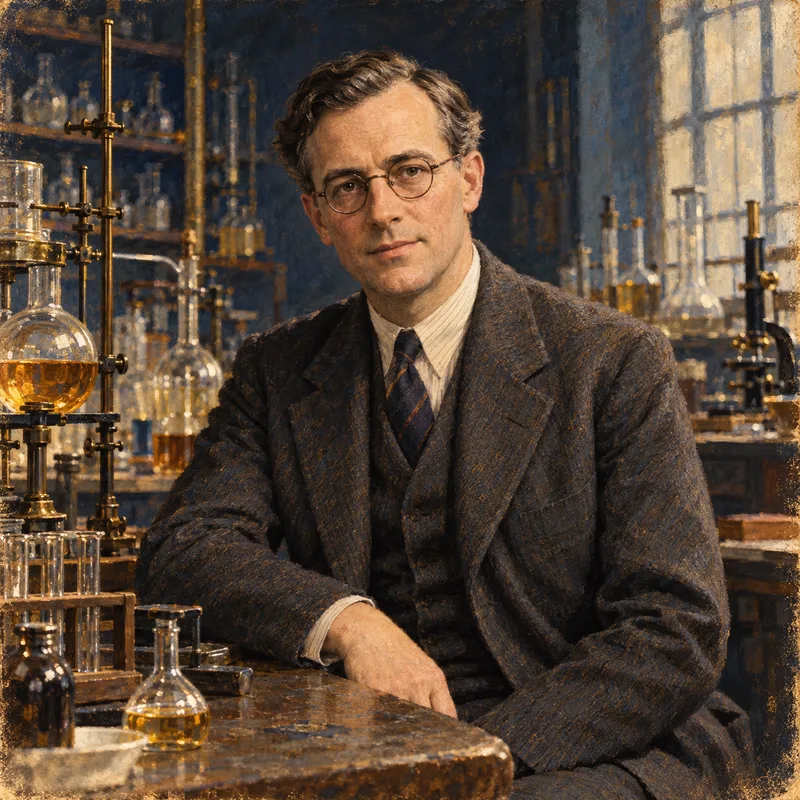
Norman Haworth
1883-1950 · United Kingdom · Nobel Chemistry 1937
Carbohydrate structure, synthesis of vitamin C