Biography · Chemist no. 62 of 350
Odd Hassel: The Quiet Norwegian Who Showed Chemists the Shape of Molecules
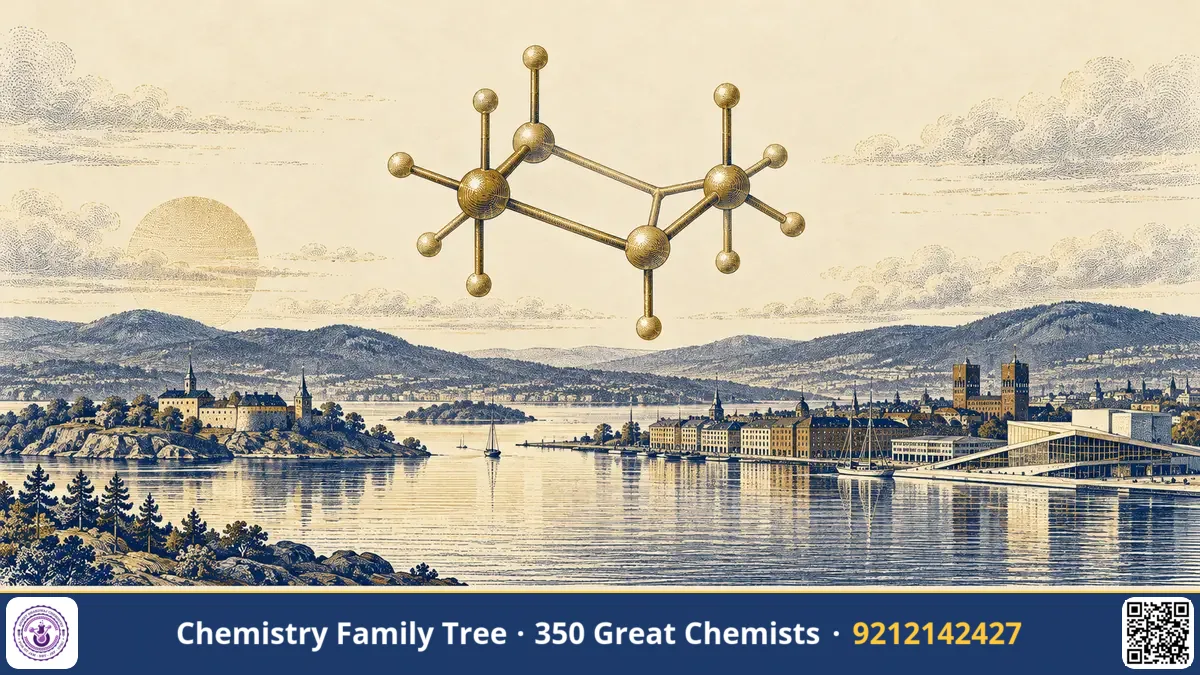
Odd Hassel (1897-1981) was a Norwegian physical chemist and crystallographer. He worked for most of his life at the University of Oslo, studying the structures of molecules with X-rays and electron beams. He proved that cyclohexane exists in the chair form, showed the difference between axial and equatorial bonds, and discovered what is today called the halogen bond. He shared the 1969 Nobel Prize in Chemistry with the British chemist Derek Barton. Hassel was known for his modest, quiet personality and for his lifelong dedication to science. This biography follows his life, with notes for students of chemistry.
Early Life and Family
Odd Hassel was born on 17 May 1897 in Kristiania, which is now Oslo, the capital of Norway. His father, Ernst Hassel, was a gynaecologist. Odd attended school in Oslo and had an early interest in science, and his schooling prepared him for university studies in the sciences. The Norway of his youth had just gained full independence from Sweden (1905), and was a small country with a rising scientific community.
Education and Mentors
Hassel studied mathematics, physics and chemistry at the University of Oslo, and graduated in 1920. He then travelled to Germany for further studies. He spent time in Munich, where he studied under Kasimir Fajans, and in Berlin at the Kaiser Wilhelm Institute for Fibre Chemistry, where he learned the technique of X-ray crystallography. In Berlin he completed his doctorate in 1924. During this period he collaborated on the crystal structure of graphite. After spending time in Germany, he returned to Norway and became a lecturer at the University of Oslo in 1925.
Career Timeline
| Year | Event |
|---|---|
| 1897 | Born in Kristiania (Oslo), Norway (17 May) |
| 1920 | Graduated from the University of Oslo |
| 1924 | Doctorate in Berlin; work on the structure of graphite |
| 1925 | Returned to the University of Oslo |
| 1934 | Professor of physical chemistry at the University of Oslo |
| 1930s | Electron diffraction studies of cyclohexane and derivatives |
| 1943-1944 | Arrested by the German occupation authorities and held in a prison camp |
| 1950 | Barton's paper brought the chair conformation to wide attention |
| 1950s | Studied charge-transfer complexes and halogen bonding |
| 1964 | Retired from the professorship |
| 1969 | Nobel Prize in Chemistry, shared with Derek Barton |
| 1981 | Died in Oslo (11 May) |
Major Scientific Contributions
1. Structure of graphite
In the 1920s, Hassel took part in determining the layered structure of graphite by X-ray diffraction. Each layer has carbon atoms in hexagonal rings, with weak forces between layers, which explains why graphite is soft and used as a lubricant and in pencils.
2. Chair cyclohexane and conformations
Using electron diffraction he demonstrated that cyclohexane is a puckered, strain-free chair, with two kinds of bonds, axial and equatorial. He also studied substituted cyclohexanes and related fused-ring systems such as decalin.
Chair cyclohexane: C-C-C angle ≈ 111°; 6 axial + 6 equatorial H atoms
3. Halogen bonding
He found that halogen molecules form short, linear contacts with donor atoms such as oxygen and nitrogen, as in the Br2-dioxane crystal. Today this is called the halogen bond. This interaction is important in crystal engineering and drug design.
4. Other structural studies
Hassel and his group determined the structures of many inorganic and organic molecules and crystals. The Oslo school of structural chemistry grew out of his laboratory and became well known worldwide. One of his students and co-workers, Otto Bastiansen, continued to develop gas electron diffraction.
Awards, Honours and Nobel Prize
Hassel and Derek Barton were awarded the Nobel Prize in Chemistry in 1969 "for their contributions to the development of the concept of conformation and its application in chemistry". Hassel was 72 years old and had retired from his chair. He was recognised by scientific societies in Norway and abroad. In Norway his Nobel Prize was a source of national pride.
Personality, Struggles and Lesser-Known Facts
- Unmarried and devoted to science: Hassel never married, and he is remembered as a person who lived for his research and his students.
- Imprisoned during the war: During the German occupation of Norway in the Second World War, he was arrested in 1943 and imprisoned for a time, after which he returned to the university.
- Late recognition: His chair conformation work was published in the 1930s and 1940s, but organic chemists paid little attention until Barton's 1950 paper. The Nobel Prize came about thirty years after his main discoveries.
- A modest scientist: He was known as a very modest person who did not look for publicity. He worked in small laboratories with simple equipment, built by himself and his students.
- Before his time: His idea of halogen bonding was not widely accepted for decades, and it became a popular topic of research only in the 1990s and 2000s.
Legacy and Influence on Modern Chemistry
The chair conformation of cyclohexane is the first stereochemical picture that every organic chemistry student learns. The language of axial and equatorial bonds, ring flipping and 1,3-diaxial interactions forms the basis of the chemistry of sugars, steroids and many natural products. Halogen bonding is now an active field, with applications in drug design, catalysis and materials. Hassel also showed that small countries can build important schools of science through steady work and quality. The Oslo school of structural chemistry that he founded continued his tradition for decades.
Lessons for Students
- Experimental proof matters: A theoretical idea (Sachse and Mohr) needed Hassel's experiments to be accepted.
- Do careful work and be patient: His work was recognised only after many years.
- Follow your curiosity: Hassel's study of why bromine sits so close to dioxane led to a new type of bond.
- Humility and dedication can take you far: A quiet researcher in a small country changed the way the world thinks about molecular shape.
Quick Facts Box
- Born: 17 May 1897, Kristiania (Oslo), Norway
- Died: 11 May 1981, Oslo, Norway
- Nationality: Norwegian
- Field: Physical chemistry, structural chemistry
- Famous for: Chair cyclohexane, axial/equatorial bonds, halogen bonding
- Nobel Prize: Chemistry 1969 (shared with Derek Barton)
FAQ
What did Odd Hassel discover?
He proved the chair conformation of cyclohexane by electron diffraction and introduced the idea of axial and equatorial bonds. He also discovered the halogen bond.
Where did Hassel work?
Mostly at the University of Oslo, where he was professor of physical chemistry from 1934.
Why did it take so long for his work to be recognised?
His main papers were published in Norwegian and German journals, and organic chemists were not aware of them until Barton used the chair model in 1950.
Was Hassel married?
No. He never married and devoted his life to science.
Published by ABC Chemistry — IIT-JAM | CSIR-NET | GATE Chemistry Coaching. Visit abcchemistry.com
About the chemist
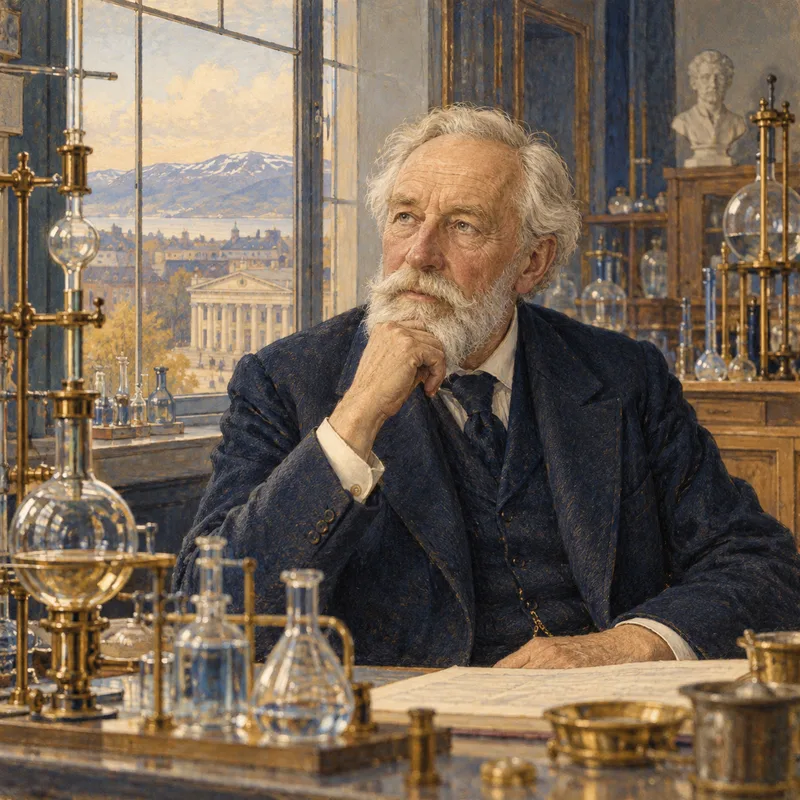
Odd Hassel
1897-1981 · Norway · Nobel Chemistry 1969
Conformational analysis of cyclohexane