The discovery, explained · Chemist no. 62 of 350
Odd Hassel: How Electron Diffraction Revealed the Chair of Cyclohexane
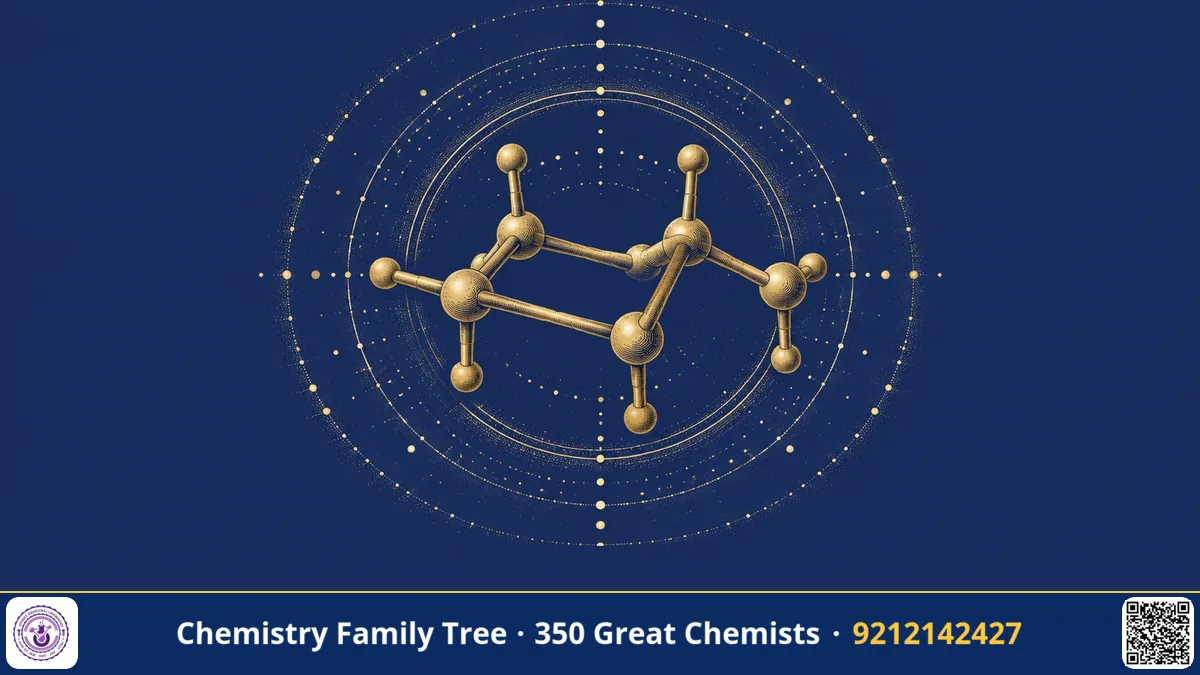
If you ask a Class 11 student to draw cyclohexane, they will draw a chair. But how do we know that the molecule really has this shape? The answer comes from the experiments of the Norwegian physical chemist Odd Hassel. Using X-ray and electron diffraction, he showed that cyclohexane exists in the strain-free chair form and that its bonds fall into two sets, which we now call axial and equatorial. He also made another discovery, now known as the halogen bond. In 1969 Hassel shared the Nobel Prize in Chemistry with Derek Barton "for their contributions to the development of the concept of conformation and its application in chemistry".
The Scientific Problem Before the Discovery
In 1885, Adolf von Baeyer proposed his strain theory, which assumed that rings are planar. For cyclohexane, a planar hexagon has angles of 120°, which differ from the tetrahedral angle of 109.5°, and it should therefore be strained. But experimental heats of combustion showed that cyclohexane is practically strain-free. In 1890, Hermann Sachse had already suggested a non-planar, puckered cyclohexane, and Ernst Mohr extended the idea in 1918 to the chair form. However, these were mathematical arguments, and most chemists doubted that such a model could be proved or that the two forms (chair and boat) could be separated. Direct structural evidence was needed. There was also little understanding of how a molecule's shape affects its properties.
The Discovery: Step by Step
- A structural chemist's toolkit: Hassel started as a crystallographer. In 1924, working in Berlin, he took part in determining the crystal structure of graphite, showing its layered arrangement of carbon atoms.
- Gas-phase electron diffraction: In Oslo, Hassel built apparatus for electron diffraction of gases. A beam of fast electrons passes through a gas of the molecule, and the scattering pattern gives the distribution of interatomic distances.
- Cyclohexane in the 1930s: Applying this technique to cyclohexane and its derivatives, Hassel and co-workers found that the interatomic distances fit a chair-shaped molecule with C-C-C angles close to the tetrahedral value, and not a planar ring.
- Two kinds of bonds: Hassel found that in the chair, the hydrogen atoms can be divided into two groups: six lying roughly parallel to the molecular axis (axial) and six pointing outwards (equatorial).
- Publication: His work, published during the 1930s and 1940s, was available mostly in German and Norwegian journals and in the Norwegian chemical journal Tidsskrift for Kjemi. In 1950 Barton's paper brought Hassel's chair model to the attention of organic chemists, who then applied it to reactivity.
The Chemistry Behind It
Why chair is strain-free
In the chair form, all C-C-C angles are about 111°, close to the tetrahedral angle of 109.5°, so there is almost no angle strain. All C-H bonds on adjacent carbons are staggered, so there is no torsional strain. The boat form has eclipsed bonds and the "flagpole" hydrogens clash, so it is higher in energy (by about 25-30 kJ/mol), and the twist-boat lies in between.
Energy order of cyclohexane conformers
chair (0) < twist-boat (~23 kJ/mol) < boat (~29 kJ/mol) < half-chair (~45 kJ/mol)
At room temperature almost every molecule is in the chair form, and ring flipping is rapid (about 105 times per second at 25 °C).
Substituents
Hassel also demonstrated that substituents prefer the equatorial position, because axial groups suffer from 1,3-diaxial repulsion. In fused-ring systems such as decalin, the same chair model applies: trans-decalin is rigid and cannot ring-flip, while cis-decalin is flexible. This idea was later used to understand steroids.
Halogen bonding
In the 1950s Hassel and co-workers studied crystals of halogens with donor molecules such as dioxane (and, later, other solvents). In the crystal of the bromine-dioxane complex, the bromine molecule is not randomly placed. The oxygen atom of dioxane approaches Br2 along the extension of the Br-Br axis. The O···Br distance (about 2.7 Å) is much shorter than the sum of the van der Waals radii of O and Br (about 3.4 Å), and the O···Br-Br angle is almost 180°. Hassel realised this is a directional attractive interaction between a halogen and a lone-pair donor, a charge-transfer type bond:
D: ··· X-Y (D = O, N, S donor; X = Br, I, Cl) angle D···X-Y ≈ 180°
Modern theory explains this with the σ-hole: the halogen atom has a region of positive electrostatic potential on the extension of the X-Y bond, which attracts lone pairs. In 2013 IUPAC gave a formal definition of the halogen bond.
Applications Today
- Drug conformations: The chair and axial/equatorial concept is fundamental to understanding the shapes of sugars, steroids and many drugs.
- Carbohydrates: β-D-glucose in the chair form has all its large substituents equatorial, which is why it is the most stable and abundant sugar.
- Drug design with halogen bonds: Medicinal chemists add Cl, Br or I atoms to a drug so that halogen bonds help it bind to a protein target.
- Crystal engineering and materials: Halogen bonding is used to design co-crystals, liquid crystals, conducting materials and supramolecular assemblies.
- Structural methods: Electron diffraction is still used to determine the structure of gaseous molecules, and the Oslo school founded by Hassel continued to be a world leader.
Exam Corner
- Cyclohexane chair: angle ≈ 111°, no angle strain, no torsional strain. Boat: eclipsing and flagpole strain.
- Stability order: chair > twist-boat > boat > half-chair.
- Axial bonds are parallel to the axis; equatorial bonds point outward. Ring flip interchanges them.
- trans-Decalin is rigid; cis-decalin can undergo ring flip.
- Halogen bond: D···X-Y, nearly linear, with σ-hole on the halogen; found by Hassel in the Br2-dioxane crystal.
Common Misconceptions
- "Baeyer's strain theory is correct for all rings." It works for small rings (cyclopropane, cyclobutane) but fails for six-membered and larger rings, which are puckered.
- "Boat is as stable as chair." The boat is higher in energy by about 29 kJ/mol and is not populated at room temperature.
- "Halogen bonding is the same as hydrogen bonding." It is similar in being directional, but the donor is a halogen atom's σ-hole and not a hydrogen atom.
Quick Revision Box
- Hassel used electron diffraction to prove the chair form of cyclohexane.
- Two types of C-H bonds: 6 axial and 6 equatorial.
- Substituents prefer equatorial to avoid 1,3-diaxial strain.
- Halogen bond discovered in Br2-dioxane crystals (1950s).
- Nobel Prize in Chemistry 1969, shared with Derek Barton.
FAQ
Who first proposed the chair form of cyclohexane?
Hermann Sachse proposed puckered forms in 1890, and Ernst Mohr developed the idea in 1918. Hassel provided the experimental proof by electron diffraction.
What is electron diffraction?
It is a method in which fast electrons are scattered by molecules, and the diffraction pattern is analysed to find the distances between atoms. For gas molecules it gives the geometry of free molecules.
What is a halogen bond?
A halogen bond is an attractive, directional interaction between an electrophilic region on a halogen atom (the σ-hole) and a nucleophile, such as a lone pair.
Why is the Nobel Prize shared between Hassel and Barton?
Hassel established the chair conformation and bond types, and Barton used these ideas to explain the reactivity and physical properties of organic molecules.
Published by ABC Chemistry — IIT-JAM | CSIR-NET | GATE Chemistry Coaching. Visit abcchemistry.com
About the chemist
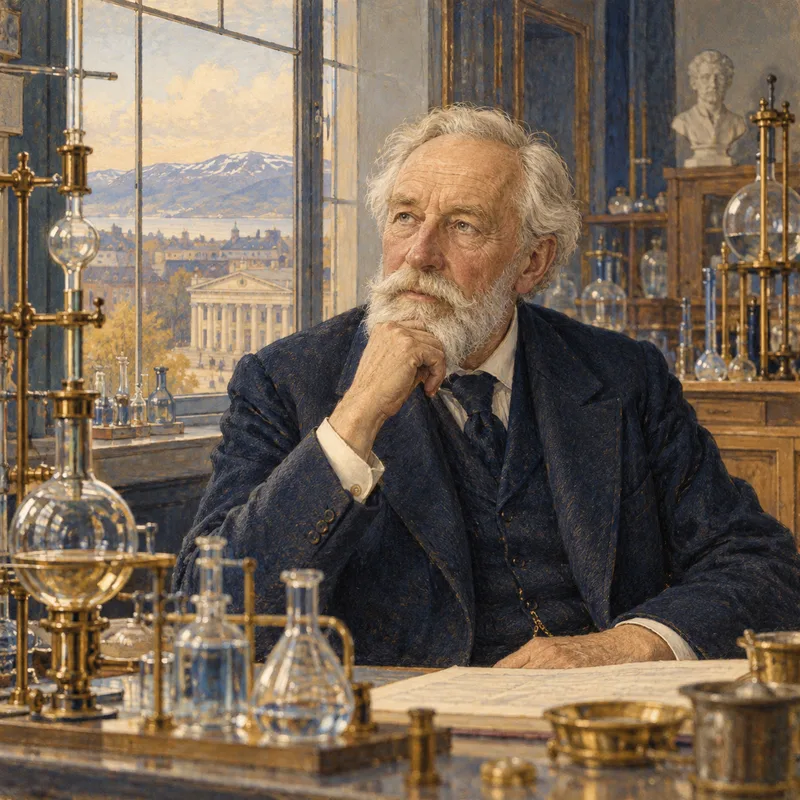
Odd Hassel
1897-1981 · Norway · Nobel Chemistry 1969
Conformational analysis of cyclohexane