Biography · Chemist no. 230 of 350
Omar Yaghi: From a One-Room Home in Amman to the Nobel Prize in Chemistry
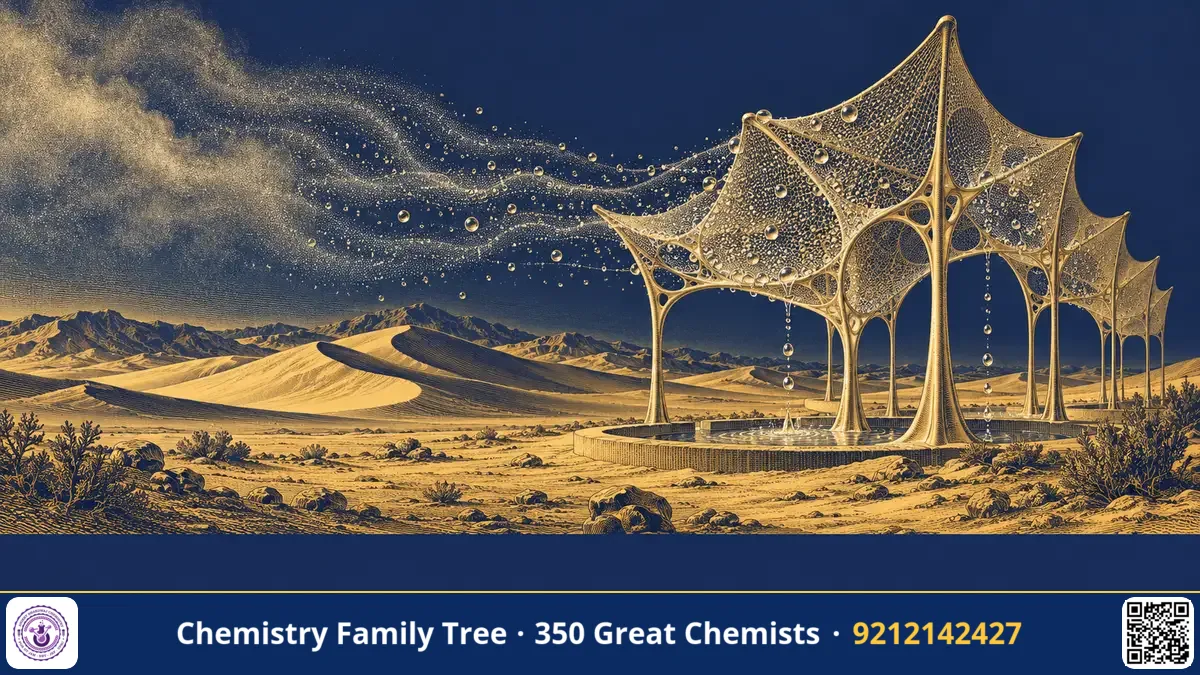
Omar Mwannes Yaghi, born in 1965 in Amman, Jordan, is a Jordanian-American chemist and professor at the University of California, Berkeley. He coined the term metal-organic framework, created the stable MOF-5, founded reticular chemistry, and developed covalent organic frameworks and MOFs that harvest water from desert air. In 2025 he shared the Nobel Prize in Chemistry with Susumu Kitagawa and Richard Robson. His legacy in one line: he turned an architectural idea into a toolbox that chemists use to design materials atom by atom.
Early Life and Family
Yaghi was born on 9 February 1965 in Amman to a Palestinian refugee family. He has described his childhood in interviews: a single room shared by a large family and even by livestock, with no running water or reliable electricity in the home. His father, who had little formal education, insisted that his children should study. As a boy, Yaghi was drawn to chemistry after finding a chemistry book in the library; he has said that the drawings of molecular structures in it fascinated him. At the age of 15 he was sent to the United States to study.
Education and Mentors
On arrival in the United States, he began at Hudson Valley Community College in New York, and then transferred to the State University of New York at Albany, where he earned a bachelor's degree in chemistry in 1985. He had to work in various jobs to support his studies and learn English quickly. He then went to the University of Illinois at Urbana-Champaign for his PhD, completed in 1990 under Walter Klemperer, a respected inorganic chemist. After this he was a National Science Foundation postdoctoral fellow at Harvard University with Richard Holm, a pioneer of metal-sulfur clusters in biology.
Career Timeline
| Year | Event |
|---|---|
| 1965 | Born in Amman, Jordan |
| 1980 | Moves to the United States at age 15 |
| 1985 | BS in chemistry, State University of New York at Albany |
| 1990 | PhD, University of Illinois at Urbana-Champaign (with Walter Klemperer) |
| 1990-1992 | Postdoctoral fellow at Harvard University (with Richard Holm) |
| 1992 | Assistant professor at Arizona State University |
| 1995 | Coins "metal-organic framework" in a paper on a copper-based framework |
| 1999 | Joins the University of Michigan; MOF-5 reported |
| 2005 | First covalent organic frameworks reported |
| 2006 | Moves to UCLA |
| 2012 | Moves to UC Berkeley |
| 2017 | Water harvesting with MOF-801 from air |
| 2025 | Nobel Prize in Chemistry (shared) |
Major Scientific Contributions
Coining and defining MOFs. In 1995 Yaghi used "metal-organic framework" for a layered copper-based structure with large rectangular channels, giving the field its name.
MOF-5 and reticular chemistry. The 1999 synthesis of MOF-5, with a stable Zn4O(BDC)3 structure and very high surface area, and the formulation of reticular chemistry with secondary building units. See our discovery post for details.
Isoreticular series and ZIFs. He showed that pore size and chemistry can be tuned without changing the topology, and invented zeolitic imidazolate frameworks (ZIFs) for CO2 capture.
Covalent organic frameworks (2005). His group made the first crystalline COFs, extending reticular chemistry to all-organic structures held by strong covalent bonds.
Water harvesting. MOF-801, tested in 2017, and the later MOF-303 and device designs, demonstrated the harvesting of water from dry air using sunlight, even in desert conditions.
Social initiatives. Yaghi founded the Berkeley Global Science Institute, which aims to bring science education and research opportunities to people in developing regions and to support scientists in refugee communities.
Awards, Honours and Nobel Prize
The Nobel Prize in Chemistry 2025 was awarded jointly to Susumu Kitagawa, Richard Robson and Omar M. Yaghi "for the development of metal-organic frameworks". Yaghi is a member of the US National Academy of Sciences Only the Nobel Prize is described in detail here, as other award details could not be checked with certainty.
Personality, Struggles and Lesser-Known Facts
- Humble beginnings. He lived in a crowded one-room home in Amman without running water or electricity at times, yet he rose to the top of world science.
- Childhood library. A visit to the library, where he found a book with drawings of molecules, is a part of his story. He has said that he knew then that he wanted to study chemistry.
- Immigrant student. He arrived in the United States at 15 with limited English and worked his way through community college before reaching Harvard and later Berkeley.
- Naming matters. He chose the name "metal-organic framework", which stuck and now describes thousands of papers a year.
- Science for all. He promotes education in the Middle East and other regions through the Berkeley Global Science Institute, and has spoken of science as a way of building understanding between communities.
Legacy and Influence on Modern Chemistry
Yaghi's work established a new area of chemistry: reticular chemistry. The structures are not only beautiful but also useful: they capture carbon dioxide, store fuel gases, remove pollutants, catalyse reactions and harvest water. Tens of thousands of MOF structures have now been reported, and companies are scaling up production for carbon capture and other uses. The idea of designing crystals from molecular building blocks changed how chemists view solids, which are no longer merely discovered but constructed. In India, with its water stress and energy needs, MOFs and COFs are active research topics, and Yaghi's rags-to-Nobel story serves as an inspiration to students from modest backgrounds.
Lessons for Students
- Background is not destiny. A refugee child from a one-room home became a Nobel laureate.
- Value your teachers and books. A single library book changed his life.
- Think like an architect. Choose geometry, then build.
- Name your ideas. Clear language helps a field to grow.
- Use science for society. Water, energy and education were his targets.
Quick Facts Box
- Born: 9 February 1965, Amman, Jordan
- Died: Living
- Nationality: Jordanian-American (Palestinian refugee family)
- Field: Inorganic and materials chemistry
- Famous for: MOF-5, reticular chemistry, COFs, water harvesting MOFs
- Nobel: Chemistry 2025, shared with Kitagawa and Robson
FAQ
Where does Omar Yaghi work?
He is a professor of chemistry at the University of California, Berkeley, and director of the Berkeley Global Science Institute.
What is reticular chemistry?
It is the chemistry of linking molecular building blocks into predetermined extended structures by strong bonds.
Who was his PhD adviser?
Walter Klemperer at the University of Illinois at Urbana-Champaign.
What exam topics link to his work?
Carboxylate coordination, metal clusters, crystal structures and unit cells, adsorption and surface area, and green energy materials.
Published by ABC Chemistry — IIT-JAM | CSIR-NET | GATE Chemistry Coaching. Visit abcchemistry.com
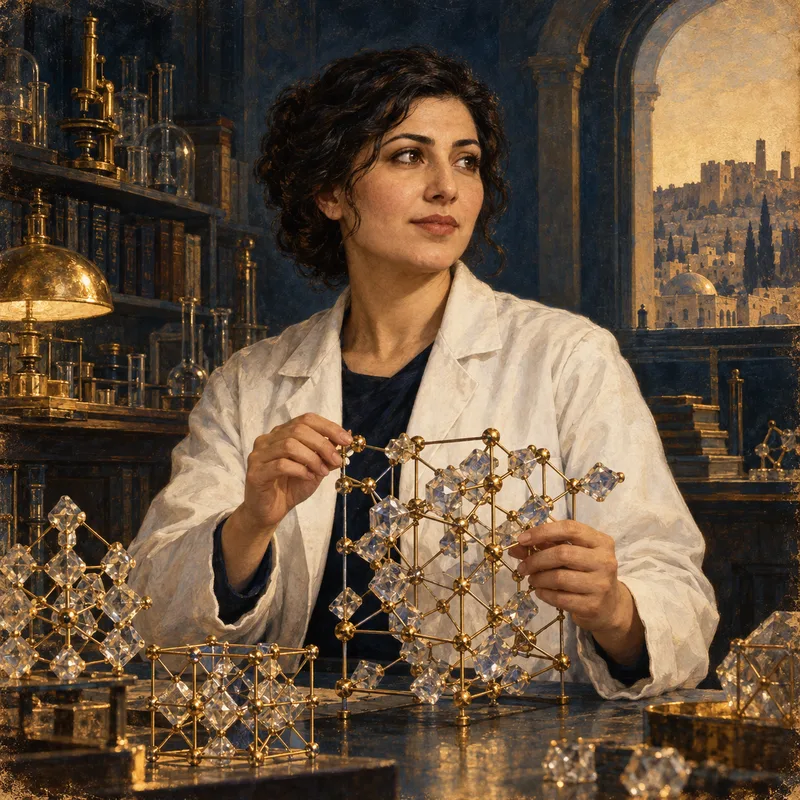
About the chemist
Omar Yaghi
1965- · United States · Nobel Chemistry 2025
Reticular chemistry; MOFs and COFs